Bloom Where You’re Planted?

Some say you should “bloom where you’re planted.”

You can get all manner of products printed with this slogan: T-shirts, mugs, posters, and notecards.

But is that always the best advice?

Maybe not. There’s something to be said for not staying in the same place for too long.

Your garden will tell you that if you plant the same type of vegetable in the same plot year after year, you’ll notice that the health of the plant and the yield it produces will begin to suffer. The plant will be attacked by more diseases and pests, and the nutrients in the soil will have been depleted by past crops of the same type.

The answer to this problem?

Crop rotation.

Don’t plant the same type of vegetable or crop in the same location several years running. Mix it up; plant something new in that spot.

What about in life?

Does God intend us to stay rooted to the same location for much of our lives?

Read more
You’re Not Insignificant to God!

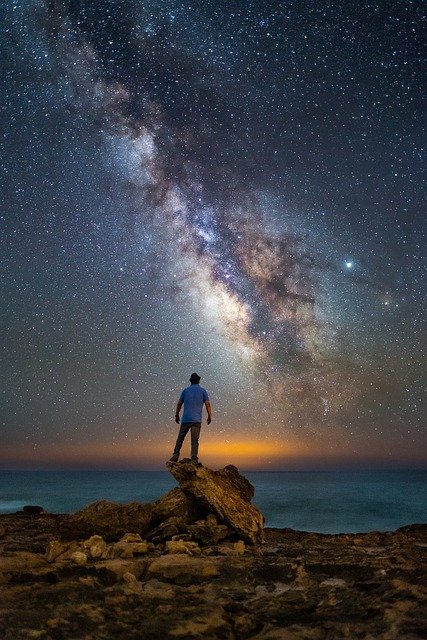
When you look up at the stars in the night sky, what do you feel?

Many people say the vastness of the universe and the countless stars make them feel puny and insignificant.

In a way, that’s understandable.

The star that Earth orbits around is just one of many in the Milky Way, the galaxy in which we live. In fact, there are perhaps 100 billion stars in our cosmic “neighbourhood.”

And the Milky Way is just one of many galaxies. Estimates vary as to how many galaxies exist in the observable universe: some experts suggest a couple hundred billion, and others postulate as many as 10 trillion.

It’s impossible for us to know how many stars there are in the observable universe, but here’s the largest guess I came across: Multiplying the higher number of estimated galaxies by the Milky Way’s estimated 100 billion stars gives a possibility of 1 septillion stars in the universe (1 quadrillion in the European system). That’s a “1” with 24 zeroes after it!

The Milky Way is so enormous that, even travelling at light speed, it would take 100,000 years to travel across it. The observable universe is incredibly more vast: according to current thinking, it’s about 93 billion light years in diameter.

No wonder people feel small when they contemplate the unimaginable expanse of the universe!

But for me, this knowledge doesn’t make me feel insignificant.

It makes me feel just the opposite.

Read more

This Is Who We Are

Today, Canada celebrates its birthday! July 1st is Canada Day, a holiday on which we have parties, set off fireworks, and wave the flag.

We’re all attached to our national flags, aren’t we? Each is beautiful in its own way. Some flags have blocks of colour; some feature significant symbols; others have patterns of stars and stripes. A handful of countries depict plants or trees on their flags, mine among them.

Canada’s flag has a maple leaf at its centre. In fact, the nickname for our flag is the Maple Leaf. As a nature lover, I’m proud to have a symbol of a plant on my national flag, and especially pleased that it’s a leaf from one of my favourite trees.

Growing up, I loved maple trees: I climbed them, enjoyed the sugar and fudge made from their sap, collected their red and orange leaves in autumn to press and even jumped into raked-up piles of them.

I’d venture to say that all Canadians love maple trees. The trees themselves are beautiful and stately; the wood harvested from them is so strong it can be used as the flooring for bowling alleys; we harvest precious sap from them to make sought-after products like maple syrup; and the leaves turn gorgeous colours in the autumn.

The maple leaf is the emblem of Canada. It symbolizes who we are as a people: hardy, strong, nature-loving northerners.

Just as the maple tree is important to Canadians, there’s another tree which is very important to a certain group of people:

It’s the tree Christ was crucified on.

Read more