A Sign From God

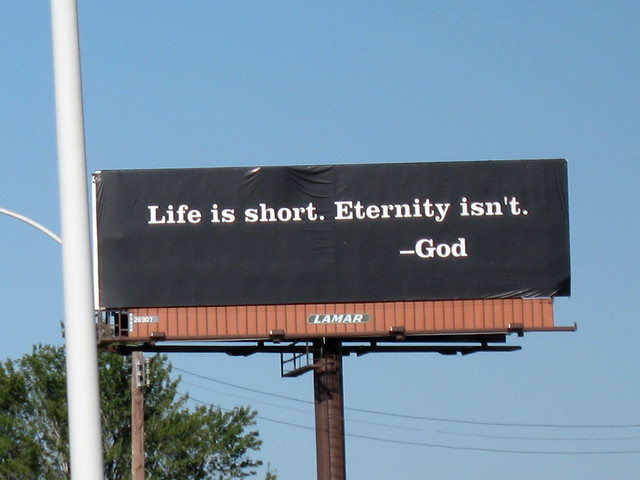
Do you sometimes wonder whether something that happened to you is a sign from God?

Maybe you’ve heard the joke about the guy who told God that if the parking spot directly in front of the donut shop was open, he’d take that as a sign that he could go ahead and buy a dozen donuts.

And sure enough, after his eighth time around the block, it was open!

It’s sometimes hard to recognize when something really is a sign from God, isn’t it? We put our own spin on circumstances, and conveniently draw the conclusions that align with our desires.

But there are some things that we can be absolutely certain are signs from God, because they align with His Word.

When you see the following “signs” in your life, take note and obey them:

ONE WAY: There is only one way to God, and that is through Jesus Christ.

Jesus answered, "I am the way and the truth and the life. No one comes to the Father except through me. (John 14:6)
Read more

Are You a Cat or a Dog?

It’s hard to embarrass a cat. They just don’t seem to have a sense of shame.

If they’ve done something naughty, like shredded the fabric on your expensive couch with their claws, they’re not actually sorry about it. They’re just ticked off that you’re making such a big fuss about it.

Cats seem to lack the ability to be repentant.

Dogs, on the other hand, can definitely feel and show contrition.

Just take a look at the plethora of “dog-shaming” videos online.

Dog owners upload clips in which they confront their mutts with the evidence of their misdeeds. The owners come home to garbage-strewn rooms, destroyed furniture, and chewed-up shoes. The disaster area is documented on video, and then the camera pans to the dog…

The results are often hilarious.

The mutt slinks off with its tail between its legs, or else sits there looking sheepish and trying not to meet their owner’s eyes. The pooch might even try to hide in a cupboard.

Yes, dogs know when they’ve done something wrong.

The question is, do we?

Are we quick to ask God’s forgiveness when we sin, or do we justify our behaviour to ourselves and continue in our disobedience?

Read more

You Need a North Star

Polaris star trail

Many of us have GPS systems in our cars or on our phones. They allow us to pinpoint our locations on a map, letting us know exactly where we are.

But in the days before modern technology, how did people navigate? If they needed to cross an ocean, what told them where they were?

The North Star did.

More formally known as Polaris, the North Star is the brightest star in the Ursa Minor constellation. Because it’s almost in a direct line above the north celestial pole, the North Star appears to stand motionless in the sky, with the other stars seeming to rotate around it.

This made it a perfect fixed point by which to draw measurements for celestial navigation. In fact, the Old English word for the North Star meant “ship-star,” reflecting its use in helping to chart a course when sailing.

We still need a north star today.

Not to get from point A to point B in our vehicles, but to navigate the seas of our lives. When our whole world has turned topsy-turvy, we need a fixed point to focus on to keep us on a stable course.

Read more

Who Loves You?

Photo from Pxhere

How many times today has someone told you that they love you?

If you have a loving family, you’ll probably hear them express their love for you frequently.

But what if your family ties are a bit strained? What if you don’t have many close relationships at all, and consider yourself to be fairly alone in the world?

Then you probably don’t hear the words “I love you” nearly enough.

There’s a remedy for that:

Open a Bible.

The unfailing love of God is a soundtrack that reverberates through the Scriptures.

It’s easy to find verses in the New Testament that exemplify God’s love:

“But God demonstrates his own love for us in this: While we were still sinners, Christ died for us.” (Romans 5:8)
“This is real love—not that we loved God, but that he loved us and sent his Son as a sacrifice to take away our sins.” (1 John 4:10)
And of course: “For God so loved the world that he gave his one and only Son, that whoever believes in him shall not perish but have eternal life.” (John 3:16)

But what about the Old Testament?

Read more

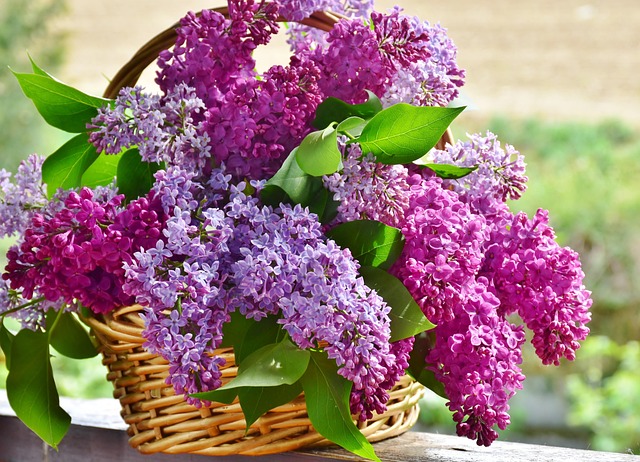
Prayers Live On, Like Lilacs

This is a special time of year in my part of Canada: the lilacs are speaking!

Lilac flowers don’t use words, of course. They announce their presence through their beautiful fragrance and delicate purple colour.

But there’s another way lilac shrubs can talk to us. Their very location can give us clues to the history of a place.

“…the story of early Canada can be read in the lilacs clustered where log cabins once stood, at the edge of abandoned fields—flowers marking time in centuries.” (from “A New Leaf,” by Merilyn Simonds)

Settlers to the northern parts of North America would often plant lilac shrubs on either side of the front door to their farmhouse. Generations or even centuries later, the building has long since been torn down, but the lilacs live on.

If you see a pair of huge lilac bushes in a field or empty lot, you can be pretty sure they used to flank someone’s front door. The house is gone, the family has moved away, but the fragrance of the lilacs they planted still fills the air.

This reminds me a bit of how prayers can live on, long after the person who prayed them is gone.

Read more

If This Isn’t Love…

The love of God for us is one of those topics that you could spend a lifetime exploring.

As believers, we often focus on the Crucifixion of Jesus to demonstrate God’s love.

And rightly so: Jesus’ sacrifice on the Cross to redeem us from our sins was the epitome of extravagant love.

“God showed his great love for us by sending Christ to die for us while we were still sinners.” (Romans 5:8)

But I wonder if we give short shrift to the Incarnation.

The fact that God took on human form and walked among us for 33 years shows an astonishing level of love.

When Jesus came to earth, our story became His story. He chose to go through the same pain we do, and carry the same burdens we do.

Read more

With God, You Get the Flower First!

Eastern Redbud Tree

Sometimes nature can be a bit unpredictable—things happen in an order we wouldn’t expect.

Normally, plants put forth leaves long before they produce flowers.

But some trees and shrubs flip the script, so to speak.

With certain plants, the normal sequence is reversed: the flowers come first, before the leaves have developed.

A good example is the beautiful redbud tree. It puts forth gorgeous pink flowers on its bare branches in early spring, when none of its leaves are yet in sight.

The forsythia shrub bears its bright yellow flowers in advance of its leaves, and the lovely magnolia presents its pink or white blooms before the green foliage appears. Some maples and oaks also exhibit this flower-first behaviour, although with less showy blossoms.

All of these plants give us a treat in springtime when we’re starved for colour. We get the flower first without having to wait for the leaves.

Why do some plants reverse the normal order of things?

Some trees are wind-pollinated, so put forth flowers before their bulky leaves get in the way. The same goes for flowers that need extra sunlight. Other plants produce a mass of conspicuous flowers first, unobscured by leaves, to better attract the attention of pollinating insects.

Did you know that God also flipped the script and gave us the flower first, so to speak?

Read more

A Cruciform Life

There are some things that can only be seen if you take a bird’s-eye view.

It’s only when you look down from a great height that you realize that the artificial island of Palm Jumeirah in Dubai is designed to resemble a palm tree.

You only really get a sense of why the Pentagon was given its name when you view this building from above and see its five-sided shape.

Someone at ground level in Nazca, Peru, might completely miss the fact that the lines etched into the desert sands at their feet actually form massive shapes of animals and plants. The full designs can only be seen from up high.

Similarly, it might not be obvious to you when entering certain churches that the outline of the building itself forms a cross when viewed from above.

Many European cathedrals feature a cross-shaped floor plan. The Church of the Nativity in Bethlehem is prime example of a cruciform building.

I like to think that when God looks down at these buildings from above, it pleases Him to see a cross reflected back at Him.

Here’s a question for you:

When God looks down from above at your life, does He see the Cross reflected in how you live? How “cruciform” is your life?

Read more

The Best Worst Day

There are some dates in history which stand out for being associated with awful events. Each year, when the calendar rolls around to these dates, we shudder in horror when we recall what happened.

Here are a few “worst days in history” that come to mind:

September 11th, 2001: the deadly World Trade Centre terrorist attacks in New York.

August 6, 1945: the dropping of a nuclear bomb on Hiroshima, Japan.

June 28, 1914: the day Archduke Ferdinand was assassinated, igniting the horrific First World War which killed tens of millions.

December 26, 2004: the Boxing Day tsunami which killed hundreds of thousands.

Some horrible dates in history have specific terms associated with them, such as:

December 7, 1941: the Japanese attack on Pearl Harbor, a date which President Roosevelt said would “live in infamy.”

October 29, 1929: called “Black Tuesday,” the worst day of a stock market crash which would send the world spiralling into the Great Depression.

What term is associated with the horrible day Jesus Christ was crucified?

“Good.” It’s called Good Friday.

But why?

Read more

Your Spiritual Resumé

If you had to write a resumé for God’s consideration, what would you list on it?

You’d probably assume that you should list all the good, noble, and praiseworthy things you’ve done.

Your perfect church attendance, your faithful donations to Christian charities, and your decades of volunteering at the soup kitchen would certainly top the list on your spiritual resumé.

You’d also want to throw in your kindness to others, your endless good deeds, and the fact that people consider you a saint.

It probably wouldn’t hurt to mention your lack of even so much as a parking ticket on your driving record.

All this would surely carry weight with God, wouldn’t it? Your impressive list of virtuous accomplishments would undoubtedly factor into in His decision as to whether He would accept you or not.

Or would it?

Read more