When Bad Cakes Happen to Good People

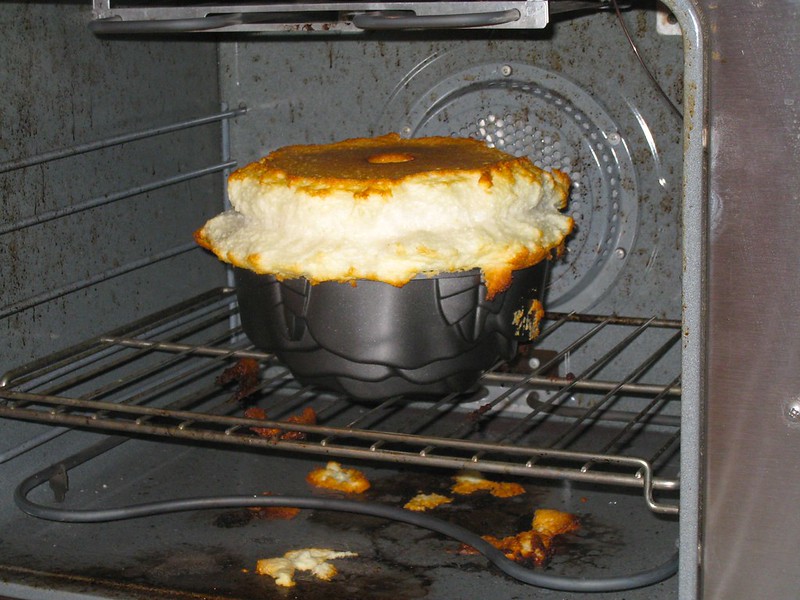
Cake Explosion Photo by Raffi Asdourian on Flickr CC BY-2.0

Sometimes, despite your best efforts, recipes don’t turn out the way they’re supposed to.

Your soufflé turns into a pancake; your cookies are as hard as hockey pucks; or your cake is a soggy mess. Any way you slice it (if it’s even possible to slice it), the recipe results in a total disaster.

Sometimes it’s due to a mistake on your part. You accidentally added twice the amount of an ingredient called for (guilty!); you used Shake ’n’ Bake instead of graham cracker crumbs for the dessert base; or you put the pizza in the oven for 450 minutes at 15 degrees, instead of 15 minutes at 450 degrees.

Or maybe the fault lies with someone else. The recipe’s author might have led you astray by inadvertently calling for 1/2 pound of flour instead of 1/2 cup’s worth. You only discover later that the recipe contained errors when you see a correction printed in the next day’s newspaper or blog post. But by then, of course, it’s too late: your family is using the rock-hard muffins you made as door-stops.

Often, you didn’t see a recipe fail coming at all. You followed the instructions to the letter, but it still didn’t work out. The ingredients may not have behaved as you expected due to humidity, altitude, or their age. Your oven may be hotter or colder than you realized, or your flour is harder than the type tested in the recipe. It wasn’t your fault, but just the nature of baking.

As Marian Keyes puts it in her cookbook, “Saved by Cake,” sometimes bad cakes happen to good people.

It’s the same in our lives, isn’t it? Sometimes things go wrong even when we’ve tried to do everything right. Our lives don’t turn out the way we expected.

But there’s good news for the believer in God: He can redeem any mistake and turn things around for your good and His glory.

Read more

Break Your Four-Minute Mile

Last October in Vienna, Kenyan Olympic champion Eluid Kipchoge made history. He became the first person to run a marathon in under two hours, a feat that had long seemed impossible.

After running the 26.2 mile course in one hour, 59 minutes and 40 seconds, Kipchoge drew comparisons to Sir Roger Bannister. Bannister was the Briton who in 1954 became the first person to run one mile in under four minutes, an achievement also once thought to be unattainable.

Kipchoge said something very significant after his race: “I expect more people all over the world to run under two hours after today.”

Why did he say that? Because Kipchoge knew that a funny thing had happened after Bannister’s victory: other people began breaking the four-minute mile as well. They suddenly saw that it was possible, and were inspired to believe that if Bannister could do it, so could they. The barrier he broke for people was just as much a mental one as a physical one.

Do you have a “four-minute mile” in your life? Are there things you would like to achieve, but you feel they’re impossible?

Take courage, because God specializes in breaking barriers!

Read more

Prayers Live On, Like Lilacs

Lilac shrub in full bloom. Photo by Holger Schué on Pixabay

This is a special time of year in my part of Canada: the lilacs are speaking!

Lilac flowers don’t use words, of course. They announce their presence through their beautiful fragrance and delicate purple colour.

But there’s another way lilac shrubs can talk to us. Their very location can give us clues to the history of a place.

“…the story of early Canada can be read in the lilacs clustered where log cabins once stood, at the edge of abandoned fields—flowers marking time in centuries.” (from “A New Leaf,” by Merilyn Simonds)

Settlers to the northern parts of North America would often plant lilac shrubs on either side of the front door to their farmhouse. Generations or even centuries later, the building has long since been torn down, but the lilacs live on. If you see a pair of lilac bushes in a field or empty lot, you can be pretty sure they used to flank someone’s front door. The house is gone, the family has moved away, but the fragrance of the lilacs they planted still fills the air.

This reminds me a bit of how prayers can live on, long after the person who prayed them is gone.

Read more

Jam The Signal!

The tiger moth Bertholdia trigona is the only animal in nature known to jam
the echolocation of its predator
Photo on Wikimedia Commons CC BY-SA 3.0

Bats are crafty creatures.

Being nocturnal, bats search for food at night, but their night vision is fairly poor. So instead they use echolocation, or reflected sound, to home in on insects such as moths. Their built-in sonar directs them to the precise location of the tasty morsels; then it’s just a matter of swooping in and gobbling them up.

So the bats’ prey have to be crafty as well.

Certain species of tiger moth have the ability to emit sonar of their own. As a bat is closing in, the moth emits a fusillade of ultrasonic clicks. This barrage blurs and disrupts the bat’s echolocation: the signal is essentially jammed. The baffled hunter can no longer “see” the moth, and is tricked into thinking its target has vanished. Thwarted, the hungry predator flies away, and the prey is safe.

Our little tiger moth beats its enemy at its own game.

Wouldn’t it be nice if we could “jam the signal” of the enemy of our soul? If we could disrupt and counter the lies the world tells us about ourselves?

In fact, there’s a way that we can.

Read more

You Already Have What You Need

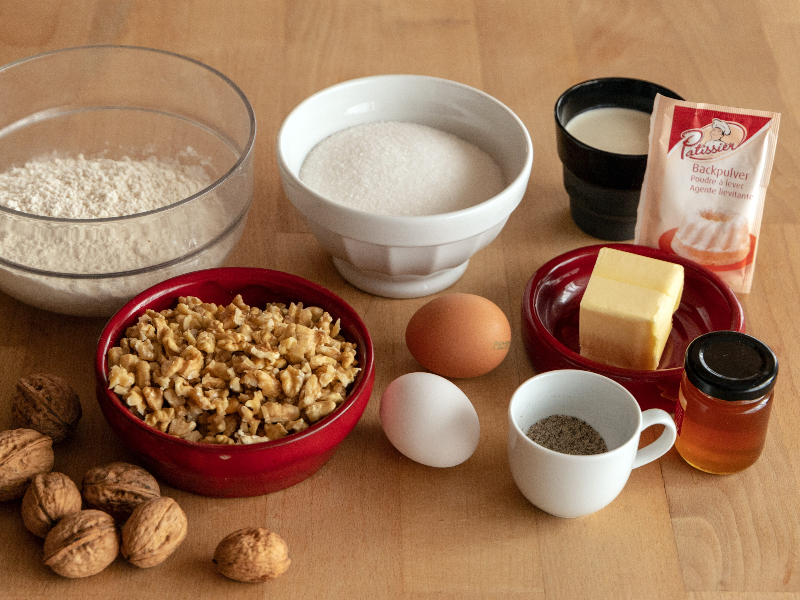
Baking ingredients
Photo by Kathy Moreno on Wallpaper Flare

I love desserts that you can make on the spur of the moment, with ingredients you already have in your kitchen (like the recipe for coffee cake below). The ones where you don’t need to make a special trip to the store to find an uncommon or rarely used ingredient.

For instance, I love the flavour of pistachios, but rarely keep them on hand in my cupboard. Walnuts, on the other hand, are more likely to be found year-round in my kitchen. If a recipe calls for nuts, I know I’m bound to have some walnuts I can use.

Or what about an ingredient like rosewater? It sounds like it would create an exotic dessert, but who keeps rosewater in their pantry?

Read more

Lick The Bowl!

Child happily licking the bowl of cookie dough
Photo by pxfuel

When I was a little girl, I always loved baking cookies with my Mom. The best part was when I “helped” her clean the mixing bowl.

Many people have fond memories of their Moms letting them “lick the bowl”: that is, scraping up and eating the bits of leftover cookie dough on the sides of the bowl.

My Mom would go one better than that, however. She’d deliberately leave not just the scrapings, but extra spoonfuls of cookie dough in the bowl for me to eat. Sometimes I wonder if more of the dough ended up in my stomach than on the cookie sheets to bake!

Isn’t God like that with us, too? He sometimes gives us unexpected favour or extra blessings in our lives just to show us how much He loves us.

We find an illustration of this favour in the beautiful Biblical story of Ruth.

Read more

Break Out Of Your Shell

Eggs of the American robin
Photo by Wikimedia Commons CC BY-SA-3.0

Is there a colour more exquisite than robin’s-egg blue? If there is, I’m not aware of it.

To me, the tiny oval of a robin’s egg is perfection itself. Its soft blue-green hue seems to evoke a feeling of serenity. And the shape of the egg itself, all gentle curves, seems to echo this calmness.

I’d love to keep it that way forever, just so, and never see it broken.

There’s only one problem with this: if the egg stayed intact, a baby robin would never be born.

Sometimes we have to break something we cherish for an even more beautiful thing to come into being.

Read more

God Sees You in Infrared

Bee on cosmos flower
Photo by Veronica H. on Pixabay

Did you know that some birds and bees can see things that are completely invisible to us? They’re able to see in infrared, just beyond the wavelengths of the visible light spectrum that human eyes can detect.

What looks to us like a regular pink flower might resemble a helicopter landing pad to a bee. Where we see only the uniform expanse of one colour, the bee may see a target-shaped design of several differently coloured concentric circles. The bee’s infrared vision allows it to home in on the most nectar-rich part of the flower.

The world looks completely different when you can see in infrared.

I sometimes think that God sees us in “infrared.” He can see things in us that are invisible to others, and even to ourselves.

Read more

The Sweetest Perfume Can’t Be Bought

Vintage perfume bottles
Photo by domeckopol on Pixabay

We humans can’t help but react instinctively to a beautiful smell, can we?

In my last post, The Perfect Recipe for Bread, I mentioned how wonderful the smell of freshly baked bread is in your own home. The same is true when you bake a cake, cook a roast, light a scented candle, or when you bring a bouquet of flowers inside: the aroma fills the whole house and gives you a deep sense of pleasure.

You get the same pleasing effect when you take a walk in your neighbourhood and can detect cooking smells emanating from houses as you pass by: here someone’s making a rich stew, over there a spicy curry. Even better is strolling by someone’s garden and being enveloped by the scent of the lilacs or roses growing there.

But what if a beautiful aroma could permeate an even bigger area?

Read more

The Perfect Recipe for Bread

Photo by Momentmal on Pixabay

There’s nothing quite like the smell of freshly baked bread in your own home, is there?

More and more people are finding this out. One of the surprising consequences of the pandemic-associated lockdowns has been a resurgence of home baking. So many people have been baking bread at home in recent months that some stores have even run out of yeast and flour.

For beginners, it might take some time to get the knack of baking bread from scratch. Even for more experienced home bakers, baking the perfect loaf of bread will take numerous tries and repeated tweaks to the recipe.

The Bible has a few things to say about this life-giving substance. By tracing the story of bread through the Scriptures, we can see how the “recipe” improves over time, culminating in something we all desire:

The perfect bread.

Read more