Golden at the Broken Places

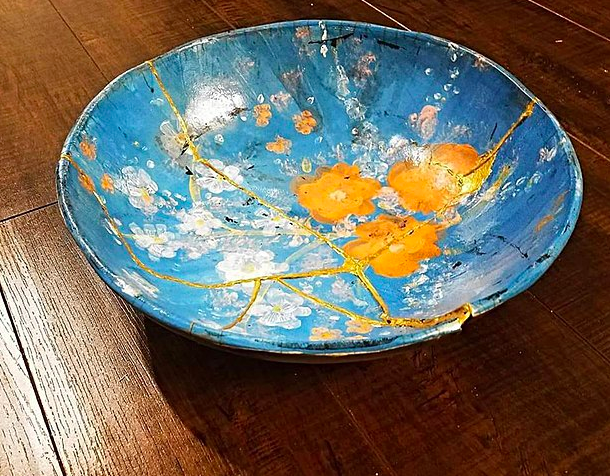
Bowl repaired using Kintsugi method by artist Ruthann Hurwitz.
Wikimedia Commons CC BY-SA-4.0

We all shudder at the sound of something breaking, don’t we? We can’t help but wince when we hear glass or crockery shattering into pieces on the floor.

Why do we have that involuntary reaction? Because we know that the object probably can’t be repaired: it’s likely to be damaged irreparably, and must be thrown away.

We’re wincing at the sound of loss.

But what if there were a way to not only put the pieces back together, but to make the object more beautiful than it was before, despite the breaks?

The Japanese long ago invented a way of doing just that, and have even made an art form of it. It’s called “Kintsugi,” which means “golden joinery.”

The process involves mending the cracks in pottery with gold lacquer. Instead of trying to hide the damaged areas, they are instead highlighted with something precious. The end result is a restored piece of pottery that is beautiful at the broken places.

But what happens if it’s not a piece of pottery that is broken, but a life? How can a shattered heart be put back together?

Long ago, God also devised a way to put the pieces of a broken life back together again. God doesn’t throw away broken people; they still have value to Him. He puts them back together again with the gold lacquer of His Son’s love and redemptive power.

Read more

Get With God’s Program!

Photo by Jill Wellington on Pixabay

I don’t seem to have much luck getting birds to cooperate with me.

Years ago, I bought a Victorian-style birdhouse, and painted it light blue with white trim. I nailed it to a tree where I could see it when sitting at my kitchen table. I imagined the delight I’d have watching birds move in and raise their young there. I couldn’t wait for my new feathered neighbours!

But the birds refused to move in.

Year after year, the pretty birdhouse sat empty. I was so disappointed. What ingrates those birds were! And after all the trouble I’d gone to for them!

The problem was, I’d put the birdhouse where I wanted it, with no thought to their needs.

The birdhouse was pretty, certainly, but its placement didn’t suit the birds one bit. Being nailed to a tree made it too accessible to predators like squirrels or racoons. The birds didn’t feel safe nesting there.

I thought the problem was with the birds, but it was with me. I’d done it all on my terms and expected them to get with the program.

Don’t we sometimes do the same with God?

We want to do things on our terms, in our own way, and expect God to get with our program. I’m afraid it doesn’t work that way.

Read more

What Is Your Inukshuk?

Inukshuk Photo by Jsig9 on Pixabay

If you’re Canadian, you probably know what an inukshuk is.

If you’re not Canadian, then let me offer you my condolences. (Sorry! Just kidding!)

But seriously, as we Canadians celebrate our national birthday today, it seems apt to delve into the meaning behind this iconic symbol of the high north.

An inukshuk is a stone structure built by the Inuit and other peoples of the Arctic regions of North America. The stones may simply be stacked vertically, or they may take the form of a human figure.

The distinctive shape of the inukshuk is featured on the flag of Nunavut, a Canadian territory, and also served as the inspiration for the logo of the 2010 Olympics in Vancouver.

Inukshuks have been traditionally used by the Inuit people as landmarks for navigation, guideposts for travellers in a barren landscape. They might also mark out a sacred spot, or function as a commemorative sign.

I think we believers need “inukshuks” in our lives, don’t we?

Reminders of the things God has done for us, how far He’s brought us. Beacons to others travelling the same journey, showing them the path that leads to life.

Read more

Give It Time

Antique clock photo by Wallpaper Flare

Do you get the feeling that society is becoming too impatient?

We seem to expect instant results these days: immediate responses to our texts or emails, same-day delivery for things we order, or instantaneous loading of videos or web pages. In fact, a study showed that a YouTube video that loads slowly will start losing viewers after two seconds.

The problem is that sometimes our impatience with technology gets applied to people, too. We expect people to change quickly, and if they don’t, we lose patience with them and give up on them.

This reminds me of the tale of the handkerchief tree.

Called the dove tree in its native China, it became known to Western visitors in the late 1800s, who were entranced by it. The handkerchief tree features stunning white bracts surrounding its flowers, which resemble doves, ghosts or fluttering handkerchiefs, hence its name in the West.

European botanists in China collected the seeds and brought them back home, keen to grow such a gorgeous tree. One gardener planted the seeds, but was disappointed to find after a year that they hadn’t sprouted into seedlings. Figuring that the seeds must be no good, he discarded them by dumping them onto his compost pile, then forgot about them.

To his surprise, two years later he saw a bunch of seedlings on the compost pile. They were from the handkerchief tree. They had sprouted after all!

What he didn’t know was that seeds of the handkerchief tree have what’s called a “double dormancy”: they require two years to germinate, unlike most seeds which will sprout within the first year.

He had written them off too soon.

Don’t we do the same with people sometimes?

Read more

Consider the Lilies

Photo of Tiger Liliy from Pxfuel

Do you spend a lot of time in the morning fretting about what to wear?

You’re not alone. Many of us worry about our clothes. We’re afraid that they aren’t stylish enough, or that they make us look fat, or that they’re last year’s (or even last millennium’s) fashions.

Some of us even worry that we won’t have enough money to buy the basic clothes we need.

But we shouldn’t be anxious that God won’t provide for us. After all, look how He’s clothed the flowers.

Have you ever marvelled at the rich “vestments” some flowers are clad in?

Look at the iris attired in silky frills, the peony robed in ruffles, or the delicate tracery of Queen Anne’s lace. The sumptuous, constantly unfurling petals of the rose boast the finest tailoring. Some flowers are decked out in speckles, mimicking the polka-dots on a dress; others are costumed in stripes, like a crocus. Even the common petunia can have petals that resemble luxurious velvet.

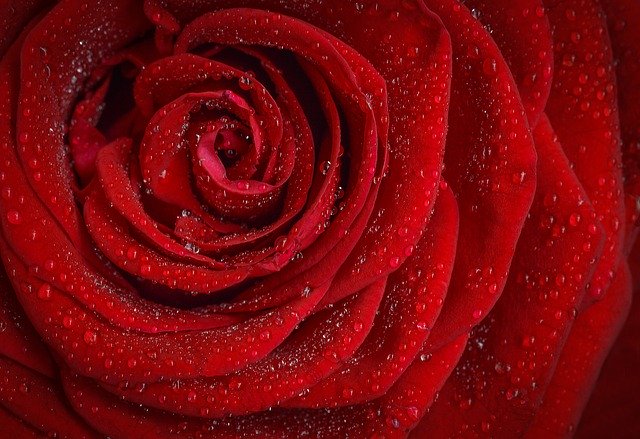
Red Rose photo by AliceKeyStudio on Pixabay

God hasn’t stinted on giving flowers rich colours, either. What about the intense blue of lobelia, suitable for any royal robe? Or the bright yellows of daffodils, the vivid oranges of marigolds, or the saturated reds of poppies? On the paler end of the spectrum are the shy blues of the forget-me-nots and the delicate ballet-pinks of some tulips.

Some flowers even have names which relate to clothing: bachelor’s buttons, lady’s slipper, Texas bluebonnet, foxglove, lady’s mantle, and monk’s hood.

And how about those lilies? In fact, I seem to remember a Bible verse which talks about the beautiful garments lilies wear:

“So why do you worry about clothing? Consider the lilies of the field, how they grow: they neither toil nor spin, yet I say to you that even Solomon in all his glory was not arrayed like one of these.” (Matthew 6:28-29 NKJV)
Read more

What’s in a Name?

Photo by Jill Wellington on Pixabay

As a gardener, I must admit that I prefer using the common or folk names for flowers.

These sometimes ancient names are often whimsical and enchanting. Who wouldn’t love calling flowers by such names as cherry pie plant, lady’s slipper, love-in-a-mist, baby blue eyes, bachelor’s button, quaker ladies, whirling butterflies, johnny-jump-up, busy lizzie, or candytuft? It makes the heart sing to use endearing names like these.

The scientific or botanical names for flowers, on the other hand, can seem daunting. They’re usually derived from Latin, and while they can give a more accurate description of what a plant’s nature is, they can sound a bit intimidating to my ears.

In fact, some botanical names actually sound like a disease:

“Don’t tell anyone, but I’ve got Scabiosa again.”

“That’s nothing! You should see my sister’s Myosotis: it’s rampant.”

“You don’t say! But did you hear about Kelly? She’s got Nepeta nervosa.”

“No! Is she seeing a psychiatrist for that?”

(In case you’re wondering, Scabiosa is the botanical name for the pincushion flower; you might know Myosotis better as the little blue forget-me-not; and Nepeta nervosa is a type of catmint.)

I’m so glad that we have the opportunity to use informal names for the flowers we cherish.

In the same way, believers have been given the great privilege of using a remarkably intimate name for God: “Abba Father.”

Read more

How Can We Sum Up God?

Image by Gerd Altmann from Pixabay

“The quick brown fox jumps over the lazy dog.”

Some of you might recognize this sentence from typing tests in school. It’s an example of a “pangram,” a sentence which contains every letter of the alphabet at least once.

At 35 letters, this is not the shortest pangram, however. This next one comes in at a slim 28 letters:

"Waltz, bad nymph, for quick jigs vex."

We can trim it even shorter than that if we allow abbreviations. The following sentence is a perfect pangram, using each of the 26 letters of the English alphabet only once:

"Mr. Jock, TV quiz PhD, bags few lynx.”

That got me thinking… If we wanted to construct a sentence expressing all of God’s attributes, how short could we make it? Is it possible to sum up God?

This is a tall order, because God is so multi-faceted.

We’d have to start off with His role as Creator of the universe and all life on earth, including you and me.

We’d have to include His unfathomable love, His mercy, truth, justice, holiness, faithfulness, wisdom, righteousness, goodness and grace.

We couldn’t leave out His omniscience, omnipotence, and omnipresence. And let’s not forget his unchanging, eternal nature.

Whew! Looks like our sentence is getting pretty long. We might have to trim it a bit.

I wonder if we can encapsulate all God is in one word?

Turns out, we can:

Jesus.

Read more

The Throne of Grace

Image by Ralph from Pixabay

What does your favourite chair look like?

Is it a ratty recliner held together with pieces of duct tape, like the one used by Marty Crane on the TV sitcom “Frasier”?

Or is it more regal and imposing, dominating the room like a throne?

I think many of us rather like the idea of having a throne like the ones monarchs throughout history sat on.

The seat of the Chinese emperors was known as the Dragon Throne. The Mughal emperors of India had the Peacock Throne.

Korean monarchs sat on the Phoenix Throne, and Japanese emperors on the Chrysanthemum Throne.

The Shahs of Persia sat on a royal throne known as the Marble Throne, while Swedish monarchs were crowned on the Silver Throne.

Both the emperors of Vietnam and the Pharaoh Tutankhamen were enthroned on a Golden Throne.

And of course fantasy novelist George R. R. Martin has given us the Iron Throne, the seat of the monarch in the fictional Seven Kingdoms of Westeros. It was said to have been made of the swords of defeated enemies.

But there’s a throne made of something infinitely more precious than any of the above…

The Throne of Grace.

Read more

The Other Side of the Window

Image from PIckpik

While walking in my neighbourhood the other day, I saw something mysterious.

On one person’s front lawn there stood a jumble of foot-high letters of the alphabet, placed upright on stakes near the front window.

But the letters seemed randomly placed; they didn’t form coherent words. Was this some sort of secret code? Also, the letters were backwards from the perspective of anyone walking by on the sidewalk.

I then realized that they were meant to be read by someone inside the house.

When I deciphered the letters with this in mind, it suddenly made sense. Someone inside looking out the front window would see this message clearly spelled out on their front lawn:

“Happy Birthday!”

I was looking at the letters from the wrong side of the window. If I had been inside the home gazing out, the message would have been clear from the get-go.

I think this is true of a lot of things in our lives.

Some things we go through as believers won’t make sense until we’re on the “other side of the window.” By that I mean when we’re in Heaven, looking back at our time on Earth.

Read more

When Nature Sings, Sing Along!

Image of crocuses by Annette Meyer from Pixabay

No matter where you live, spring is a time of joy.

In my part of the world, shy white snowdrops are the first flowers to bloom in spring.

Crocuses, slightly bolder in colour with their yellows or purples, are the next to make an appearance.

The tulips take their time, first poking the tips of their leaves above the ground like a periscope, as if checking to see whether it’s safe to emerge. They then burst forth in bright, vivid colours, their blooms held aloft on tall stems like upright trumpets.

“The flowers are springing up, the season of singing birds has come, and the cooing of turtledoves fills the air.” (Song of Solomon 2:12)

After a long, colourless winter, it makes my heart sing to see the arrival of spring.

But do the flowers and trees themselves sing? And if they do, what is their song telling us?

Author Linda Brooks, in her 2018 book, “Orchestra In My Garden,” seems to share my sentiments about the spring season:

”Once the snow disappears and my garden starts to emerge from its slumber, I cannot jump up fast enough to catch the first light, to lose (and find) myself among kindred spirits and bend my ear to their voices. No, I am not deluded. I do understand that plants are not human and cannot speak, but no one can convince me that they do not sing.”

She’s right: plants do sing. But she’s perhaps missed who they’re singing to.

They sing to God.

Read more