Are You At The Breaking Point?

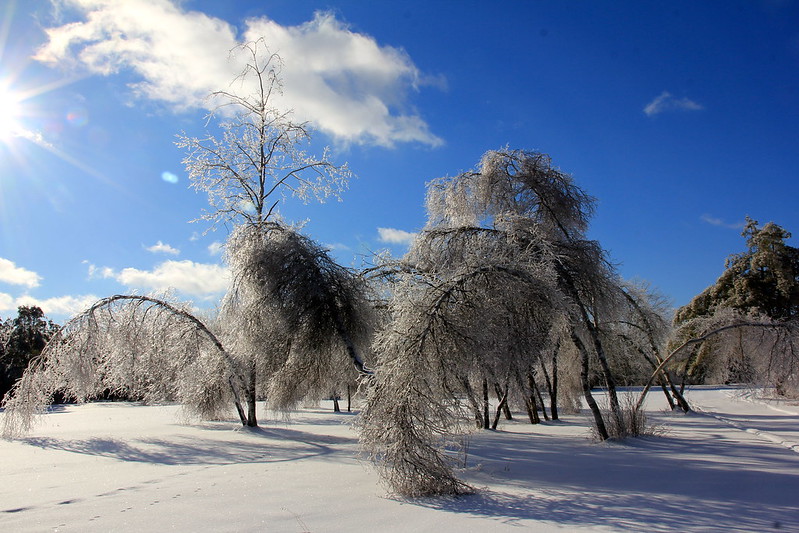
“Ice Cathedrals” photo by Daryne Rockett on Flickr CC-BY-NC-SA 2.0

If you live in a cold climate, have you ever woken up to discover that there had been an ice storm overnight? You look outside to find the bare branches of the trees are encased in a thick layer of ice.

The effect can be absolutely stunning. The branches glisten and sparkle in the sunlight. People rush outside to take photos of the ice-covered trees.

But the beauty masks a danger: those bare branches are at risk. They were never meant to carry the weight of so much ice. The branches may break off, and the tree can be left devastated.

Do you ever feel like you’re carrying too much “weight”?

We often take on too much responsibility in our lives; we carry too much weight on our shoulders. We try to juggle being a spouse, parent, employee, friend, and volunteer. It may look impressive from the outside: people might even admire our glistening, seemingly perfect lives.

But behind the facade lies an uncomfortable fact: we’re at risk. We were never meant to carry all those burdens ourselves. It may seem like we’re coping, but the weight will soon become too much to bear.

The truth is, we’re about to break.

Read more

What Is Your “Burning Bush”?

Image by Leonora Enking via Flickr CC BY-SA 2.0

You’ve got to love a plant that turns pink in the autumn.

I’m referring to the Euonymus alatus shrub, whose leaves change from green to a vivid, hot pink in the fall.

One of its nicknames is “burning bush,” because in autumn the shrub looks like it’s on fire. It must have reminded people of the burning bush Moses encountered in Exodus 3, through which God spoke to him.

I think God uses many different ways to speak to us today, each a “burning bush” tailored to our unique personalities.

Probably the primary way that God communicates to us is through Scripture. We read or hear a verse that seems to speak directly into our situation. By reading the words of Jesus, we “hear” God’s heart. We may also receive a word from the Holy Spirit or sense God’s guidance through prayer.

There are many instances in the Bible of God giving someone a message through dreams or visions. He may relay information in a dramatic fashion via an audible voice, or the more subtle “still, small voice.”

Other times God may use another person to convey something to you: a Christian speaker or author, or a family member or friend who’s a believer. God may also speak to you through the lyrics of a song or hymn.

He might be sending a message to you through your circumstances, especially via some difficult situation. Or, you may encounter a coincidence that seems like a “sign,” and you think God may be trying to tell you something.

With me, I feel that God occasionally “speaks” to me through nature.

Read more

The Inside Scoop

Image by Dan Fador from Pixabay

What do you see when you look at a tree?

Probably the same things I do: its pleasing shape, the attractiveness of the leaves, its height, or the welcoming shade it casts. The presence of flowers, fruit, or nuts on its branches would also catch my attention.

But someone who wants to use the tree will look at it quite differently.

A woodworker will assess a tree’s trunk and branches and have a sense of the quality of wood it will bear. He or she will know which areas will produce the truest grain, and whether the core of the tree is likely to be “conky,” or decayed inside.

My grandfather could judge a tree in this way.

He could discern how the way the tree had grown and the stresses it had been exposed to would combine to make the strongest grain. He could point to the best part of the tree out of which to make an axe handle, for instance.

My grandfather and I could look at the same tree but see entirely different things. I would consider the outside, but he would look much deeper.

I think God’s vision works in the latter way.

Read more

The Beauty of Redeemed Brokenness

Image of parrot tulip by Coanri/Rita via Flickr CC BY-NC-ND-2.0

What’s your favourite flower?

Even though I certainly love roses, the tulip holds a special place in my heart. It’s not as showy or fragrant as a rose, but it brings such joy in spring after a long winter.

Among the many types of tulips, I especially like the variegated ones (with multicoloured petals).

But did you know that the dramatic colour combinations of variegated tulips are caused by a virus?

Gardeners had long noticed that tulip petals occasionally “broke” into unusual patterns. But it wasn’t until the late 1500s that botanists realized that the beautiful mixed colouring arising spontaneously in some tulips was actually the result of a disease.

While the tulip-breaking virus causes lovely variegated colouring, it also weakens the tulip bulb, eventually leading to the death of its genetic line.

So how is it that we can still enjoy variegated tulips today? Why haven’t they all died out?

Fortunately, botanists centuries ago learned to graft healthy tulip bulbs onto the diseased or “broken” ones, preserving their lineage. Today, we can enjoy countless cultivars in a dizzying array of colours and patterns.

Doesn’t this remind you of what God does for us?

Read more

Keep Your Eyes On The Son

Image by mbll from Pixabay

Why don’t trees freeze to death in winter?

After all, if you or I stood outside naked for several months in sub-zero temperatures, we’d soon be turned into frosty statues.

Trees can’t burrow into the ground and hibernate like bears, and they can’t fly south like migratory birds. They’re fixed in place, at the mercy of the elements.

And yet they somehow survive through the cold depths of winter. Why don’t they turn to ice, since, like other living things, they’re made mostly of water?

Their trick is something called “hardening.”

In autumn, trees in cold climates undergo a change whereby water flows out of their cells. The concentrated sugars, proteins, and acids left behind act as a potent antifreeze. The water now in the spaces between the cells is so pure that ice crystals can’t form. This ultra-pure water can be cooled to -40 degrees F and still remain an ice-free liquid.

Pretty cool, isn’t it?

But what is it that triggers the hardening?

Ah, this is where we can learn a lesson from the trees.

Read more

We Grow Better Together

Image by Jill Wellington from Pixabay

As gardeners know, some plants need their best buddies nearby in order to flourish.

It’s been known for centuries that planting certain combinations of plants together can help the garden prosper. This practice is known as “companion planting.”

For instance, planting alliums such as garlic underneath roses can protect the latter against blackspot and aphids. When lilies and roses are planted together, the scent of each improves.

Yarrow and foxglove have a tonic effect on the plants in their vicinity. Yarrow helps fight off pests, attracts beneficial insects, and improves the soil. Likewise, foxglove stimulates the growth of nearby plants and helps them build up resistance to disease. Planting foxglove under fruit trees improves the storage qualities of the fruit.

Perhaps the ultimate companion plant is marigold. It has traditionally been grown with tomatoes to keep them healthy and produce a better crop. Marigold’s pungent odour disguises the scent of vegetables from pests, preventing them from homing in, and its root secretions kill nematodes that attack plant roots.

Who wouldn’t want such stalwart companions in their corner?

God wants us to have buddies like these on our team, too.

Read more

The Fires of Life

Image of giant sequoia by LoggaWiggler from Pixabay

Forest fires are fearsome things.

They can lay waste to hundreds of square miles of mature trees and displace wildlife. If they spread to areas of human habitation, they can raze buildings to the ground and devastate communities.

And yet, fires can play an important role in nature. Trying to suppress them too drastically can have a negative effect on the ecology of the forest.

It can backfire, so to speak.

Take the giant sequoia, native to inland California. This majestic tree can live for thousands of years and grow to a height of almost 300 feet.

You’d think that protecting groves of sequoias from fire would help preserve them. But sometimes when we interfere with the natural cycle of fire and regrowth, we do a forest no favours.

The suppression of fire during the last century by U.S. land management authorities actually hobbled the sequoia’s ability to survive. Its seedlings can only grow into mature trees if competing plants are regularly eliminated by low-level forest fires. (The sequoia’s spongy bark helps protect it against fire.)

Not only that, the cones of the sequoia require the intense heat of a forest fire in order to open up and release their cargo of seeds. If the surrounding ground has just been cleared of competing vegetation by fire and enriched with the resultant nutritious ash, the seeds are given an additional leg up to grow.

So the sequoia can only grow to its impressive grandeur with the help of fire.

Perhaps the same is true of us.

Read more

Some Things Never Change

Image by mabi2000 on Flickr. by CC BY-SA 2.0

Has your head been spinning with all the changes the world has undergone in the past several years?

We stumble through one crisis, only to find another totally unexpected one emerge. We wonder if life will ever truly be the same again.

It’s at times like these that we need something that never changes, much like conifers.

During the winter, when deciduous trees are bare, I’m thankful for coniferous trees. These loyal friends, like the spruces, pines and firs, still have their mantle of green, which they’ll keep year-round. These silent sentinels might not be flashy, but we can count on them not to change.

God’s character is like that, too.

When the world seems to be in turmoil, and life is changing in ways that are distressing and unpredictable, we need something unchanging to hold on to. That something is our eternal Heavenly Father.

Read more

God Knows How To Get The Word Out

Image of milkweed pod and seeds by HeungSoon from Pixabay

Plants are ingenious things.

They have numerous ways of dispersing their seeds to grow new plants, methods that go far beyond simply dropping a seed to the ground from the mother plant above.

Some plants sport wings on their seeds (called samaras) to enable the wind to carry them farther away from the mother tree than regular seeds could go. The maple tree uses this method of seed dispersal: once released from the tree, its seeds spin through the air like helicopters to find a new home.

Other seeds, like that of the milkweed, drift on the wind using their own downy parachutes. Dandelions do the same (much to the chagrin of those trying to maintain a dandelion-free lawn!).

Some seeds come wrapped in tasty packages, like that of the raspberry. Animals or birds eat the berry, then excrete the seed later on (along with some “fertilizer”).

The burdock plant takes another tack: its seeds have sticky hooks that attach to an animal’s fur as it passes by. The seed essentially “hitchhikes” to begin life in another location.

Another intriguing method of seed dispersal is used by the jewelweed plant. Its seed pod “explodes” when touched, flinging the seeds far and wide. It’s no coincidence that jewelweed also goes by the name “touch-me-not.”

I guess we can’t put nature in a box when it comes to seed dispersal. It uses a variety of creative ways to achieve its goal of propagating new plants.

We can’t put limits on God either.

He uses many different ways to plant the seed of the Word of God in people’s hearts.

Read more

Mustard Seed Faith

What are the smallest seeds on earth?

You might guess mustard seeds. Close, but not quite.

How about poppy seeds?

They’re very tiny. You’ll find out how extremely tiny they are if you accidentally spill them on the floor. You’ll discover that you can’t pick them all up by hand: it’s hopeless. You have to bring out your vacuum. (Don’t ask me how I found this out!)

Actually, the tiniest seeds on earth are said to be those of certain orchids from the tropical rainforest. Each of these dust-like seeds weighs only one 35 millionth of an ounce. They’re smaller than a grain of salt.

At the opposite end of the spectrum, the prize for the largest seed on earth probably goes to the Coco-de-Mer palm tree of the Seychelles Islands. One of its seeds can weigh up to 45 pounds.

Mustard seeds are a bit larger than poppy seeds, but they’re still exceptionally tiny compared to most seeds.

They’re so small that Jesus used them as an example in one of His teachings. Surprisingly, He said that if we have faith the size of a mustard seed, we could see great things accomplished.

How is this possible?

Because when we have even a small amount of pure faith, God uses it as a force multiplier. Our tiny contribution somehow provides the spark for God’s power to show up in a big way.

Read more