The Beauty of Redeemed Brokenness

Image of parrot tulip by Coanri/Rita via Flickr CC BY-NC-ND-2.0

What’s your favourite flower?

Even though I certainly love roses, the tulip holds a special place in my heart. It’s not as showy or fragrant as a rose, but it brings such joy in spring after a long winter.

Among the many types of tulips, I especially like the variegated ones (with multicoloured petals).

But did you know that the dramatic colour combinations of variegated tulips are caused by a virus?

Gardeners had long noticed that tulip petals occasionally “broke” into unusual patterns. But it wasn’t until the late 1500s that botanists realized that the beautiful mixed colouring arising spontaneously in some tulips was actually the result of a disease.

While the tulip-breaking virus causes lovely variegated colouring, it also weakens the tulip bulb, eventually leading to the death of its genetic line.

So how is it that we can still enjoy variegated tulips today? Why haven’t they all died out?

Fortunately, botanists centuries ago learned to graft healthy tulip bulbs onto the diseased or “broken” ones, preserving their lineage. Today, we can enjoy countless cultivars in a dizzying array of colours and patterns.

Doesn’t this remind you of what God does for us?

Read more

The Wrong Yardstick

Image by Ariel from Pixabay

Do you have a friend who’s a bit of a screw-up?

No? You’ve got to get one!

Friends who make a shambles of things are amazing, because they make you feel so competent by comparison.

Your friend Sue might misplace one of her children, regularly set off the smoke detector when cooking, or accidentally rear-end a police car.

You roll your eyes smugly and think, “At least I’m not as bad as she is!”

In the same way, we like to justify ourselves before God by comparing our sins to those of others.

We think, “At least I’m not a bank robber or a serial killer. I’m not as bad as others. On the whole, I figure I’m a pretty decent person. I don’t think I really qualify as a ‘sinner.’ ”

The problem with this is that we’re using the wrong yardstick.

Instead of measuring ourselves against other people, we should be seeing whether we pass muster according to God’s standards.

Read more

Label Jars, Not People

By Frank Vincentz, Wikimedia Commons, CC BY-SA 3.0

What’s the difference between a tart and a torte?

For that matter, what’s the difference between torte-with-an-e and tort-without-an-e? Are they all edible?

Let’s see if we can straighten out the confusion.

A tart is an open pastry containing a filling. A torte is a multi-layered cake-like confection. They’re both edible (and extremely tasty—see recipe for Lemon Almond Tart below).

Tort is a legal term referring to a wrongful act or infringement of a right. You could try to eat the paper a tort was described on, but I wouldn’t recommend it!

But we’re not quite finished unpacking the meanings of these similar-sounding words.

A tart can also refer to a promiscuous woman: one who has had many sexual partners. A woman others would look down on. A woman polite society might consider to be “loose.”

But we should be careful before we slap anyone with a label such as this. We never know how God might use them.

Read more

Straight Out of Left Field

Image by Pexels from Pixabay

Have you ever had a time in your life when God did a work for you that came straight out of left field?

The blessing, provision or miracle he bestowed on you caught you off guard and astonished you. It was completely unexpected and surprising.

You never saw it coming.

God seems to like to work that way, doesn’t he?

Think of Moses in the Old Testament, when he was leading the children of Israel out of bondage in Egypt.

They found themselves in a jam: cornered at the Red Sea with the Egyptian army snapping at their heels.

Moses had faith that God would save them, but I wonder if he was racking his brains trying to figure out just how it would happen.

Maybe God would send a flotilla of boats from the other side to rescue them, Dunkirk-style? But no one knew they were coming, and at any rate, the only people on the other side were either enemies or strangers.

Maybe God would send an affable and reasonable Egyptian captain to negotiate with Moses? Not likely, since all of Egypt’s firstborn had just been killed. The Egyptians were in no mood to parley with their escaped slaves.

No matter what Moses came up with as a potential solution, he never could have expected the curveball that God threw:

God miraculously parted the waters of the Red Sea and allowed the Israelites to cross over on dry ground, then closed up the waters to drown their enemies. Moses surely didn’t see that one coming!

And that’s not the only curveball that God threw…

Read more

God Sees You In Infrared

Photo by Veronica H. on Pixabay

Did you know that some birds and bees can see things that are completely invisible to us? They’re able to see in infrared, just beyond the wavelengths of the visible light spectrum that human eyes can detect.

What looks to us like a regular pink flower might resemble a helicopter landing pad to a bee. Where we see only the uniform expanse of one colour, the bee may see a target-shaped design involving different colours. The bee’s infrared vision allows it to home in on the most nectar-rich part of the flower.

The world looks completely different when you can see in infrared.

I sometimes think that God sees us in “infrared.” He can see things in us that are invisible to others, and even to ourselves.

Read more

Beauty Out Of Brokenness

Photo by treenabelle on Pixabay

Once this pandemic is over, psychologists warn that many of us may suffer from post-traumatic stress for some time to come.

Some of us will have seen our business close down for good, suffered isolation and loneliness, or may have even lost a loved one during the COVID-19 crisis.

But is PTSD a given in these circumstances? Is there different outcome that can occur, an unexpected benefit that may arise out of these difficult times?

Psychologists say yes: there’s such a thing as post-traumatic growth.

It’s been found in survivors of war, cancer, and natural disasters. Some people emerge from a crisis with increased spirituality, a greater sense of personal strength, new priorities and closer relationships with others. What could have broken them actually made them better.

This phenomenon reminds me a bit of “sea glass.” Sea glass, or beach glass, found washed up on shores, starts out as merely cast-aside pieces of broken glass. Perhaps they’ve been tossed overboard from a ship, or thrown into the sea from land along with other garbage.

These shards of glass endure years of being buffeted against the stones of the sea bottom. It seems like they’re being dashed about mercilessly by the relentless action of the waves. Surely no good could come of this?

But then, something almost magical emerges.

Read more

Empty Rooms Tell A Story

Image by dozemode from Pixabay

Empty rooms can sometimes tell a pretty full story.

For instance, if you come downstairs into your empty kitchen and find chocolate sauce smeared over everything and a trail of chocolatey footprints leading into a closet, you can probably surmise what happened:

Your four-year-old went wild while you were busy upstairs and is now in hiding.

Or if you come home to an empty living room only to discover the sofa’s cushions have been chewed to bits and there is stuffing all over the place, the room itself tells you all you need to know: that your naughty dog shouldn’t be left alone so long.

Perhaps you arrive back from vacation and each empty room shows evidence of having been ransacked. A window was broken, drawers have been pulled open, and valuable items are missing. Police detectives find additional clues in the house that help them figure out the identity of the burglar.

Investigators (and parents) are masters at being able to figure out what story an empty room tells.

I wonder if we can use our detective skills to determine what the empty tomb of Jesus conveys?

Read more

God Can Use Anything And Anyone

Image by Terri Cnudde from Pixabay

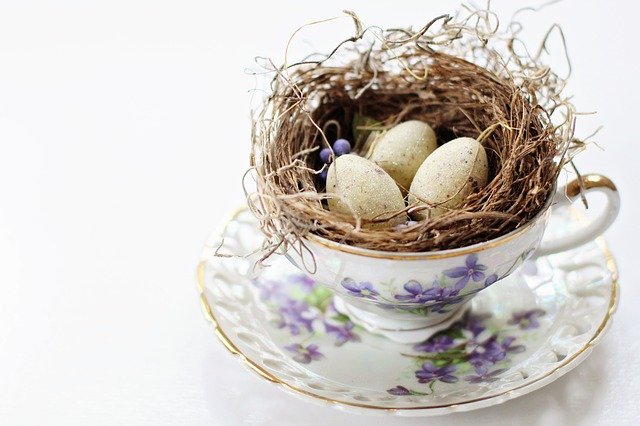
Now that spring has arrived, the birds are starting to build their nests.

It’s delightful to watch them collect items to fashion into a new home.

They’ll mostly gather twigs and leaves as their construction materials. They might also add moss, plant fluff, dried grass, or feathers to make the nest soft for their chicks.

But sometimes birds use unexpected things when constructing a home.

They’ve been known to use mud, pet fur, discarded snake skins, and spider silk for their nests. They’ll even use man-made items, such as plastic, tinsel, dryer lint, or even purloined underwear from a clothesline!

Birds don’t seem to count anything out: they’ll use the most unlikely things to achieve their goal.

And so does God.

God also uses unexpected things and unlikely people to fulfill His purposes. The Bible is chock-full of examples of this:

Read more

The Banana Paradox

Image by Alexas_Fotos from Pixabay

Who doesn’t like banana cake?

Even people who won’t eat bananas seem to like banana cake or bread. It seems to be one of those desserts that is universally liked. In fact, each year we celebrate National Banana Bread Day on February 23rd.

And what kind of bananas do you use to make a banana cake? Only the most uniformly yellow, firm, spot-free, perfect ones, right?

Wrong.

Counterintuitively, banana cake or bread is made using mushy, overripe, spotted, or even brownish-black bananas. The kind that no grocery store would even think of trying to sell. The kind that look sort of yucky, to be honest. The kind no one wants to eat. The kind that was used as an insult in the Christmas song about Mr. Grinch: “You’re a bad banana with a greasy black peel!”

Whenever we had those sorts of bananas in the kitchen when I was little, my Dad would say to my Mom, “Honey, why don’t you throw those things out? They look awful!”

My mother would interpose her body protectively between my Dad and the bananas and say, “No, no! I’m saving them for a banana cake.”

You see, Mom understood the banana paradox. She knew that the mushiest bananas make the best cake. She could see beyond the decaying exterior to what the banana could become.

She saw what my Dad couldn’t see: their potential.

In the same way, God can see beyond our faults and failures to what we can become. God sees the potential in people who have been written off by others, who seem to have disqualified themselves from ever achieving anything great for the Kingdom. God can still use those of us who feel our record is too spotty, that we have too many black marks against us.

Read more

Of Lions And Lambs

Image by David Mark from Pixabay

Do you have some weather sayings or proverbs in your area?

Maybe you’ve heard ones like “April showers bring May flowers,” or “Clear moon, frost soon.”

Perhaps you know this weather proverb: “Red sky at night, sailor’s delight. Red sky in morning, sailors take warning.”

Here in the northern hemisphere, we say “March comes in like a lion but goes out like a lamb.”

This saying might have started out referring to the stars. The beginning of March sees the constellation Leo (the lion) rising in the east. The end of the month features the constellation Aries (the ram or lamb) setting in the west.

Over time, the saying shifted to have more of a weather connotation. The start of March is often cold and stormy, fierce like a lion. By the end of the month, the weather has turned more calm and gentle, almost lamb-like.

This weather proverb doesn’t always hold true, of course; sometimes March starts out like a lamb but ends like a ferocious lion!

There is, however, a Biblical promise about these two animals that you can bank on:

Jesus came to earth first as a lamb, but will return as a lion.

Read more