Message in a Bottle

Image by Antonios Ntoumas from Pixabay

Have you ever put a message in a bottle and then thrown it into the ocean?

More importantly, has anyone ever come across it years later?

Believe it or not, there are actually people who keep track of this sort of thing.

According to the Message in a Bottle Hunter website, the world’s oldest seagoing message in a bottle is almost 132 years old. It was dropped into the Indian Ocean by a German research vessel studying ocean currents in 1886, and was found on a beach in Western Australia in 2018. (Wikipedia records an even older message, a Japanese one found after 151 years afloat.)

Bottled messages have travelled many thousands of miles. The farthest recorded distance travelled is probably the one that floated from New Zealand to Spain, almost an antipodean journey.

Perhaps the most romantic message in a bottle story concerns Swedish sailor Ake Viking. In 1956, he stuffed the message “To Someone Beautiful and Far Away” into a bottle and cast it into the sea. It was later retrieved by a young woman named Paolina in Sicily. Their subsequent correspondence culminated in marriage in 1958, with the wedding ceremony attracting 4,000 people.

We marvel at events like these: the idea that something thought lost and forgotten can show up decades later.

But there are some things we don’t want to come across again.

Who wants to be reminded of a sordid episode in our past—something that we did that now makes us cringe with regret and horror?

Fortunately, once our sins have been forgiven by God, they won’t wash up on a beach somewhere to accuse us.

Read more

The Slippery Slope

Image by Hermann Kollinger from Pixabay

As in many northern climes, a favourite pastime of Canadian children in winter is tobogganing.

I did my share of barrelling down snowy slopes on a sled when I was a kid.

Even though we lived in a big city, we had nature nearby. A ravine adjoined our neighbourhood, featuring steep hills bordering a river valley.

These hills were perfect for tobogganing.

The trick was to follow the paths through the snow that others had already made. Trying to forge a path through newly fallen snow yourself was hard going, but if you positioned your sled on ready-made routes, you could really pick up some speed.

The highest hill in the ravine was nicknamed “The Killer” by the kids. When the snow was tamped down by dozens of tobogganing runs it became icy, and you’d find yourself going faster than you expected.

You could build up so much momentum sliding down this hill that you could end up plunging into the freezing cold river.

It was a slippery slope, quite literally.

And dangerous.

Sometimes in life we find ourselves on slippery slopes, don’t we?

If we’re not careful, we might blindly follow the path of others into sin. It might seem fun at first, and we might not notice that we’re accelerating.

Eventually, though, we may lose control and not be able to stop in time. We can unexpectedly end up in dangerous places.

Make no mistake, sin is a killer.

It kills relationships, reputations, trust, and future options.

Most importantly, it kills our connection with God.

Read more

The Ultimate Love Story

Image by lillaby from Pixabay

Valentine’s Day is just around the corner!

On this beloved day of the calendar, we celebrate our love for that special someone in our lives. Many of us will be giving (or receiving) boxes of chocolates and bouquets of roses as an expression of that love.

But sometimes those roses have thorns, don’t they?

The truth is, love sometimes hurts. It can cost us something.

We think of Valentine’s Day as simply about romantic love, but the history behind this day shows us that true love is often about sacrifice.

This was certainly the case for Saint Valentine of Rome, for whom Valentine’s Day is named.

This third-century priest was known for his evangelistic work and for aiding persecuted Christians. He was martyred for his faith on February 14 in AD 269, executed by order of Emperor Claudius for refusing to deny Christ.

Saint Valentine patterned for us a life focussed on loving others; he refused to deny the Source of that love, even if it cost him his life.

Christ modelled that sort of sacrificial love, too.

He would let nothing stop His purpose of showing love to others by securing for them a way to spend eternity with Him, even if it cost Him His life.

And it did.

Read more

Thirteen By Any Other Name…Is Still Thirteen

I recently realized that I wasn’t living in the house that I thought I was.

Last summer I moved into a house bearing the number 15. I love everything about it: the house itself, the neighbours, and the area’s community spirit.

It wasn’t until some months later that I realized that I didn’t actually live at #15: I live at #13. The house next door is #11, and opposite my house is #12. Counting from the bottom of the street, mine is the thirteenth house.

So why didn’t the city call it #13 when it was assigning street numbers to the houses?

In many countries, the number 13 has unlucky connotations. Why? One reason is that there were thirteen present at the Last Supper, including Judas, who would betray Jesus.

Some people are superstitious about this number, and try to avoid its “bad luck” by keeping away from anything labelled 13. There’s even a word for the fear of the number thirteen: triskaidekaphobia.

The result is that many companies and cities fudge their numbering to avoid 13. This is why many hotels and tall buildings seem to lack a thirteenth floor: the elevator buttons skip from floor 12 to 14.

The thirteenth floor continues to exist, as does the thirteenth house on a street: we haven’t erased them. But we just call them by other names. We simply pretend that they’re actually the fourteenth floor or the fifteenth house. Everyone goes along with this fiction because it means we don’t have to face reality. We’re deluding ourselves, of course, but it seems we prefer to live in denial.

We do the same with sin, don’t we?

We call it by other names so we don’t have to face up to the reality of what it really is.

Read more

See What You’re Missing!

Image of the Milky Way by Evgeni Tcherkasski from Pixabay

Have you seen the Milky Way recently?

If you have, you can count yourself among the fortunate.

Astronomers say that light pollution from artificial lights is strong enough in many places to blot out the stars. They’ve calculated that over a third of humanity, and almost 80 percent of North Americans, can no longer see the Milky Way. Indeed, here in Toronto we’re lucky if we can even see the Big Dipper.

Few of us seem to recognize how sad this really is.

Vision scientist Sonke Johnsen does. He wrote:

“The thought of light traveling billions of years from distant galaxies only to be washed out in the last billionth of a second by the glow from the nearest strip mall depresses me no end.”

We seem to devalue the incredible gift of the night skies. We don’t pay it much mind when it’s there. And if we can’t see it any longer, the loss is of little importance to us.

Why is it that losing our connection to the wonder of our galaxy doesn’t seem to bother us? Is it our self-sufficiency? Are we so caught up with our shiny, man-made baubles that we’re blind to our need for something real?

I think this detachment from the cosmos speaks to a spiritual apathy, too.

How is it that we’re indifferent to the awesome gift of the Son of God?

Read more

The Beauty of Redeemed Brokenness

Image of parrot tulip by Coanri/Rita via Flickr CC BY-NC-ND-2.0

What’s your favourite flower?

Even though I certainly love roses, the tulip holds a special place in my heart. It’s not as showy or fragrant as a rose, but it brings such joy in spring after a long winter.

Among the many types of tulips, I especially like the variegated ones (with multicoloured petals).

But did you know that the dramatic colour combinations of variegated tulips are caused by a virus?

Gardeners had long noticed that tulip petals occasionally “broke” into unusual patterns. But it wasn’t until the late 1500s that botanists realized that the beautiful mixed colouring arising spontaneously in some tulips was actually the result of a disease.

While the tulip-breaking virus causes lovely variegated colouring, it also weakens the tulip bulb, eventually leading to the death of its genetic line.

So how is it that we can still enjoy variegated tulips today? Why haven’t they all died out?

Fortunately, botanists centuries ago learned to graft healthy tulip bulbs onto the diseased or “broken” ones, preserving their lineage. Today, we can enjoy countless cultivars in a dizzying array of colours and patterns.

Doesn’t this remind you of what God does for us?

Read more

The Wrong Yardstick

Image by Ariel from Pixabay

Do you have a friend who’s a bit of a screw-up?

No? You’ve got to get one!

Friends who make a shambles of things are amazing, because they make you feel so competent by comparison.

Your friend Sue might misplace one of her children, regularly set off the smoke detector when cooking, or accidentally rear-end a police car.

You roll your eyes smugly and think, “At least I’m not as bad as she is!”

In the same way, we like to justify ourselves before God by comparing our sins to those of others.

We think, “At least I’m not a bank robber or a serial killer. I’m not as bad as others. On the whole, I figure I’m a pretty decent person. I don’t think I really qualify as a ‘sinner.’ ”

The problem with this is that we’re using the wrong yardstick.

Instead of measuring ourselves against other people, we should be seeing whether we pass muster according to God’s standards.

Read more

Label Jars, Not People

By Frank Vincentz, Wikimedia Commons, CC BY-SA 3.0

What’s the difference between a tart and a torte?

For that matter, what’s the difference between torte-with-an-e and tort-without-an-e? Are they all edible?

Let’s see if we can straighten out the confusion.

A tart is an open pastry containing a filling. A torte is a multi-layered cake-like confection. They’re both edible (and extremely tasty—see recipe for Lemon Almond Tart below).

Tort is a legal term referring to a wrongful act or infringement of a right. You could try to eat the paper a tort was described on, but I wouldn’t recommend it!

But we’re not quite finished unpacking the meanings of these similar-sounding words.

A tart can also refer to a promiscuous woman: one who has had many sexual partners. A woman others would look down on. A woman polite society might consider to be “loose.”

But we should be careful before we slap anyone with a label such as this. We never know how God might use them.

Read more

Straight Out of Left Field

Image by Pexels from Pixabay

Have you ever had a time in your life when God did a work for you that came straight out of left field?

The blessing, provision or miracle he bestowed on you caught you off guard and astonished you. It was completely unexpected and surprising.

You never saw it coming.

God seems to like to work that way, doesn’t he?

Think of Moses in the Old Testament, when he was leading the children of Israel out of bondage in Egypt.

They found themselves in a jam: cornered at the Red Sea with the Egyptian army snapping at their heels.

Moses had faith that God would save them, but I wonder if he was racking his brains trying to figure out just how it would happen.

Maybe God would send a flotilla of boats from the other side to rescue them, Dunkirk-style? But no one knew they were coming, and at any rate, the only people on the other side were either enemies or strangers.

Maybe God would send an affable and reasonable Egyptian captain to negotiate with Moses? Not likely, since all of Egypt’s firstborn had just been killed. The Egyptians were in no mood to parley with their escaped slaves.

No matter what Moses came up with as a potential solution, he never could have expected the curveball that God threw:

God miraculously parted the waters of the Red Sea and allowed the Israelites to cross over on dry ground, then closed up the waters to drown their enemies. Moses surely didn’t see that one coming!

And that’s not the only curveball that God threw…

Read more

God Sees You In Infrared

Photo by Veronica H. on Pixabay

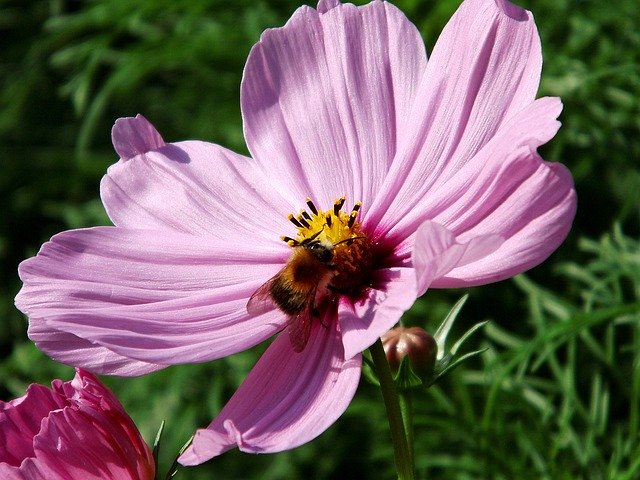
Did you know that some birds and bees can see things that are completely invisible to us? They’re able to see in infrared, just beyond the wavelengths of the visible light spectrum that human eyes can detect.

What looks to us like a regular pink flower might resemble a helicopter landing pad to a bee. Where we see only the uniform expanse of one colour, the bee may see a target-shaped design involving different colours. The bee’s infrared vision allows it to home in on the most nectar-rich part of the flower.

The world looks completely different when you can see in infrared.

I sometimes think that God sees us in “infrared.” He can see things in us that are invisible to others, and even to ourselves.

Read more