Sounds Like Paradise

Image of New Zealand by Lars_Nissen from Pixabay

Right now, living in countries like New Zealand sounds like a sort of paradise to the rest of the world.

Some island nations have been able to beat back the novel coronavirus to the point where life is almost back to normal.

People in those countries can once again attend concerts, go out to restaurants or to church, return to their workplaces, and hug their friends and family.

They can pretty much go about their pre-pandemic lives.

For those of us living in countries still battling second or third waves of COVID-19, life in places like New Zealand seems like a dream.

We hope that one day maybe life will be like that for us, too: we long for a world where there are no more restrictions, suffering or death due to COVID-19.

In essence, we all yearn for a release from “bondage,” don’t we?

But even when we’ve been able to put the novel coronavirus in the rear-view mirror, this ache for freedom won’t quite go away.

Why?

Read more

Your Past Doesn’t Determine Your Future

Image by Mediamodifier from Pixabay

If you’ve ever invested in stocks or mutual funds, you’ll probably have come across a disclaimer like this:

“Past performance is not a reliable indicator of future results.”

This phrase is meant to warn us and give us pause before we press the “Buy” button. We shouldn’t assume that an investment will continue to succeed in the future just because it’s done so in the past.

But there’s a secondary meaning that can be read into that disclaimer, too.

We shouldn’t discount or overlook an investment opportunity simply because it has performed poorly recently. It could well turn around and gain ground.

It’s this last meaning of the disclaimer that we see exemplified in several characters in the Bible. It applies to our own lives as well:

Past failures in our lives don’t mean that God can’t still use us.

They’re not a reliable indicator of our future results or success.

Read more

Faster Than The Speed of Light

Artist’s concept of Mars Perseverance Rover, Wikimedia Commons, Public Domain

Last week, NASA’s science rover “Perseverance” landed successfully on Mars, to jubilant cheers from scientists back home.

Mission managers at NASA’s Jet Propulsion Lab near Los Angeles had been waiting anxiously for confirmation that the craft had landed safely.

Because it takes radio waves 11 minutes to reach Earth from Mars, “Perseverance” had already settled on the surface of the Red Planet by the time news of its safe arrival reached scientists back on Earth. NASA had to endure a nerve-wracking wait before they got the verification.

We encounter this time lag throughout our universe.

The light from our own Sun takes 8 minutes to reach Earth. Light from Pluto takes 5 hours. It takes 8 years for the light from the “Dog Star” Sirius to reach our planet.

This time lag means that with stars extremely distant from us, we’re actually seeing them now as they were thousands of years ago. It takes that long for their light to travel to us.

It sometimes seems as though there’s a similar “time lag” between our brains and our hearts.

Read more

A Series of Fortunate Events

Image by Susann Mielke from Pixabay

Sometimes it takes a bit of time before we can tell if an event will turn out to be good or bad for us.

Take the famous Chinese proverb about Sai Weng losing his horse. The story goes like this:

Sai Weng, a old farmer, raised horses for a living. One day, his prized stallion ran away. His neighbours comforted him in his misfortune by saying, “What terrible luck!”

Sai Weng merely replied, “Maybe so, maybe not. We’ll see.”

Later, the stallion returned, bringing with it several wild mares. The farmer’s neighbours congratulated him on his good fortune: “What wonderful luck!”

Again, Sai Weng only said, “Maybe so, maybe not. We’ll see.”

One day, Sai Weng’s son tried to ride one of the new mares, but was thrown off and broke his leg. The neighbours again commiserated with the farmer, saying, “What bad luck!”

Sai Weng once again replied, “Maybe so, maybe not. We’ll see.”

Later, soldiers from the national army came through town, conscripting all able-bodied men for service in the war. The farmer’s son was spared, however, because he was still recovering from his broken leg. The neighbours said, “What great luck!”

Sai Weng simply said with a smile, “We’ll see.”

We often can’t judge whether an event in an of itself is fortunate or unfortunate. Sometimes only time will tell the whole story.

Read more

The Essential Ingredient

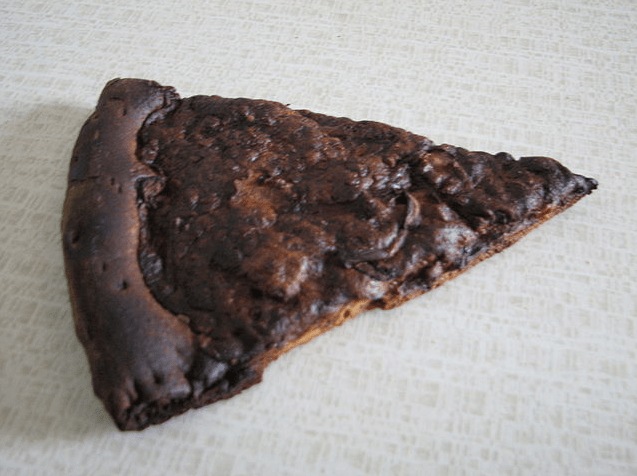
Perhaps this pizza slice is slightly overcooked?
Photo by Kevin Payravi, Wikimedia Commons, CC BY SA-3.0

Have you ever cooked a dish which turned out to be plainly inedible, or even downright dangerous to consume?

It can happen to the best of us, as these examples prove:

A grandmother with failing eyesight accidentally grabbed a bottle of ammonia instead of vinegar when making potato salad for her family. They started gagging at the mere smell of it, which fortunately prevented anyone from eating it!

An 18-year-old living on his own for the first time wanted to make fried rice. He poured some oil into a very hot pan, then dumped in a bunch of uncooked rice. Needless to say, the burned mess had to be thrown out.

Another young person forgot to add water when cooking packaged ramen noodles. I guess cooking isn’t for everyone!

Did you know that a cooking fail even happened in the Bible?

Read more

A Gardener’s Worst Enemy

Garlic Mustard
Photo by Simone VomFeld on Pixabay

Gardeners may not realize it, but they’re a bit like soldiers in wartime. Their enemies aren’t people, of course, but an even more insidious foe:

Weeds.

Weeds infiltrate our gardens like enemy invaders: dandelions, nettles, thistles, couch grass and garlic mustard, to name a few. They may seem innocent enough when there are only a few of them, but make no mistake: their ultimate aim is to take over and occupy your territory.

One vanguard weed may sneak in and settle, and you think nothing of it. If you’re not vigilant, though, that lone plant will soon multiply into an overwhelming host.

Or you pull up a dandelion and think that’s the end of it, but unless you’ve been very thorough, part of the taproot remains deep in the soil. The weed will come up again long after you thought you’ve eradicated it.

The seeds of weeds may stay in the soil of your garden and remain viable for years. They lie in wait like sleeper agents, waiting patiently for the right opportunity to spring up and attack.

The mission of weeds is simple but deadly: to compete with other plants for light, water and nutrients and crowd them out so they die. They’re dastardly adversaries, often needing less sunlight and water than other plants to survive.

And the worst part of it is that they’re very hard to kill.

Weeds are sort of like sin, aren’t they?

Read more

The God of Second Chances

Hands holding seedling
Photo by Pikrepo

It’s an awesome feeling to realize that you’ve got a second chance, isn’t it?

A friend of mine discovered this after moving into a house with a large garden this summer. A beginner gardener, she was delighted to finally have enough space for an extensive vegetable garden. She immediately planted some tomato and cucumber seedlings, which grew vigorously and are now producing ripe veggies.

Because she’d moved in mid-summer, however, she lamented that she’d missed the chance to start growing vegetables like beets, spinach, peas, and carrots from seed in spring. She knew that cool-weather-loving veggies like peas wouldn’t thrive in the summer heat. She figured that if you didn’t plant those seeds in the spring, you’d missed your chance for the whole year.

But the garden, like God, often gives us second chances.

I told my friend that she could actually plant those seeds now for a fall harvest. There was still time to grow a second crop before the frosts of November hit. She hadn’t missed out after all: she could still grow the cool-weather veggies she’d hoped for.

What a wonderful metaphor for how God deals with us!

Read more

God Won’t Waste Your Pain

Quilting Bee circa 1910, New Jersey
Photo by Richard on Flickr CC BY-2.0

Did you grow up in a family that hated wasting things? So did I.

Instead of throwing out old scraps of fabric, my paternal great-grandmother would twist the lengths and sew the resulting cords together into a rag rug. Nothing was wasted.

It was the same on my mother’s side of the family. Material from clothes that were no longer of use would be cut up and sewn into quilts. My Mom recalls sitting underneath the quilting frame as a child when her mother and other female relatives worked together at a quilting bee (Mom thought she was “helping” push the needle back up to the top surface). Even as a little girl, my mother learned an early lesson in letting nothing go to waste.

I must have inherited that trait.

I love recipes that not only produce a yummy result, but that are efficient. By that I mean that you’re not left with partly used cans of an ingredient that will languish in the fridge and eventually have to be thrown out.

I prefer a recipe that uses up the whole can of an ingredient, or, if it calls for 3 egg yolks for the batter, it also calls for 3 egg whites for the filling or a meringue (see cheesecake recipe below). Nothing is wasted. No leftover egg whites that you have to store until you think of another recipe that can use them up.

Likewise, I think God is efficient in how He manages our lives. He won’t waste anything we go through: it all has a purpose, even the negative parts.

Read more

Golden at the Broken Places

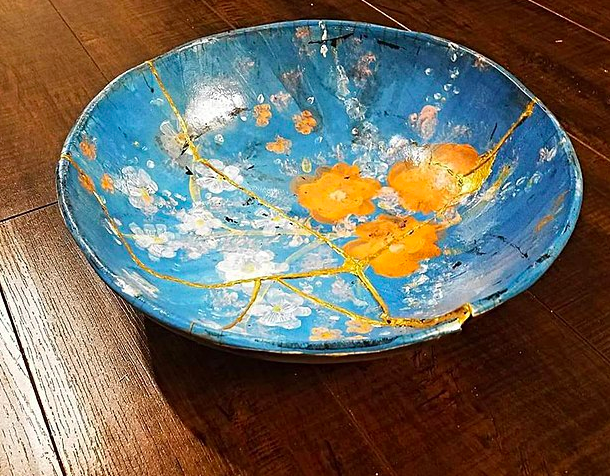
Bowl repaired by Kintsugi method by artist Ruthann Hurwitz
Wikimedia Commons CC BY-SA-4.0

We all shudder at the sound of something breaking, don’t we? We can’t help but wince when we hear glass or crockery shattering into pieces on the floor.

Why do we have that involuntary reaction? Because we know that the object probably can’t be repaired: it’s likely to be damaged irreparably, and must be thrown away.

We’re wincing at the sound of loss.

But what if there were a way to not only put the pieces back together, but to make the object more beautiful than it was before, despite the breaks?

The Japanese long ago invented a way of doing just that, and have even made an art form of it. It’s called “Kintsugi,” which means “golden joinery.” The process involves mending the cracks in pottery with gold lacquer. Instead of trying to hide the damaged areas, they are instead highlighted with something precious. The end result is a restored piece of pottery that is beautiful at the broken places.

But what happens if it’s not a piece of pottery that is broken, but a life? How can a shattered heart be put back together?

Read more

Give It Time

Handkerchief Tree photo from Wikimedia Commons CC BY-SA 3.0

Do you get the feeling that society is becoming too impatient?

We seem to expect instant results these days: immediate responses to our texts or emails, same-day delivery for things we order, instantaneous loading of videos or web pages. In fact, a study showed that a YouTube video that loads slowly will start losing viewers after two seconds.

The problem is that sometimes our impatience with technology gets applied to people, too. We expect people to change quickly, and if they don’t, we lose patience with them and give up on them.

This reminds me of the tale of the handkerchief tree.

Called the dove tree in its native China, it became known to Western visitors in the late 1800s, who were entranced by it. The handkerchief tree features stunning white bracts surrounding its flowers, which resemble doves, ghosts or fluttering handkerchiefs, hence its name in the West.

European botanists in China collected the seeds and brought them back home, keen to grow such a gorgeous tree. One gardener planted the seeds, but was disappointed to find after a year that they hadn’t sprouted into seedlings. Figuring that the seeds must be no good, he discarded them by dumping them onto his compost pile, then forgot about them.

To his surprise, two years later he saw a bunch of seedlings on the compost pile. They were from the handkerchief tree. They had sprouted after all!

What he didn’t know was that seeds of the handkerchief tree have what’s called a “double dormancy”: they require two years to germinate, unlike most seeds which will sprout within the first year.

He had written them off too soon.

Don’t we do the same with people sometimes?

Read more