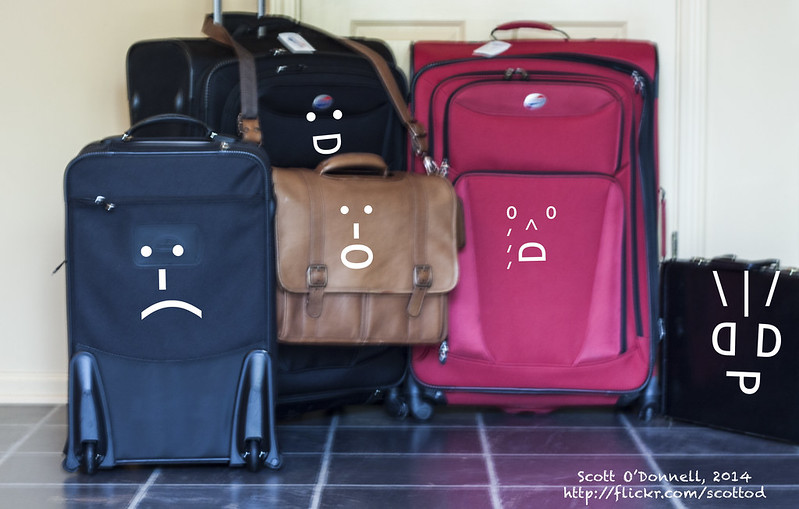
Got Baggage? Jesus Understands

Image by Scott O’Donnell on Flickr CC BY-2.0

Do you ever feel like you have too much “baggage” to ever be accepted by people, let alone by God?

Do you need a sense of hope that you could be loved despite the burdens you’re carrying from your background? Then read on…

A few weeks ago, we explored the moving account of Ruth and Boaz in the Old Testament. It’s a favourite of many people, because it’s one of the few outright love stories in the Bible. But we sometimes get so caught up in the romance of the story that we miss how startling their pairing actually was.

Boaz was a wealthy landowner living in ancient Israel. He was successful and respected, a descendent of Abraham himself. One would have expected him to marry a woman of his own people, someone from an equally illustrious family.

But Boaz ended up marrying Ruth, a woman with three strikes against her: she was poor, a widow and a foreigner. She had nothing and was a nobody in the eyes of the Israelites. In fact, she was worse than that: she was a Moabite, a group hated by the Israelites. No doubt Ruth was looked down on by many in the community.

So why would Boaz agree to marry her? We know that Boaz respected Ruth for how she’d cared for her mother-in-law. And certainly, God’s hand was on their meeting and their union. But why was Boaz so accepting of the idea of marrying someone like Ruth? Why was he not put off by her “baggage”?

I believe an answer lies in Boaz’ background. Turns out he had some baggage of his own.

Read more

When Bad Cakes Happen to Good People

Cake Explosion Photo by Raffi Asdourian on Flickr CC BY-2.0

Sometimes, despite your best efforts, recipes don’t turn out the way they’re supposed to.

Your soufflé turns into a pancake; your cookies are as hard as hockey pucks; or your cake is a soggy mess. Any way you slice it (if it’s even possible to slice it), the recipe results in a total disaster.

Sometimes it’s due to a mistake on your part. You accidentally added twice the amount of an ingredient called for (guilty!); you used Shake ’n’ Bake instead of graham cracker crumbs for the dessert base; or you put the pizza in the oven for 450 minutes at 15 degrees, instead of 15 minutes at 450 degrees.

Or maybe the fault lies with someone else. The recipe’s author might have led you astray by inadvertently calling for 1/2 pound of flour instead of 1/2 cup’s worth. You only discover later that the recipe contained errors when you see a correction printed in the next day’s newspaper or blog post. But by then, of course, it’s too late: your family is using the rock-hard muffins you made as door-stops.

Often, you didn’t see a recipe fail coming at all. You followed the instructions to the letter, but it still didn’t work out. The ingredients may not have behaved as you expected due to humidity, altitude, or their age. Your oven may be hotter or colder than you realized, or your flour is harder than the type tested in the recipe. It wasn’t your fault, but just the nature of baking.

As Marian Keyes puts it in her cookbook, “Saved by Cake,” sometimes bad cakes happen to good people.

It’s the same in our lives, isn’t it? Sometimes things go wrong even when we’ve tried to do everything right. Our lives don’t turn out the way we expected.

But there’s good news for the believer in God: He can redeem any mistake and turn things around for your good and His glory.

Read more

Break Your Four-Minute Mile

Last October in Vienna, Kenyan Olympic champion Eluid Kipchoge made history. He became the first person to run a marathon in under two hours, a feat that had long seemed impossible.

After running the 26.2 mile course in one hour, 59 minutes and 40 seconds, Kipchoge drew comparisons to Sir Roger Bannister. Bannister was the Briton who in 1954 became the first person to run one mile in under four minutes, an achievement also once thought to be unattainable.

Kipchoge said something very significant after his race: “I expect more people all over the world to run under two hours after today.”

Why did he say that? Because Kipchoge knew that a funny thing had happened after Bannister’s victory: other people began breaking the four-minute mile as well. They suddenly saw that it was possible, and were inspired to believe that if Bannister could do it, so could they. The barrier he broke for people was just as much a mental one as a physical one.

Do you have a “four-minute mile” in your life? Are there things you would like to achieve, but you feel they’re impossible?

Take courage, because God specializes in breaking barriers!

Read more

God Sees You in Infrared

Bee on cosmos flower
Photo by Veronica H. on Pixabay

Did you know that some birds and bees can see things that are completely invisible to us? They’re able to see in infrared, just beyond the wavelengths of the visible light spectrum that human eyes can detect.

What looks to us like a regular pink flower might resemble a helicopter landing pad to a bee. Where we see only the uniform expanse of one colour, the bee may see a target-shaped design of several differently coloured concentric circles. The bee’s infrared vision allows it to home in on the most nectar-rich part of the flower.

The world looks completely different when you can see in infrared.

I sometimes think that God sees us in “infrared.” He can see things in us that are invisible to others, and even to ourselves.

Read more

Beauty Out Of Brokenness

Sea glass on a rock
Photo by treenabelle on Pixabay

Once the worst of this pandemic is over, psychologists warn that many of us may suffer from post-traumatic stress for some time to come. Some of us will have lost a job, seen our business close down for good, suffered isolation and loneliness, or may have even lost a loved one during the COVID-19 crisis.

But is PTSD a given in these circumstances? Is there different outcome that can occur, an unexpected benefit that may arise out of these difficult times?

Psychologists say yes: there’s such a thing as post-traumatic growth. It’s been found in survivors of war, cancer, and natural disasters. Some people emerge from a crisis with increased spirituality, a greater sense of personal strength, new priorities and closer relationships with others. What could have broken them actually made them better.

This phenomenon reminds me a bit of “sea glass.” Sea glass, or beach glass, found washed up on shores, starts out as merely cast-aside pieces of broken glass. Perhaps they’ve been tossed overboard from a ship, or thrown into the sea from land along with other garbage.

These shards of glass endure years of being buffeted against the stones of the sea bottom. It seems like they’re being dashed about mercilessly by the relentless action of the waves. Surely no good could come of this?

But then, something almost magical emerges.

Read more

The Best Worst Day

1895 lithograph of Edvard Munch’s “The Scream”
Photo by Steven Zucker on Flickr CC BY-NC-SA-2.0

There are some dates in history which stand out for being associated with awful events. Each year, when the calendar rolls around to these dates, we shudder in horror when we recall what happened.

Here are a few “worst days in history” that come to mind:

September 11th, 2001: the deadly World Trade Centre terrorist attacks in New York.

August 6, 1945: the dropping of a nuclear bomb on Hiroshima, Japan.

June 28, 1914: the day Archduke Ferdinand was assassinated, igniting the horrific First World War which killed tens of millions.

December 26, 2004: the Boxing Day tsunami which killed hundreds of thousands.

Some horrible dates in history have specific terms associated with them, such as:

December 7, 1941: the Japanese attack on Pearl Harbor, a date which President Roosevelt said would “live in infamy.”

October 29, 1929: called “Black Tuesday,” the worst day of a stock market crash which would send the world spiralling into the Great Depression.

What term is associated with the horrible day Jesus Christ was crucified?

Good. It’s called Good Friday.

But why?

Read more

The Most Dazzling Christmas Light

Photo by Paul Vladuchick on Flickr CC BY-NC-ND 2.0

What’s your favourite Christmas tradition? Is it exchanging gifts, baking special desserts, decorating the tree, or perhaps wearing ugly Christmas sweaters?

For many of us, our most cherished Christmas tradition probably involves lights, whether they’re on your own Christmas tree, or decorating houses in your neighbourhood. Some people go all out, putting tens of thousands of lights on their home, as in the example pictured above. Apparently, the interior of that house is decorated with the same exuberance, and with all the lights on, the homeowner can’t use the microwave without blowing all the fuses.

This season is inextricably linked to lights, but might we have missed the most important light of all?

Read more

The Perfect Christmas?

Photo by Adam Clark on Flickr CC BY-SA 2.0

What’s your idea of the perfect Christmas? Many of us have images in our minds of what the ideal Yuletide should look like.

It usually involves a spectacular Christmas tree with enticing gifts piled beneath it. The house would be decorated with pine boughs and red bows inside, and the exterior decked out with lights. The day itself would feature a scrumptious dinner with all the fixings, and numerous home-baked desserts. Top it all off with a house full of family, friends and laughter.

There’s only one problem with this picture.

Read more

How Larch Trees Are Like Jesus

Larch Trees, Banff National Park, Alberta, Canada
Photo by Steve Jurvetson on Flickr CC BY-2.0

It’s easy to categorize trees, isn’t it? Deciduous trees lose their leaves in the autumn. Coniferous trees bear cones and keep their needles throughout the year. It’s simple to tell them apart.

Case closed, right?

But what about the larch tree? It bears cones and has needles like a conifer, but the needles drop off each autumn like a deciduous tree.

So which is it, coniferous or deciduous?

Read more