Empty Rooms Tell A Story

Image by dozemode from Pixabay

Empty rooms can sometimes tell a pretty full story.

For instance, if you come downstairs into your empty kitchen and find chocolate sauce smeared over everything and a trail of chocolatey footprints leading into a closet, you can probably surmise what happened:

Your four-year-old went wild while you were busy upstairs and is now in hiding.

Or if you come home to an empty living room only to discover the sofa’s cushions have been chewed to bits and there is stuffing all over the place, the room itself tells you all you need to know: that your naughty dog shouldn’t be left alone so long.

Perhaps you arrive back from vacation and each empty room shows evidence of having been ransacked. A window was broken, drawers have been pulled open, and valuable items are missing. Police detectives find additional clues in the house that help them figure out the identity of the burglar.

Investigators (and parents) are masters at being able to figure out what story an empty room tells.

I wonder if we can use our detective skills to determine what the empty tomb of Jesus conveys?

Read more

Easter: Jesus’ Finest Hour

Image by Gerd Altmann from Pixabay

What makes something your “finest hour”?

To answer that question, we first have to reach back to June 16, 1940, when that phrase was made famous in a speech by British Prime Minister Winston Churchill.

World War Two had begun the previous year. France, Poland, Norway, Denmark, Belgium and the Netherlands had all fallen under the jackboots of the Nazis. It was a dark time, and the only thing standing between Hitler and control of the rest of Europe was the island nation of Britain.

In this context, Churchill prepared his people for the immense sacrifices that would be asked of them in the coming battles. He told them that the survival of their nation and way of life lay at stake. He let them know the consequences both of success and of failure in the task ahead of them.

He concluded his speech with one of the great rallying cries in history:

“Let us therefore brace ourselves to our duties, and so bear ourselves that, if the British Empire and its Commonwealth last for a thousand years, men will still say, ‘This was their finest hour.’ ”

Churchill was telling the British people that their finest hour would not be a time of ease or comfort. Rather, it would encompass pain, sacrifice, duty, and selflessness.

The same holds true for us.

And the same held true for Jesus in His finest hour.

Read more

Have You Found The Way?

Image by claumoho on Flickr CC BY-2.0

Have you ever tried navigating through a maze?

Perhaps as a kid you tried to find your way in and out of a hedge maze in a park. Or maybe you visited a maze made of corn or sunflower stalks in a farmer’s field. They’re fun, aren’t they?

Mazes can vary dramatically in size. Some are so large that visitors are given an emergency cell phone number to call if they get lost in the maze and can’t find their way out!

You might wonder, is a maze the same as a labyrinth?

The terms are often used interchangeably, but there’s actually a difference between them.

A maze is known as “multicursal.”

It branches off into many confusing paths and surprising dead ends. A maze may have several entrances and exits. The surrounding hedges or walls are so high and dense that you can’t see the whole pattern unless you get up high in a viewing tower or balloon ride. A maze is for entertainment, a fun puzzle to try to solve.

A labyrinth, on the other hand, is “unicursal.”

A labyrinth has only one track or walkway, and it doesn’t branch off into dead ends. There’s only one way in or out. You enter, follow the path to the centre, and continue on the same path until you reach the exit. Sometimes the barriers on either side are very low, allowing you to see the entire pattern. Walking a labyrinth can be a calming, spiritual practice.

Which does Christianity most resemble, a maze or a labyrinth?

Jesus implies that it’s more like a labyrinth:

There’s only one way in, and one path to follow.

Read more

You Are Now Entering The Mission Field

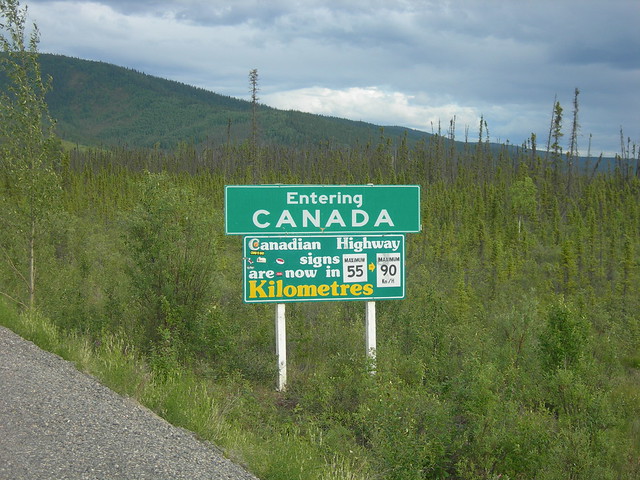
Image by Jimmy Emerson on Flickr CC BY-NC-ND-2.0

There are a lot of exciting things about travelling, aren’t there?

Things like seeing famous landmarks, interacting with different cultures, trying new cuisines, or having once-in-a-lifetime experiences.

Even simply crossing the boundary into a new city can be exciting.

You often pass a large sign when you enter the outskirts of a new place. It might read, “You are now entering Albuquerque” or whatever your destination happens to be.

You get the same frisson of excitement even if you’re entering a small town that’s new to you. It still seems momentous, because the unknown awaits you. You never know who you might meet there, or what might happen.

These thoughts crossed my mind recently as I was exiting a church parking lot onto the main street. Leaving the lot, we were faced with a sign that read:

“You are now entering the mission field.”

My heart skipped a beat as I read that.

Read more

What Will You Grow: Fear or Faith?

Image by HeungSoon from Pixabay

With the arrival of spring, gardeners are faced with some difficult decisions:

What should I grow in my garden?

You only have so much square footage and only so much soil.

You have to make hard choices about what plants will be given space, and which ones you’ll have to forgo this year.

Maybe you’d like to grow dozens of pink roses in your garden plot. That’s a great idea: it would look gorgeous and smell beautiful.

But then you’d have to give up on the idea of growing a vegetable garden in that spot. You simply don’t have the space to do both.

If you dream of having a wildflower meadow in your yard, you’ll have to skip your plan of creating a formal French garden. You have enough room for one or the other, but not both.

Similarly, you only have so much real estate in your mind.

You have to make decisions about what you’ll let take up space.

What will you grow there?

Faith or fear?

They both grow in the same soil, so to speak: uncertainty.

But only one of them produces a harvest that’s worthwhile.

Read more

Same Spider, Different Silks

Dew drops on spider’s web. Image by Pezibear from Pixabay

When you let your mind wander, do you ever find yourself asking odd questions?

Such as, “Why doesn’t glue stick to the inside of the bottle?”

Or, “How do you grow a seedless fruit?”

Or how about this one:

“Why don’t spiders get caught in their own webs?”

I can’t help you with the first two, but I do have an answer for the third.

When spiders build their webs, they draw out silk from their abdomens with six spinnerets. The key is that they’re able to emit different types of silk for different purposes.

The spider first constructs a frame for its web. Then, it lays down spokes of non-sticky silk to use as walkways.

Next, the spider weaves spirals of connecting lines between the spokes using sticky silk. This is for ensnaring small insects that it will later eat. The spider knows to avoid walking on these gluey strands.

A spider can also spin stretchy silk for the centre of its web, or extra-strong silk for the anchor lines.

Whichever type of silk the spider decides to spin, it all has a specific purpose. And even though the types of silk differ, they all come from the same source.

I think we can borrow this analogy to describe how we can receive quite different things from God’s hand.

Read more

God Can Use Anything And Anyone

Image by Terri Cnudde from Pixabay

Now that spring has arrived, the birds are starting to build their nests.

It’s delightful to watch them collect items to fashion into a new home.

They’ll mostly gather twigs and leaves as their construction materials. They might also add moss, plant fluff, dried grass, or feathers to make the nest soft for their chicks.

But sometimes birds use unexpected things when constructing a home.

They’ve been known to use mud, pet fur, discarded snake skins, and spider silk for their nests. They’ll even use man-made items, such as plastic, tinsel, dryer lint, or even purloined underwear from a clothesline!

Birds don’t seem to count anything out: they’ll use the most unlikely things to achieve their goal.

And so does God.

God also uses unexpected things and unlikely people to fulfill His purposes. The Bible is chock-full of examples of this:

Read more

We’re Here To Help

Image by An SiYu from Pixabay

Not far from The Faith Cafe, there’s a big-box home-improvement store. I had occasion to go there, and noticed the smiling greeter at the entrance.

He had a name-tag sticker on his apron that read, “Frank: Front End.”

I was both puzzled and amused.

Did the store managers figure that customers needed guidance determining which was the front end of Frank?

If I peered around to see Frank’s backside, would I see another sticker that read, “Frank: Rear End”?

Or maybe Frank needed a sticker on his apron to tell him which way to put it on, so he wouldn’t wear it back-to-front?

I giggled my way through the store until I finally realized that perhaps the sticker meant that Frank was responsible for covering the front end of the store. I felt a little sheepish at my mistake, but reasoned that the sticker could have been a little less confusing.

At another similar store I visited, the greeter had a name tag that read: “I’m George. I’m here to help.” That was much clearer. No mistaking what the employee was there for.

Then I thought, isn’t that what we believers are here on earth to do, too?

Read more

Mustard Seed Faith

What are the smallest seeds on earth?

You might guess mustard seeds. Close, but not quite.

How about poppy seeds?

They’re very tiny. You’ll find out how extremely tiny they are if you accidentally spill them on the floor. You’ll discover that you can’t pick them all up by hand: it’s hopeless. You have to bring out your vacuum. (Don’t ask me how I found this out!)

Actually, the tiniest seeds on earth are said to be those of certain orchids from the tropical rainforest. Each of these dust-like seeds weighs only one 35 millionth of an ounce. They’re smaller than a grain of salt.

At the opposite end of the spectrum, the prize for the largest seed on earth probably goes to the Coco-de-Mer palm tree of the Seychelles Islands. One of its seeds can weigh up to 45 pounds.

Mustard seeds are a bit larger than poppy seeds, but they’re still exceptionally tiny compared to most seeds.

They’re so small that Jesus used them as an example in one of His teachings. Surprisingly, He said that if we have faith the size of a mustard seed, we could see great things accomplished.

How is this possible?

Because when we have even a small amount of pure faith, God uses it as a force multiplier. Our tiny contribution somehow provides the spark for God’s power to show up in a big way.

Read more

The Banana Paradox

Image by Alexas_Fotos from Pixabay

Who doesn’t like banana cake?

Even people who won’t eat bananas seem to like banana cake or bread. It seems to be one of those desserts that is universally liked. In fact, each year we celebrate National Banana Bread Day on February 23rd.

And what kind of bananas do you use to make a banana cake? Only the most uniformly yellow, firm, spot-free, perfect ones, right?

Wrong.

Counterintuitively, banana cake or bread is made using mushy, overripe, spotted, or even brownish-black bananas. The kind that no grocery store would even think of trying to sell. The kind that look sort of yucky, to be honest. The kind no one wants to eat. The kind that was used as an insult in the Christmas song about Mr. Grinch: “You’re a bad banana with a greasy black peel!”

Whenever we had those sorts of bananas in the kitchen when I was little, my Dad would say to my Mom, “Honey, why don’t you throw those things out? They look awful!”

My mother would interpose her body protectively between my Dad and the bananas and say, “No, no! I’m saving them for a banana cake.”

You see, Mom understood the banana paradox. She knew that the mushiest bananas make the best cake. She could see beyond the decaying exterior to what the banana could become.

She saw what my Dad couldn’t see: their potential.

In the same way, God can see beyond our faults and failures to what we can become. God sees the potential in people who have been written off by others, who seem to have disqualified themselves from ever achieving anything great for the Kingdom. God can still use those of us who feel our record is too spotty, that we have too many black marks against us.

Read more