Prayers Live On, Like Lilacs

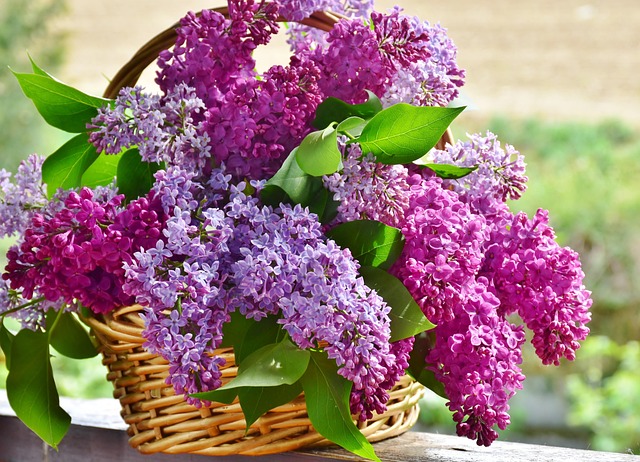
This is a special time of year in my part of Canada: the lilacs are speaking!

Lilac flowers don’t use words, of course. They announce their presence through their beautiful fragrance and delicate purple colour.

But there’s another way lilac shrubs can talk to us. Their very location can give us clues to the history of a place.

“…the story of early Canada can be read in the lilacs clustered where log cabins once stood, at the edge of abandoned fields—flowers marking time in centuries.” (from “A New Leaf,” by Merilyn Simonds)

Settlers to the northern parts of North America would often plant lilac shrubs on either side of the front door to their farmhouse. Generations or even centuries later, the building has long since been torn down, but the lilacs live on.

If you see a pair of huge lilac bushes in a field or empty lot, you can be pretty sure they used to flank someone’s front door. The house is gone, the family has moved away, but the fragrance of the lilacs they planted still fills the air.

This reminds me a bit of how prayers can live on, long after the person who prayed them is gone.

Read more

If This Isn’t Love…

The love of God for us is one of those topics that you could spend a lifetime exploring.

As believers, we often focus on the Crucifixion of Jesus to demonstrate God’s love.

And rightly so: Jesus’ sacrifice on the Cross to redeem us from our sins was the epitome of extravagant love.

“God showed his great love for us by sending Christ to die for us while we were still sinners.” (Romans 5:8)

But I wonder if we give short shrift to the Incarnation.

The fact that God took on human form and walked among us for 33 years shows an astonishing level of love.

When Jesus came to earth, our story became His story. He chose to go through the same pain we do, and carry the same burdens we do.

Read more

With God, You Get the Flower First!

Eastern Redbud Tree

Sometimes nature can be a bit unpredictable—things happen in an order we wouldn’t expect.

Normally, plants put forth leaves long before they produce flowers.

But some trees and shrubs flip the script, so to speak.

With certain plants, the normal sequence is reversed: the flowers come first, before the leaves have developed.

A good example is the beautiful redbud tree. It puts forth gorgeous pink flowers on its bare branches in early spring, when none of its leaves are yet in sight.

The forsythia shrub bears its bright yellow flowers in advance of its leaves, and the lovely magnolia presents its pink or white blooms before the green foliage appears. Some maples and oaks also exhibit this flower-first behaviour, although with less showy blossoms.

All of these plants give us a treat in springtime when we’re starved for colour. We get the flower first without having to wait for the leaves.

Why do some plants reverse the normal order of things?

Some trees are wind-pollinated, so put forth flowers before their bulky leaves get in the way. The same goes for flowers that need extra sunlight. Other plants produce a mass of conspicuous flowers first, unobscured by leaves, to better attract the attention of pollinating insects.

Did you know that God also flipped the script and gave us the flower first, so to speak?

Read more

A Cruciform Life

There are some things that can only be seen if you take a bird’s-eye view.

It’s only when you look down from a great height that you realize that the artificial island of Palm Jumeirah in Dubai is designed to resemble a palm tree.

You only really get a sense of why the Pentagon was given its name when you view this building from above and see its five-sided shape.

Someone at ground level in Nazca, Peru, might completely miss the fact that the lines etched into the desert sands at their feet actually form massive shapes of animals and plants. The full designs can only be seen from up high.

Similarly, it might not be obvious to you when entering certain churches that the outline of the building itself forms a cross when viewed from above.

Many European cathedrals feature a cross-shaped floor plan. The Church of the Nativity in Bethlehem is prime example of a cruciform building.

I like to think that when God looks down at these buildings from above, it pleases Him to see a cross reflected back at Him.

Here’s a question for you:

When God looks down from above at your life, does He see the Cross reflected in how you live? How “cruciform” is your life?

Read more

The Best Worst Day

There are some dates in history which stand out for being associated with awful events. Each year, when the calendar rolls around to these dates, we shudder in horror when we recall what happened.

Here are a few “worst days in history” that come to mind:

September 11th, 2001: the deadly World Trade Centre terrorist attacks in New York.

August 6, 1945: the dropping of a nuclear bomb on Hiroshima, Japan.

June 28, 1914: the day Archduke Ferdinand was assassinated, igniting the horrific First World War which killed tens of millions.

December 26, 2004: the Boxing Day tsunami which killed hundreds of thousands.

Some horrible dates in history have specific terms associated with them, such as:

December 7, 1941: the Japanese attack on Pearl Harbor, a date which President Roosevelt said would “live in infamy.”

October 29, 1929: called “Black Tuesday,” the worst day of a stock market crash which would send the world spiralling into the Great Depression.

What term is associated with the horrible day Jesus Christ was crucified?

“Good.” It’s called Good Friday.

But why?

Read more

Your Spiritual Resumé

If you had to write a resumé for God’s consideration, what would you list on it?

You’d probably assume that you should list all the good, noble, and praiseworthy things you’ve done.

Your perfect church attendance, your faithful donations to Christian charities, and your decades of volunteering at the soup kitchen would certainly top the list on your spiritual resumé.

You’d also want to throw in your kindness to others, your endless good deeds, and the fact that people consider you a saint.

It probably wouldn’t hurt to mention your lack of even so much as a parking ticket on your driving record.

All this would surely carry weight with God, wouldn’t it? Your impressive list of virtuous accomplishments would undoubtedly factor into in His decision as to whether He would accept you or not.

Or would it?

Read more

The Game is Rigged

In life, it’s easy to conclude that you’re getting the short end of the stick.

On social media, everyone seems to be having a better life than you are.

At the grocery store, each year you pay a bit more for the same item.

In the parking lot, the other guy inevitably gets the spot you were waiting for.

At the casino, the house always wins.

Even your bathroom scale seems to be part of the conspiracy against you: surely it’s rounding up?

But with God, this isn’t true. The game is rigged in your favour!

How so?

When we think of the scales of justice and mercy, we assume they’re evenly balanced. But God actually has his finger on the scale, so to speak. For those who believe in His Son, it’s tilted heavily toward mercy.

“The Lord isn't slow about keeping his promises, as some people think he is. In fact, God is patient, because he wants everyone to turn from sin and no one to be lost.” (2 Peter 3:9)

God longs to be merciful (Isaiah 30:18). But at the same time He must judge sin.

How does He reconcile these two seemingly contradictory impulses?

At the Cross.

Read more

Put On Some Heart-Shaped Glasses!

Image by StockSnap from Pixabay

When we’re going through tough times, it’s easy to get discouraged.

We all worry about our health, our families, our finances, and the future. Believers aren’t immune to these anxieties.

When life is spinning out of control, we often feel overwhelmed. We wonder where God is in our difficulties.

What we need is a different perspective.

I’m not suggesting we put on rose-coloured glasses, but rather heart-shaped ones.

The beating heart of God resounds with love for His children.

Read more

The Garden of the Heart

Image by Miroslav KaclĂ­k from Pixabay

As a special treat for my Faith Cafe visitors, here’s a fresh take on Psalm 23:

In the garden of the heart, where shadows fade,
I walk with the Beloved, who never leads astray.
He is the shepherd, gentle and wise,
His love, like a river, flows through the skies.
The pastures of grace are green and wide,
I rest in His presence, where peace will reside.
Still waters call, soft and serene,
In His embrace, I am cleansed, I am seen.
Though the valley of darkness may stretch its might,
I fear no shadow, for He is my light.
His staff and His rod, steady in hand,
Guide me with wisdom, through this shifting land.
Image by Kati from Pixabay
No hunger nor thirst shall find me here,
For the table He sets, overflows with cheer.
Anointing my soul with oil of bliss,
I drink from His cup, a cup of endless kiss.
In the house of the Beloved, I shall stay,
Where love is the lamp that lights my way.
From moment to moment, from breath to breath,
I walk in His grace, defying death.
In the arms of the Shepherd, I am whole,
For He leads me home, to the garden of soul.
Image by Susann Mielke from Pixabay

(In case you’re wondering who wrote this lovely poem, it was the result of my tooling around with ChatGPT!)

© 2025 Lori J. Cartmell. All rights reserved.

Note to Subscribers

Dear friends:

Just a note to let my cherished subscribers know that I’ll be posting on a less frequent schedule moving forward.

Other commitments mean that I have less time to devote to the Faith Cafe nowadays.

I’ll still be writing articles for this blog, but on a more occasional basis.

Thanks for your understanding, and thank you for tuning in over the past five years!

Love and blessings,

Lori

© 2025 Lori J. Cartmell. All rights reserved.