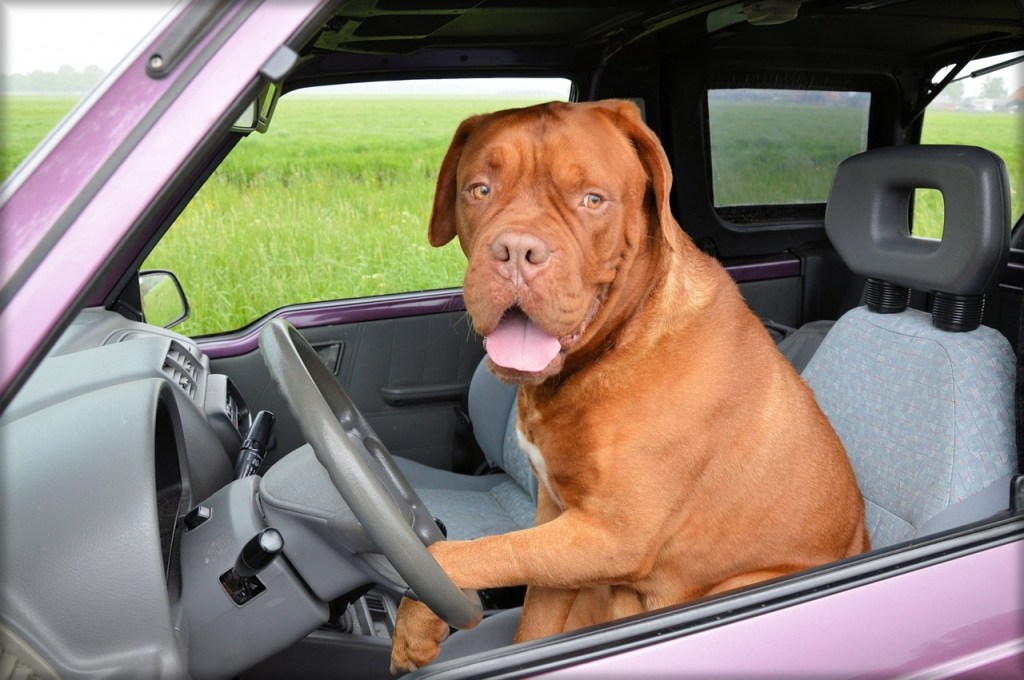
How’s My Driving?

Have you seen the bumper sticker “How’s My Driving?”

Commercial vehicles often have it on their back bumper, along with a phone number to report bad driving on the part of the company’s employees.

Many companies feel that the way their drivers behave on the road reflects their firm’s values.

They don’t want wild, inconsiderate, or negligent drivers operating a vehicle with the company’s logo splashed on the sides. It would send a negative message about how the company trains them.

Similarly, when we believers go about our daily lives, our behaviour reflects the One we belong to.

For better or worse, we reflect Christ.

Oftentimes, we don’t do a great job of this…

Read more

Cats and Dogs

Image by Chiriac Ciprian from Pixabay

When two people couldn’t be more different, we say they’re like night and day, or chalk and cheese.

Comparing people who are unalike to cats and dogs can also be apt. There are several notable differences between these species of our furry friends:

They say dog is man’s best friend. If so, then a cat is man’s strange, aloof roommate.

Owners train their dogs. Cats train their owners.

Dogs don’t mind it when you dress them in silly clothing. Cats give you murderous looks if you so much as attempt to put a hat on them.

Dogs look at their owners and think: “These people feed, shelter and love me: they must be gods!”

Cats look at their owners and think: “These people feed, shelter and love me: I must be a god!”

But perhaps cats and dogs have more in common than we might think.

They both come running when they hear the can opener. They both know who in the family has the most comfortable lap. And they both show their love by licking you and shedding their fur on you.

There are two people in the Bible, who, at first glance, couldn’t seem to be more different: Simeon and the thief on the cross. Both of their stories are found in the Book of Luke.

Read more

How to Win at Chess

Image by Jan Vašek from Pixabay

Let’s assume you’ve challenged the all-time, undefeated World Chess Champion to a game.

You were confident in your chess skills, and figured that you had a fair chance of winning. The challenge seemed like a good idea at the time.

As the game progresses, however, you realize you’re vastly outmatched. You severely overestimated your abilities. The champion is on course to trounce you easily.

Worse still, you’d made a rash and cocky wager. You bet everything you had that you’d win: your house, your car, all your possessions.

Now you have a horrible sinking feeling, certain that you’re about to lose everything you own.

But then the chess champion does something unexpected.

He comes over to your side of the table, picks up one of your pieces, and makes a move for you.

Then he goes back to his side of the table and makes his own move.

This pattern repeats several times. Eventually you realize what he’s doing: he’s making very shrewd moves on your behalf, employing a strategy you’d never have thought of.

It slowly dawns on you that he’s opening up a path to victory for you.

The chess champion is actually helping you win! He’s doing for you what you had no possibility of doing for yourself.

After he’s won the game for you, the champion gives you a hearty handshake and a wink. All you can do is humbly thank him with profound gratitude. If it weren’t for his gracious actions, you’d have lost everything.

What’s the spiritual lesson for us here?

To ultimately “win” at life, you need God to be on both sides of the equation.

Read more

The Nick of Time

Image by Jan Vašek from Pixabay

Do you know the feeling of relief you get when you get something important accomplished with barely a minute to spare?

Perhaps you realize at the eleventh hour that today is actually your wedding anniversary, and you haven’t yet bought a present for your spouse. But you race over to the store and manage to find the perfect gift just before they close. Crisis averted!

Or maybe you have to give a crucial presentation at work, but you’re stuck in traffic. So you take every shortcut you know and, lo and behold, you slide into the office as the clock strikes 9 AM. Your boss never knows how close you came to being late.

I imagine the thief on the cross knew this feeling.

When we speak of the “thief on the cross,” we’re referring to one of the two criminals between whom Jesus was crucified.

This is the one who said, “Jesus, remember me when you come into your kingdom” (Luke 23:42). Jesus assured him that that very day he would be with Him in Paradise.

Talk about being in the nick of time!

The thief was dying an excruciating death. He probably only had a few hours left to live. Yet even at that late hour, he professed faith in Jesus and was accepted.

His story is often given as an example of how it’s never too late to turn to God, and that’s certainly true.

But I wonder if there’s more we can glean from the account of the thief on the cross?

There’s a question that’s always niggled at me: how did he know that Jesus was indeed Lord?

Read more

You Dirty Dog!

Bad dog! Image from Picryl, Public Domain.

Imagine your living room is perfectly clean.

I mean perfectly. Your white couch is utterly spotless. Your white carpet looks pristine. There isn’t an iota of dust or dirt anywhere in the room.

And then your dog wants in.

Rover somehow found the only mud puddle in the dog park and spent a considerable amount of time rolling around in it.

He stands on the other side of the back door, wagging his tail and smiling, unable to figure out why you won’t let him in. After all, surely you love him, don’t you?

But you know that the second you let Rover in, he’ll shake his fur and send thousands of bits of mud all over your perfectly clean living room.

The solution?

Clean Rover off before he can enter the house. Hose him down, dry him off, and wipe his paws. Rover may not understand the necessity of all this, but it’s your living room and your rules.

Likewise, we sometimes can’t understand why God wouldn’t let us into Heaven just as we are.

Sure, we’ve committed a few sins, but we’re pretty decent people overall, aren’t we? Doesn’t God love us? What’s the necessity of a having a Saviour to atone for our sins?

Read more

Still Water Reflects Best

Lago di Limides, Italy
Photo by Julius Silver on Pixabay

We seem to have difficulty being still these days, don’t we?

For many of us, life happens at warp speed. We’re always on the go, and have little downtime to pause and reflect on things.

But with all our constant motion, are we missing out on something?

Recently, I visited a park with a pond large enough to almost be a small lake. A slight breeze left ripples on the water, disturbing the reflection of the trees in the distance. The image on the water’s surface was wavy and impressionistic, not a true representation of the landscape nearby.

I then walked to a different part of the park where a river flowed lazily into the pond. The water was running slowly, and because it was sheltered from the breeze in this area, it was very still. The trees here were perfectly reflected in the water, giving a mirror image of their true forms.

I guess that to get the best reflection in water, stillness is the key.

Perhaps the spiritual lesson here is that if our lives are too frantic, it’s hard for us to reflect Christ.

Read more

The Key to Stronger Faith

Chickadee Photo by Larry Doucet on Pixabay

A chickadee may have a bird-brain, but it can actually be pretty smart.

Especially if it lives in a harsh climate.

What does climate have to do with bird intelligence? As it turns out, more than you’d expect.

Biologists have discovered that chickadees living in the mountains or in northern latitudes, where the weather is more severe, were smarter than their peers living more comfortably down below.

Chickadees from harsher habitats had superior spatial memories and problem-solving abilities than those living in gentler climes. They were better at finding stored caches of food and at figuring out how to access a worm treat that scientists had cleverly tucked into a glass tube.

The harsh environment made their brains work a bit harder.

Is there a lesson for humans in the example of the chickadees?

Yes, but it isn’t to move to a more wintry climate (take it from a Canadian who’s done her share of shovelling snow—it hasn’t made me smarter!).

The takeaway here is that there can be unseen benefits to the challenges we face.

Read more

The Promise of Return

Photo of Monarch butterfly by Peter Miller on Flickr CC BY-NC-ND-2.0

One of the greatest natural events on Earth is now underway: the migration of the monarch butterfly.

Each fall, millions of these colourful insects set off from their summer breeding grounds in the northeastern U.S. and Canada for a gruelling journey. They travel thousands of miles across North America all the way to Mexico, where they’ll spend the winter.

Many people believe that the monarch butterflies that leave in the fall are the same ones that arrive back in the spring, but this isn’t so. Individual butterflies don’t make the entire round-trip journey. The ones that migrate from the northeastern part of North America in fall will never return.

Rather, their great-great-grandchildren are the ones who will arrive the following spring, as successive generations keep making their way north. The entire annual migration cycle of the monarch takes about four generations.

Perhaps I’m being fanciful, but I can imagine monarch butterflies telling their children of the awesome journey they’ll be undertaking. They may say that they’ll only be able to go part of the way with them, but to keep the faith and keep going.

Maybe they encourage their children to tell successive generations to keep believing in the promise of return. Because eventually, their descendants will see the promise fulfilled.

Aren’t we in a similar situation as believers?

We’re living in a time when we’re awaiting the fulfillment of a promise, the promise of Christ’s return. We’re not sure exactly when Christ will come back to Earth, but He has promised that He will.

Read more

What Geese Can Teach Us

Photo by David Mark on Pixabay

Usually, the first signs of fall are visual: the leaves on trees start to redden, the fall asters begin blooming, and the sun is at a noticeably lower angle.

But sometimes you can hear the onset of fall.

There’s a chill in the air hereabouts this week, and it won’t be long before we hear the sound of Canada geese honking at each other as they fly overhead, preparing to go south for the winter. They’ll fly to warmer climes in their iconic V-formation, honking the whole trip.

But why do they honk at one another as they undertake their momentous journey, and why fly in a V-shape at all?

The lessons geese can teach us have long been used in leadership seminars, but I think they apply to our Christian walk as well.

The V-shape that Canada geese fly in actually has aerodynamic benefits to the flock. As each goose flaps its wings, uplift is created for the bird following it. By flying in a V-formation, the flock can add over 70% more flying range than if each bird was flying on its own.

As Christians, we’re all “flying” in the same direction, pointing others to Christ. We have a common purpose, to bring others into the Kingdom, and a common destination, our heavenly home. We’re more effective when we work together in Christian community, because we give one another “uplift” and turbocharge one another’s efforts.

Read more

The God of Second Chances

Image by Irina from Pixabay

It’s an awesome feeling to realize that you’ve got a second chance, isn’t it?

A friend of mine discovered this after moving into a house with a large garden in the summer. A beginner gardener, she was delighted to finally have enough space for an extensive vegetable garden. She immediately planted some tomato and cucumber seedlings, which are now growing vigorously.

Because she’d moved in mid-summer, however, she lamented that she’d missed the chance to start growing vegetables like beets, spinach, peas, and carrots from seed in spring. She knew that cool-weather-loving veggies like peas wouldn’t thrive in the summer heat. She figured that if you didn’t plant those seeds in the spring, you’d missed your chance for the whole year.

But the garden, like God, often gives us second chances.

I told my friend that she could actually plant those seeds in summer for a fall harvest. There was still time to grow a second crop before the frosts of November hit. She hadn’t missed out after all: she could still grow the cool-weather veggies she’d hoped for.

What a wonderful metaphor for how God deals with us!

So often, we think we’ve missed out on what we’d wanted to accomplish or what God had planned for us. We figure that either the passage of time or our own mistakes have disqualified us from achieving our dreams. We lament that it’s too late for us.

But with God, it’s never too late. Our Heavenly Father never gives up on us, and never writes us off.

Read more