Lost In Translation

Sign on toilet door in Chengdu airport, China
Photo by Anne Roberts on Flickr, CC BY-NC-SA-2.0

There’s a real art to translation: zeroing in on just the right words to convey the nuance of what the original author intended.

Done well, a translated work can be a masterpiece in its own right.

Oftentimes, though, a translation can turn out to be a farce, as in the following examples:

A menu item in Chinese for a roasted gluten dish was translated into English as “Sixi Roasted Husband.” (The perfect dish for wives who’ve finally had enough of their mates?)

A hot and spicy chicken dish on another Chinese menu became “Chicken Rude and Unreasonable” in English. (No wonder the chicken met his end—he had it coming!)

Or this Google Translate zinger: “It’s been the goat in the budget, because His raining badly, so quite short, he is on the bucket month out.” (Not sure what this meant in the original Danish, but I hope the goat was able to figure it out.)

Then there’s the sign for a hair salon in China whose English name is “Could Not Connect To Translator Service.” (A bit of a give-away that they didn’t bother hiring a real live translator?)

Sometimes, we have a different understanding or “translation” of what God actually meant in certain Bible verses.

For example, in times of difficulty, we cling to verses such as Romans 8:28:

“And we know that all things work together for good to those who love God, to those who are the called according to his purpose.”

However, it can often be hard to see what good could possibly come from our difficult situations. We might be going through health challenges, injustice, hardship or loneliness. Where is the good in any of that?

But maybe we have a limited understanding of what “good” means. Perhaps we and God have different “translations” of what this looks like in our lives.

Read more

The Commander of the Universe Has Your Back

Canadian Army reservists train at Fort Pickett.
Photo from Virginia Guard Public Affairs.

Do you ever wish you had your own personal army?

It would come in handy, wouldn’t it, when your boss chews you out, or when someone cuts you off in traffic. Just summon your cavalry, and your tormentors would soon change their tune.

The Bible doesn’t promise us our own armed forces, but it does say that we can call on the name of the Commander of all the forces in the universe:

The Lord of Hosts.

This compound name for God is found over 270 times in Scripture. The Hebrew word for “hosts,” Sabaoth, can refer to human armies, angelic armies, or celestial bodies such as the sun, moon and stars. It’s a military term: God as Commander of all creation.

We see this name for God appear when David confronts Goliath. David says,

“You come to me with a sword and with a spear and with a javelin, but I come to you in the name of the LORD of Hosts, the God of the armies of Israel, whom you have defied.” (1 Samuel 17:45)

Goliath must have wondered what David was talking about. The only army he could see, the Israelite army under King Saul, had been quaking in their boots for 40 days at the thought of confronting him in battle. And now here’s this kid with a slingshot talking about armies in the plural. Faced with David’s “threat,” Goliath might have thought, “Oh, yeah, you and whose army?” Famous last words, indeed!

Elisha and his servant were given the privilege of seeing God’s Heavenly armies. When they were surrounded by the Aramean army, Elisha prayed that his servant’s spiritual eyes would be opened. They were able to see the fiery multitudes of the Lord’s armies protecting them, the horses and chariots of fire. It was actually the Arameans who were surrounded! (2 Kings 6:17).

The title “Lord of Hosts” includes control over military forces, but it is also employed in Scripture to describe God’s power over every aspect of life…

Read more

When the Underdog Becomes Top Dog

Image by Neel Shakilov from Pixabay

Don’t you love it when an underdog turns the tables?

We’ve all cheered at movies in which the little guy triumphs over impossible odds and wins the day.

Part of what makes these stories attractive is the confidence the underdog displays in the face of adverse circumstances. He or she often thinks that it’s the other guy who’s at a disadvantage.

I’m reminded of a classic headline from a British newspaper, possibly from the early 1930s (and possibly apocryphal). The English Channel was blanketed with thick fog, making ship travel dangerous. The witty headline read:

“Fog in Channel: Continent Isolated.”

What makes this funny is that surely it was the island of Great Britain that was isolated by the dense fog, not Continental Europe!

You’ve got to admire this type of self-assurance.

I think this the type of attitude God wants us to display, but to focus it on faith and trust in Him. He wants us to believe that with Him on our side, the one who comes against is the one who’s isolated and on the ropes.

Consider the story of David and Goliath in the Bible…

Read more

Your Training Won’t Make Sense at First

Image by Bart via Flickr. CC-BY-NC 2.0

“Why do we have to learn math? We’ll never use it in real life!”

Did you ever say something like that to your teachers in school?

It’s true that you may never have used algebra once you graduated from high school. Your knowledge of trigonometry or calculus may have lain dormant since then, too.

But that wasn’t actually the point of algebra, or any other subject.

The point of learning math was to train your brain.

Mastering mathematical concepts increases your problem-solving skills, develops flexible thinking and creativity, and encourages analytical reasoning.

These are things that are extremely valuable in every area of life.

But you might not have been able to see that when you were trying to understand the Pythagorean theorem in school.

That’s because your training often won’t make sense until much later.

Several heroes in the Bible found this out:

Read more

God Can Use Anything And Anyone

Image by Terri Cnudde from Pixabay

Now that spring has arrived, the birds are starting to build their nests.

It’s delightful to watch them collect items to fashion into a new home.

They’ll mostly gather twigs and leaves as their construction materials. They might also add moss, plant fluff, dried grass, or feathers to make the nest soft for their chicks.

But sometimes birds use unexpected things when constructing a home.

They’ve been known to use mud, pet fur, discarded snake skins, and spider silk for their nests. They’ll even use man-made items, such as plastic, tinsel, dryer lint, or even purloined underwear from a clothesline!

Birds don’t seem to count anything out: they’ll use the most unlikely things to achieve their goal.

And so does God.

God also uses unexpected things and unlikely people to fulfill His purposes. The Bible is chock-full of examples of this:

Read more

Lost In Translation

Sign on toilet door in Chengdu airport, China
Photo by Anne Roberts on Flickr, CC BY-NC-SA-2.0

There’s a real art to translation: zeroing in on just the right words to convey the nuance of what the original author intended.

Done well, a translated work can be a masterpiece in its own right.

Oftentimes, though, a translation can turn out to be a farce, as in the following examples:

A menu item in Chinese for a roasted gluten dish was translated into English as “Sixi Roasted Husband.” (The perfect dish for wives who’ve finally had enough of their mates?)

A hot and spicy chicken dish on another Chinese menu became “Chicken Rude and Unreasonable” in English. (No wonder the chicken met his end—he had it coming!)

Or this Google Translate zinger: “It’s been the goat in the budget, because His raining badly, so quite short, he is on the bucket month out.” (Not sure what this meant in the original Danish, but I hope the goat was able to figure it out.)

Then there’s the sign for a hair salon in China whose English name is “Could Not Connect To Translator Service.” (A bit of a give-away that they didn’t bother hiring a real live translator?)

Sometimes, we have a different understanding or “translation” of what God actually meant in certain Bible verses.

Read more

Let Off Some Steam

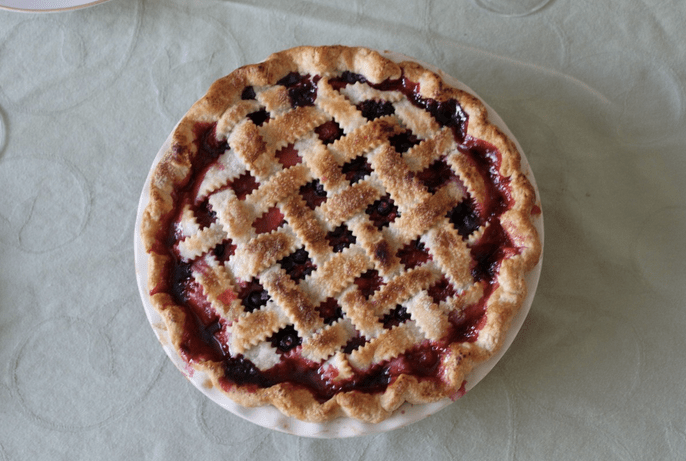
Latticework Pie Crust. Photo from Pxhere, Public Domain

In baking, as in life, it’s important to let off some steam every so often.

When you’re baking a pie, the recipe will usually instruct you to make some slashes or holes in the top crust before putting the pie in the oven. This isn’t just to make a pretty design, although some people do get very creative and make decorative cut-outs of hearts or dots, or even create a latticework effect in the crust.

The real purpose of these openings is to let the steam escape. If there’s no outlet for the steam building up under the crust, the filling will burst through and spill out. Your pie will end up looking like an unsightly mess.

Sometimes we need to let off a bit of steam, too. We get frustrated or angry at the circumstances in our lives, and need to “vent” our feelings.

David certainly did his share of venting in the Psalms. He let loose with some very raw emotions, crying out to God to intervene in his situation.

Surprisingly, God seemed okay with David’s outbursts. In fact, David was the only person in Scripture whom God called “a man after my own heart” (Acts 13:22).

I believe David’s example can give us a key to how to vent appropriately without letting our emotions explode all over, making a mess of our lives and leaving us bitter.

Read more