You Can’t Go Wrong With These Ingredients!

When you’re trying out a new recipe for the first time, do you ever get apprehensive that it won’t work out?

I certainly do. That’s why I usually stick with one of my mother’s tried-and-true dessert recipes.

I worry that if I bake a dessert I’ve never attempted before, I’m bound to mess it up. I fear that I’ll disappoint the people I serve it to, and tongues will wag.

As I walk by, people will whisper, “There’s that woman who serves fallen soufflés!”

Or, “Isn’t she the one who bakes cookies that are as hard as hockey pucks?”

In the worst-case scenario of my imagination, my baking debacle will be so embarrassing that I’d have to leave town.

With some recipes, however, you really can’t go wrong, even if you’ve never tried them before.

Brownies, for instance.

A while ago I tried a brownie recipe (see recipe below) that was different from my mother’s traditional one. I was a little nervous about how it would turn out, as I’d be serving it to friends and wanted to impress them.

I needn’t have worried.

How far wrong can you go when you throw together things like chocolate, butter and sugar? As long as you don’t burn it to a crisp, it’s going to be yummy.

You’ve got the right ingredients. Bake away!

Read more
Don’t Spoil Your Spiritual Appetite!

When you were young, did your parents ever admonish you not to eat sweets too close to dinner time because it would “spoil your appetite”?

Mine certainly did. However, delaying dessert until after dinner is difficult to do.

The look of a beautifully frosted cake or the smell of freshly baked cookies can be notoriously tempting. And of course, one cookie or piece of cake invariably leads to another…

Before you know it, you’ve stuffed yourself with sugary foods and are too full to eat dinner. You miss out on all the good protein and vegetables in the main meal.

I guess Mom and Dad knew best: we should fill ourselves with more nourishing things first, and leave the dessert until afterward as a treat, not the main course.

The same lesson holds for us spiritually, doesn’t it?

We should concentrate on things of substance in our lives first.

So often we fill our lives with things we think will make us happy: entertainment, money, accomplishments, or possessions. But these things are temporary, and will eventually disappoint us. They’re not really satisfying in a lasting way.

Read more

The Wrong Idea of Dessert

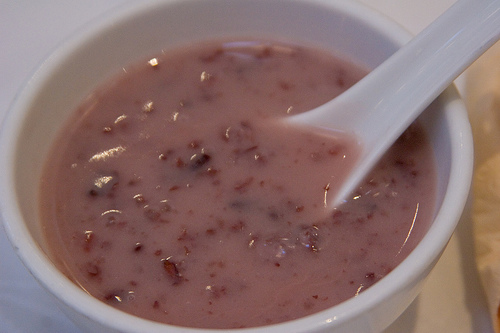
Image of sweet red bean soup by Roland from Flickr, CC BY 2.0

Do you like brownies? How about chocolate cake?

If you do, then you and I are on the same page when it comes to sweets. We both have the same idea of what a perfect dessert is.

Not everyone might agree with us, however.

Take my friend John, whose background is Greek. He likes syrupy-sweet desserts like the Greek classic baklava, or nut-based ones like walnut cake, things I love as well.

John happens to be married to an Asian woman. They agree on most things, except when it comes to dessert.

Case in point: John’s in-laws once treated him to dinner at a Chinese restaurant. They promised him an extra-special dessert to finish off the banquet, something he’d absolutely love.

John couldn’t wait: his mouth was watering in anticipation of this mystery dessert. He imagined something intensely sweet to finish off the meal, perhaps a cake with multiple layers and lots of icing.

But when the dessert was placed in front of him, John was confused.

It was red bean soup.

While this dish is popular among Chinese people and is considered the crown jewel to end a banquet with, it wasn’t John’s idea of dessert. He was gracious in front of his in-laws, but secretly felt cheated.

The problem? John’s definition of dessert was different to that of his in-laws. His expectations were askew, so he was disappointed with what he got.

I think the same thing happens to us when read certain Bible verses—we may build up incorrect expectations based on our ingrained ideas.

Read more

Turning the Bitter Sweet

Image by Steve Buissinne from Pixabay

“Go suck a lemon!”

Have you ever heard anyone say that?

It means they’re annoyed with you and want you to experience something unpleasant. Lemon juice is so sour that it makes your mouth pucker.

But if lemon juice is so bitter, why are lemon desserts so yummy?

It’s thanks to the addition of a sweetener.

I like lemon-based desserts much better than orange-flavoured ones. It seems to me that the combination of sour and sweet is what makes lemon desserts so satisfying (see below for Lemon Poppyseed Cake recipe).

They say when life hands you lemons, make lemonade.

No, when life hands you lemons, turn it over to God.

He can transform your unwelcome experiences into something good, and make the bitter waters of your life sweeter than any lemonade.

Read more

All You Can Eat

Image by Chris from Pixabay

When it comes to yummy treats, children often don’t want to share.

When my father was a little boy, he and his brother would almost come to blows when it was time for dessert. There would be loud protests if one brother thought he was getting a smaller slice of pie.

So my grandparents came up with a rule: one brother would cut the pieces, and the other would get to choose his portion first.

The idea behind this arrangement was that if the pieces had been cut unequally by the first brother, the other would take advantage of this and choose the larger slice. So the boy cutting the pieces would want to make sure that they were as close in size as possible.

My dad or his brother would actually use a protractor to cut the pie to ensure that each slice was exactly the same angle. Each was determined not to let his brother get a larger piece!

This is a humorous story, but the attitude it portrays can linger in our thoughts as we become adults.

It can even affect how we view God’s beneficence.

We’re somehow afraid that when God divvies things up, there won’t be enough for us. We think that if God gives someone else certain blessings or gifts, it will mean less is available for us.

But God’s economy doesn’t work this way—it’s not a zero sum game.

Read more

Label Jars, Not People

By Frank Vincentz, Wikimedia Commons, CC BY-SA 3.0

What’s the difference between a tart and a torte?

For that matter, what’s the difference between torte-with-an-e and tort-without-an-e? Are they all edible?

Let’s see if we can straighten out the confusion.

A tart is an open pastry containing a filling. A torte is a multi-layered cake-like confection. They’re both edible (and extremely tasty—see recipe for Lemon Almond Tart below).

Tort is a legal term referring to a wrongful act or infringement of a right. You could try to eat the paper a tort was described on, but I wouldn’t recommend it!

But we’re not quite finished unpacking the meanings of these similar-sounding words.

A tart can also refer to a promiscuous woman: one who has had many sexual partners. A woman others would look down on. A woman polite society might consider to be “loose.”

But we should be careful before we slap anyone with a label such as this. We never know how God might use them.

Read more

The Best Fire Protection

Baked Alaska dessert set alight. Image by Vxla on Flickr. CC BY-2.0

Baked Alaska is one of those desserts that seems like it will end in disaster.

This dessert involves covering a core of ice cream and cake with meringue and baking it at 450-500 degrees Fahrenheit. Really.

Who puts ice cream in a hot oven anyway?

Surely it will result in a melted mess, and you’ll be spending the next hour resentfully scrubbing out your oven.

But Baked Alaska will surprise and amaze you.

When you take this dessert out of the oven after a few minutes, you find that the meringue has cooked and slightly browned, but the ice cream underneath it is still cold and has retained its firm shape. The ice cream inside the “igloo” has remained untouched by the intense heat.

It seems miraculous, because you’d think that ice cream would melt when it came anywhere near temperatures that high. It’s not actually a miracle, however, but rather a clever application of physics. The dessert was invented in the 1800s by American physicist Benjamin Thompson, who was investigating the insulating properties of whipped egg whites.

If you want a genuine example of miraculous protection from a hot oven, you need to go the book of Daniel in the Old Testament.

Read more