The Best Worst Day

There are some dates in history which stand out for being associated with awful events. Each year, when the calendar rolls around to these dates, we shudder in horror when we recall what happened.

Here are a few “worst days in history” that come to mind:

September 11th, 2001: the deadly World Trade Centre terrorist attacks in New York.

August 6, 1945: the dropping of a nuclear bomb on Hiroshima, Japan.

June 28, 1914: the day Archduke Ferdinand was assassinated, igniting the horrific First World War which killed tens of millions.

December 26, 2004: the Boxing Day tsunami which killed hundreds of thousands.

Some horrible dates in history have specific terms associated with them, such as:

December 7, 1941: the Japanese attack on Pearl Harbor, a date which President Roosevelt said would “live in infamy.”

October 29, 1929: called “Black Tuesday,” the worst day of a stock market crash which would send the world spiralling into the Great Depression.

What term is associated with the horrible day Jesus Christ was crucified?

“Good.” It’s called Good Friday.

But why?

Read more

The Game is Rigged

In life, it’s easy to conclude that you’re getting the short end of the stick.

On social media, everyone seems to be having a better life than you are.

At the grocery store, each year you pay a bit more for the same item.

In the parking lot, the other guy inevitably gets the spot you were waiting for.

At the casino, the house always wins.

Even your bathroom scale seems to be part of the conspiracy against you: surely it’s rounding up?

But with God, this isn’t true. The game is rigged in your favour!

How so?

When we think of the scales of justice and mercy, we assume they’re evenly balanced. But God actually has his finger on the scale, so to speak. For those who believe in His Son, it’s tilted heavily toward mercy.

“The Lord isn't slow about keeping his promises, as some people think he is. In fact, God is patient, because he wants everyone to turn from sin and no one to be lost.” (2 Peter 3:9)

God longs to be merciful (Isaiah 30:18). But at the same time He must judge sin.

How does He reconcile these two seemingly contradictory impulses?

At the Cross.

Read more

How to Win at Chess

Image by Jan Vašek from Pixabay

Let’s assume you’ve challenged the all-time, undefeated World Chess Champion to a game.

You were confident in your chess skills, and figured that you had a fair chance of winning. The challenge seemed like a good idea at the time.

As the game progresses, however, you realize you’re vastly outmatched. You severely overestimated your abilities. The champion is on course to trounce you easily.

Worse still, you’d made a rash and cocky wager. You bet everything you had that you’d win: your house, your car, all your possessions.

Now you have a horrible sinking feeling, certain that you’re about to lose everything you own.

But then the chess champion does something unexpected.

He comes over to your side of the table, picks up one of your pieces, and makes a move for you.

Then he goes back to his side of the table and makes his own move.

This pattern repeats several times. Eventually you realize what he’s doing: he’s making very shrewd moves on your behalf, employing a strategy you’d never have thought of.

It slowly dawns on you that he’s opening up a path to victory for you.

The chess champion is actually helping you win! He’s doing for you what you had no possibility of doing for yourself.

After he’s won the game for you, the champion gives you a hearty handshake and a wink. All you can do is humbly thank him with profound gratitude. If it weren’t for his gracious actions, you’d have lost everything.

What’s the spiritual lesson for us here?

To ultimately “win” at life, you need God to be on both sides of the equation.

Read more

Jesus Has an Open Door Policy

Image by Lori from Pixabay

When building a birdhouse for your feathered friends, the size of the “front door” is crucial.

You must create the right-sized entrance hole or the “wrong” bird will take up residence.

For instance, a wren or chickadee prefers an entrance hole to be about 1.125 inches across. A bluebird likes a slightly bigger doorway, about 1.5 inches in diameter.

A finch needs an opening 2 inches across, thank you very much, and purple martins prefer a bit more wiggle room than that to squeeze through the front door.

And if you don’t surround the hole with protective metal mesh, the squirrels will chew the hole bigger and move in themselves. Then you’ll discover you’re the proud owner of a squirrel house (I learned this the hard way).

All of this got me thinking about the story of Noah’s Ark in the Bible…

Read more

Fooled You, Satan!

Image by Marco Verch on Flickr

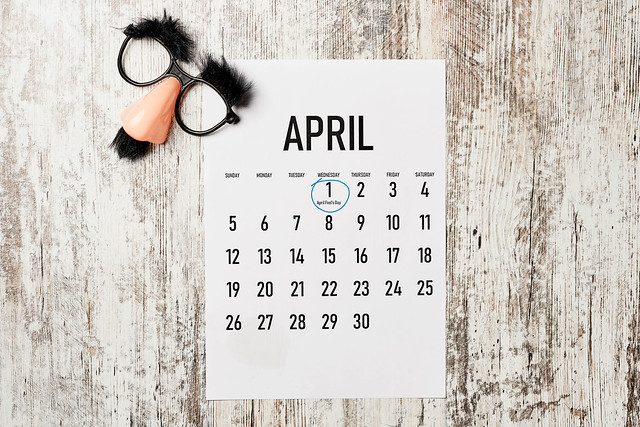
What is the best April Fool’s prank in history?

Many believe that a BBC TV hoax from over 60 years ago takes the cake.

In 1957 the news show Panorama reported that, thanks to a mild winter in Switzerland, the dreaded spaghetti weevil had been eradicated. As a result, Swiss farmers had enjoyed a bumper crop of spaghetti. The programme showed farmers carefully plucking strands of spaghetti from trees.

Scores of viewers fell for the prank, calling the BBC and asking how they could grow a spaghetti tree themselves. They were advised to “place a spring of spaghetti in a tin of tomato sauce and hope for the best.”

There must be something in the water at the BBC, because in 1980 their pranksters were at it again. On April Fool’s Day they announced that Big Ben, London’s iconic clock tower, would become digital and henceforth be known as Digital Dave. This “news” produced a flood of irate calls to the station.

Other European countries are no slouches at April Fool’s pranks either.

In 1969 the Netherlands’ public broadcaster announced that government inspectors would be roving the streets armed with remote scanners, detecting people who had not paid their TV/radio tax. It was suggested that the only way to stymie the scanners was to wrap the TV or radio in aluminum foil. The next day, all the supermarkets were sold out of foil, and suddenly a flood of TV/radio taxes were being paid.

These probably rate as some of the best wide-scale practical jokes ever.

But with Easter Monday falling on April Fool’s Day this year, it got me thinking of an ever greater example of someone being outwitted.

Read more

The Slippery Slope

Image by Hermann Kollinger from Pixabay

As in many northern climes, a favourite pastime of Canadian children in winter is tobogganing.

I did my share of barrelling down snowy slopes on a sled when I was a kid.

Even though we lived in a big city, we had nature nearby. A ravine adjoined our neighbourhood, featuring steep hills bordering a river valley.

These hills were perfect for tobogganing.

The trick was to follow the paths through the snow that others had already made. Trying to forge a path through newly fallen snow yourself was hard going, but if you positioned your sled on ready-made routes, you could really pick up some speed.

The highest hill in the ravine was nicknamed “The Killer” by the kids. When the snow was tamped down by dozens of tobogganing runs it became icy, and you’d find yourself going faster than you expected.

You could build up so much momentum sliding down this hill that you could end up plunging into the freezing cold river.

It was a slippery slope, quite literally.

And dangerous.

Sometimes in life we find ourselves on slippery slopes, don’t we?

If we’re not careful, we might blindly follow the path of others into sin. It might seem fun at first, and we might not notice that we’re accelerating.

Eventually, though, we may lose control and not be able to stop in time. We can unexpectedly end up in dangerous places.

Make no mistake, sin is a killer.

It kills relationships, reputations, trust, and future options.

Most importantly, it kills our connection with God.

Read more

The Most Memorable Gift Of All

Image by Marco Verch on Flickr CC BY-2.0

What’s the most memorable gift you’ve ever received?

Whatever it was, it probably wasn’t something bought for you in a panic at the last minute.

More likely, the gift you remember most involved time or trouble on the part of the giver.

Perhaps your child presented you with something that they’d painstakingly fashioned themselves.

Or maybe your spouse had a piece of jewellery custom made for you that they’d had a hand in designing.

Or a friend spent months searching high and low for a hard-to-find collector’s item that you’d always wanted, and finally tracked one down.

The present was especially meaningful for you because the time and trouble the giver went to were part of the gift.

Did you know that Jesus has given you a gift? And it isn’t something He picked up at the mall on Christmas Eve.

He offers you the gift of eternal life.

Read more

The Best Swap Of All

World’s Largest Paperclip, Bell Park, Kipling, Saskatchewan, Canada.
Photo by purecanucks on Flickr. CC BY-2.0

Did you hear about the guy who traded a paperclip for a house?

It’s a little more involved than that, but it really happened.

Over the course of a year starting in 2005, Canadian Kyle MacDonald made a series of 14 online trades, bartering small items for successively larger and more valuable ones.

He started with a red paperclip, which he traded for a pen. He swapped the pen for a doorknob, which he then bartered for a Coleman stove.

The stove was flipped for a generator, which was exchanged for an instant party, which he soon traded for a snowmobile.

Kyle’s next transactions involved a trip, a truck, a recording contract, and a year’s rent in Phoenix. They eventually culminated in a film role, which was traded for a two-storey farmhouse in Kipling, Saskatchewan.

A large sculpture of a red paperclip now stands in the small Canadian town where his trades ended, commemorating his achievement.

Pretty impressive, I must say!

But I can think of an even more astonishing swap.

It took only one transaction and involved the most valuable thing of all…

Read more

The Best Worst Day

1895 lithograph of Edvard Munch’s “The Scream”
Photo by Steven Zucker on Flickr CC BY-NC-SA-2.0

There are some dates in history which stand out for being associated with awful events. Each year, when the calendar rolls around to these dates, we shudder in horror when we recall what happened.

Here are a few “worst days in history” that come to mind:

September 11th, 2001: the deadly World Trade Centre terrorist attacks in New York.

August 6, 1945: the dropping of a nuclear bomb on Hiroshima, Japan.

June 28, 1914: the day Archduke Ferdinand was assassinated, igniting the horrific First World War which killed tens of millions.

December 26, 2004: the Boxing Day tsunami which killed hundreds of thousands.

Some horrible dates in history have specific terms associated with them, such as:

December 7, 1941: the Japanese attack on Pearl Harbor, a date which President Roosevelt said would “live in infamy.”

October 29, 1929: called “Black Tuesday,” the worst day of a stock market crash which would send the world spiralling into the Great Depression.

What term is associated with the horrible day Jesus Christ was crucified?

Good. It’s called Good Friday.

But why?

Read more

We Still Have So Much

A little boy chasing bubbles: almost as cute as my neighbour’s son!
Photo by Beat Kung on Flickr. CC BY-NC 2.0

The news these days is pretty depressing, isn’t it?

Each day brings reports of the latest closures due to the coronavirus threat. We’re seeing schools shut down, stores and workplaces shuttered, and restrictions on travel and gathering in groups. More and more aspects of our normal lives are being taken away from us.

Feeling discouraged after watching the news on TV yesterday, I went into the kitchen to make dinner. Out of the corner of my eye, I suddenly saw something shiny pass by the window. First one shimmery orb, then dozens whizzed by. I peered out to discover what on earth they were.

What I saw quickly dispelled my negative thoughts:

Bubbles.

Read more