With God, You Get the Flower First!

Eastern Redbud Tree

Sometimes nature can be a bit unpredictable—things happen in an order we wouldn’t expect.

Normally, plants put forth leaves long before they produce flowers.

But some trees and shrubs flip the script, so to speak.

With certain plants, the normal sequence is reversed: the flowers come first, before the leaves have developed.

A good example is the beautiful redbud tree. It puts forth gorgeous pink flowers on its bare branches in early spring, when none of its leaves are yet in sight.

The forsythia shrub bears its bright yellow flowers in advance of its leaves, and the lovely magnolia presents its pink or white blooms before the green foliage appears. Some maples and oaks also exhibit this flower-first behaviour, although with less showy blossoms.

All of these plants give us a treat in springtime when we’re starved for colour. We get the flower first without having to wait for the leaves.

Why do some plants reverse the normal order of things?

Some trees are wind-pollinated, so put forth flowers before their bulky leaves get in the way. The same goes for flowers that need extra sunlight. Other plants produce a mass of conspicuous flowers first, unobscured by leaves, to better attract the attention of pollinating insects.

Did you know that God also flipped the script and gave us the flower first, so to speak?

Read more

The Language of Flowers and the Language of God

Say it with flowers!
Wikimedia Commons, CC BY-SA-2.0

Flowers speak. Not just through their fragrance or their beauty, but with secret codes, too.

Perhaps you’ve heard of the “language of flowers” that was popular during Victorian times?

This enchanting symbolic language enabled suitors to send coded messages to their paramours, ones that couldn’t be spoken aloud. The message depended on the particular flowers and colours chosen for the bouquet. An entire conversation could be carried out solely through flowers, with no words employed at all.

We all know that red roses symbolize true love, and we’d rightly guess that the forget-me-not begs that the giver be remembered. But did you know the following flower meanings?

Red carnation: My heart aches for you
Hyacinth: Your loveliness charms me
Canterbury bell: Your letter received
Yellow rose: Jealousy
Butterfly weed: Let me go
Weeping willow: Sadness

The Victorian language of flowers is a cryptic tongue. Most people only see the surface of the flower and not the symbolic meaning hidden within it.

God has His own “language of flowers,” but it actually encompasses all of creation. God is continually speaking to us through nature:

“For ever since the world was created, people have seen the earth and sky. Through everything God made, they can clearly see his invisible qualities—his eternal power and divine nature. So they have no excuse for not knowing God.” (Romans 1:20)
“The heavens proclaim the glory of God. The skies display his craftsmanship.” (Psalm 19:1)

If we listened in to what nature was saying about its Creator, what messages would be revealed?

Read more

Consider the Lilies

Photo of Tiger Liliy from Pxfuel

Do you spend a lot of time in the morning fretting about what to wear?

You’re not alone. Many of us worry about our clothes. We’re afraid that they aren’t stylish enough, or that they make us look fat, or that they’re last year’s (or even last millennium’s) fashions.

Some of us even worry that we won’t have enough money to buy the basic clothes we need.

But we shouldn’t be anxious that God won’t provide for us. After all, look how He’s clothed the flowers.

Have you ever marvelled at the rich “vestments” some flowers are clad in?

Look at the iris attired in silky frills, the peony robed in ruffles, or the delicate tracery of Queen Anne’s lace. The sumptuous, constantly unfurling petals of the rose boast the finest tailoring. Some flowers are decked out in speckles, mimicking the polka-dots on a dress; others are costumed in stripes, like a crocus. Even the common petunia can have petals that resemble luxurious velvet.

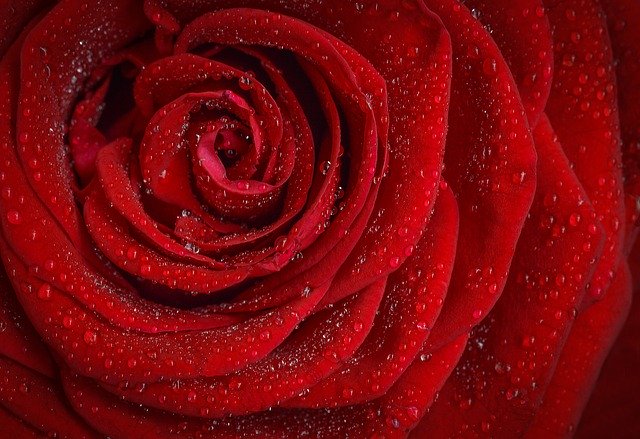
Red Rose photo by AliceKeyStudio on Pixabay

God hasn’t stinted on giving flowers rich colours, either. What about the intense blue of lobelia, suitable for any royal robe? Or the bright yellows of daffodils, the vivid oranges of marigolds, or the saturated reds of poppies? On the paler end of the spectrum are the shy blues of the forget-me-nots and the delicate ballet-pinks of some tulips.

Some flowers even have names which relate to clothing: bachelor’s buttons, lady’s slipper, Texas bluebonnet, foxglove, lady’s mantle, and monk’s hood.

And how about those lilies? In fact, I seem to remember a Bible verse which talks about the beautiful garments lilies wear:

“So why do you worry about clothing? Consider the lilies of the field, how they grow: they neither toil nor spin, yet I say to you that even Solomon in all his glory was not arrayed like one of these.” (Matthew 6:28-29 NKJV)
Read more

What’s in a Name?

Photo by Jill Wellington on Pixabay

As a gardener, I must admit that I prefer using the common or folk names for flowers.

These sometimes ancient names are often whimsical and enchanting. Who wouldn’t love calling flowers by such names as cherry pie plant, lady’s slipper, love-in-a-mist, baby blue eyes, bachelor’s button, quaker ladies, whirling butterflies, johnny-jump-up, busy lizzie, or candytuft? It makes the heart sing to use endearing names like these.

The scientific or botanical names for flowers, on the other hand, can seem daunting. They’re usually derived from Latin, and while they can give a more accurate description of what a plant’s nature is, they can sound a bit intimidating to my ears.

In fact, some botanical names actually sound like a disease:

“Don’t tell anyone, but I’ve got Scabiosa again.”

“That’s nothing! You should see my sister’s Myosotis: it’s rampant.”

“You don’t say! But did you hear about Kelly? She’s got Nepeta nervosa.”

“No! Is she seeing a psychiatrist for that?”

(In case you’re wondering, Scabiosa is the botanical name for the pincushion flower; you might know Myosotis better as the little blue forget-me-not; and Nepeta nervosa is a type of catmint.)

I’m so glad that we have the opportunity to use informal names for the flowers we cherish.

In the same way, believers have been given the great privilege of using a remarkably intimate name for God: “Abba Father.”

Read more

When Nature Sings, Sing Along!

Image of crocuses by Annette Meyer from Pixabay

No matter where you live, spring is a time of joy.

In my part of the world, shy white snowdrops are the first flowers to bloom in spring.

Crocuses, slightly bolder in colour with their yellows or purples, are the next to make an appearance.

The tulips take their time, first poking the tips of their leaves above the ground like a periscope, as if checking to see whether it’s safe to emerge. They then burst forth in bright, vivid colours, their blooms held aloft on tall stems like upright trumpets.

“The flowers are springing up, the season of singing birds has come, and the cooing of turtledoves fills the air.” (Song of Solomon 2:12)

After a long, colourless winter, it makes my heart sing to see the arrival of spring.

But do the flowers and trees themselves sing? And if they do, what is their song telling us?

Author Linda Brooks, in her 2018 book, “Orchestra In My Garden,” seems to share my sentiments about the spring season:

”Once the snow disappears and my garden starts to emerge from its slumber, I cannot jump up fast enough to catch the first light, to lose (and find) myself among kindred spirits and bend my ear to their voices. No, I am not deluded. I do understand that plants are not human and cannot speak, but no one can convince me that they do not sing.”

She’s right: plants do sing. But she’s perhaps missed who they’re singing to.

They sing to God.

Read more

What Is Your “Burning Bush”?

Image by Leonora Enking via Flickr CC BY-SA 2.0

You’ve got to love a plant that turns pink in the autumn.

I’m referring to the Euonymus alatus shrub, whose leaves change from green to a vivid, hot pink in the fall.

One of its nicknames is “burning bush,” because in autumn the shrub looks like it’s on fire. It must have reminded people of the burning bush Moses encountered in Exodus 3, through which God spoke to him.

I think God uses many different ways to speak to us today, each a “burning bush” tailored to our unique personalities.

Probably the primary way that God communicates to us is through Scripture. We read or hear a verse that seems to speak directly into our situation. By reading the words of Jesus, we “hear” God’s heart. We may also receive a word from the Holy Spirit or sense God’s guidance through prayer.

There are many instances in the Bible of God giving someone a message through dreams or visions. He may relay information in a dramatic fashion via an audible voice, or the more subtle “still, small voice.”

Other times God may use another person to convey something to you: a Christian speaker or author, or a family member or friend who’s a believer. God may also speak to you through the lyrics of a song or hymn.

He might be sending a message to you through your circumstances, especially via some difficult situation. Or, you may encounter a coincidence that seems like a “sign,” and you think God may be trying to tell you something.

With me, I feel that God occasionally “speaks” to me through nature.

Read more

The Beauty of Redeemed Brokenness

Image of parrot tulip by Coanri/Rita via Flickr CC BY-NC-ND-2.0

What’s your favourite flower?

Even though I certainly love roses, the tulip holds a special place in my heart. It’s not as showy or fragrant as a rose, but it brings such joy in spring after a long winter.

Among the many types of tulips, I especially like the variegated ones (with multicoloured petals).

But did you know that the dramatic colour combinations of variegated tulips are caused by a virus?

Gardeners had long noticed that tulip petals occasionally “broke” into unusual patterns. But it wasn’t until the late 1500s that botanists realized that the beautiful mixed colouring arising spontaneously in some tulips was actually the result of a disease.

While the tulip-breaking virus causes lovely variegated colouring, it also weakens the tulip bulb, eventually leading to the death of its genetic line.

So how is it that we can still enjoy variegated tulips today? Why haven’t they all died out?

Fortunately, botanists centuries ago learned to graft healthy tulip bulbs onto the diseased or “broken” ones, preserving their lineage. Today, we can enjoy countless cultivars in a dizzying array of colours and patterns.

Doesn’t this remind you of what God does for us?

Read more

The Things That Bug Us

Image by Ralf Kunze from Pixabay

Do you ever think that you could have designed this planet a bit better than God did?

Don’t get me wrong. I love the beauty of God’s Creation: the animals, birds, trees, flowers, oceans, mountains, and starry night sky.

But I have just one quibble….

Bugs.

I think God made far too many of them.

Scientists estimate that there are 10 quintillion bugs on Earth, which works out to well over a billion insects per person.

I find this excessive. All most of them do is bite, sting, or frighten people.

In an ideal world of my creation, there would only be a few select insects. Cute ones like ladybugs and beautiful ones like butterflies would make the cut, but I can do without the rest.

Plus, I’d make a lot more flowers. Sound good?

There’s only one problem with the utopia I’ve designed: what would pollinate the flowers?

Insects are responsible for the vast majority of pollination. In my version of this world, I would have eliminated the very things that make possible productivity in flowering plants.

I think we take the same attitude when it comes to things in our lives that we find unpleasant or demanding.

We want nothing to do with the things that “bug” us.

Read more

Supercharge Your Prayers

Fertilized vs. unfertilized rows of maize. Wikimedia Commons, Public Domain

If you’re a gardener, you might sometimes look at your plants and decide that they’re missing something.

They need more “oomph.”

That’s where fertilizer comes in.

It can supercharge your flowers and vegetable plants by providing them with nutrients, such as nitrogen, that might be lacking in the soil.

With the addition of fertilizer, your plants can grow to their full potential and become as fruitful as they were meant to be.

Similarly, our prayers sometimes need more oomph, too.

But how do we give them that? How do we go about supercharging our prayers?

Read more

He Loves Me, He Loves Me Not

Did you ever play games with flowers as a child?

Perhaps you squeezed the “mouth” of a snapdragon flower to make it “talk.”

Or maybe you held a buttercup underneath the chin of a friend. If it reflected back a yellow colour, it meant that they liked butter (apparently, everyone does!).

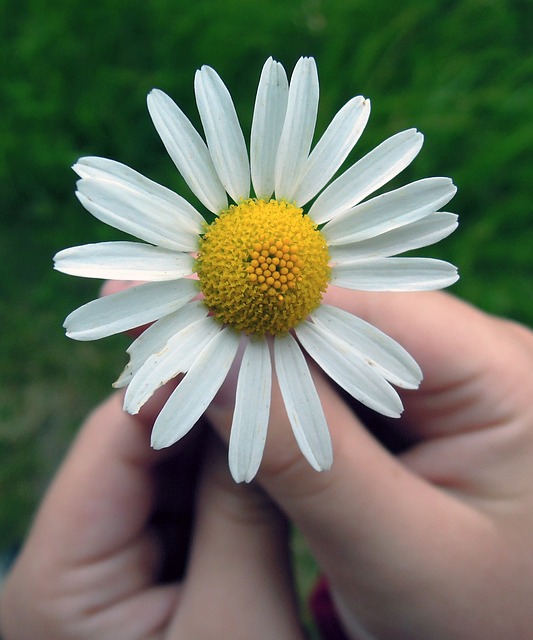
Probably one of the most famous flower games involves the daisy: it’s considered the oracle of affairs of the heart. The daisy supposedly has the ability to tell you if your sweetheart truly loves you or not.

It goes like this: you pluck off each petal of a daisy in turn, and as you do so, alternately say, “He loves me,” or “He loves me not.”

The final petal tells you which statement is true.

You’re left in suspense the whole time, and worry about what the last petal will reveal.

I know this is just a children’s game, but even as adults we sometimes worry if we’re truly loved, don’t we?

Human love can be a fickle thing, and we can often be unsure about the commitment and loyalty of those we love.

That’s why it’s so good to know that with Jesus, we’re never left wondering whether He loves us or not. He never leaves us in suspense as to whether He cares.

He always does.

And He always will.

Read more