Golden at the Broken Places

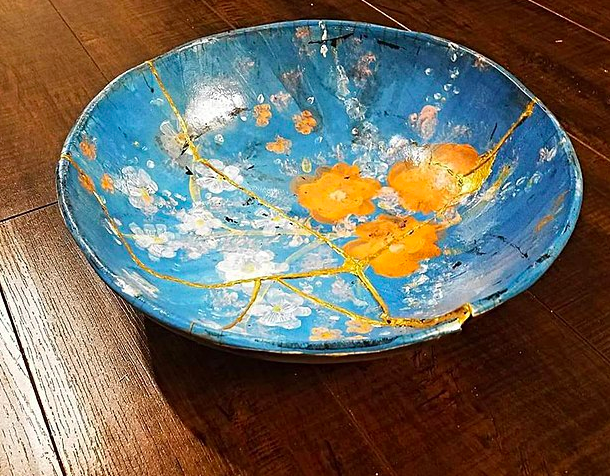
Bowl repaired using Kintsugi method by artist Ruthann Hurwitz.
Wikimedia Commons CC BY-SA-4.0

We all shudder at the sound of something breaking, don’t we? We can’t help but wince when we hear glass or crockery shattering into pieces on the floor.

Why do we have that involuntary reaction? Because we know that the object probably can’t be repaired: it’s likely to be damaged irreparably, and must be thrown away.

We’re wincing at the sound of loss.

But what if there were a way to not only put the pieces back together, but to make the object more beautiful than it was before, despite the breaks?

The Japanese long ago invented a way of doing just that, and have even made an art form of it. It’s called “Kintsugi,” which means “golden joinery.”

The process involves mending the cracks in pottery with gold lacquer. Instead of trying to hide the damaged areas, they are instead highlighted with something precious. The end result is a restored piece of pottery that is beautiful at the broken places.

But what happens if it’s not a piece of pottery that is broken, but a life? How can a shattered heart be put back together?

Long ago, God also devised a way to put the pieces of a broken life back together again. God doesn’t throw away broken people; they still have value to Him. He puts them back together again with the gold lacquer of His Son’s love and redemptive power.

Read more
It’s Raining Diamonds!

If diamonds are a girl’s best friend, I’m on the wrong planet.

I’ve just discovered that there are planets on which it rains diamonds.

Scientists believe that diamond rain could occur deep in the atmospheres of our gas giant neighbours in the solar system: Jupiter, Saturn, Uranus and Neptune.

Thousands of miles below the surface of these planets, carbon atoms come under such crushing pressure in the dense atmospheres that diamonds could form. The conditions are so extreme that further down, the diamonds could melt into liquid, forming diamond “rain” drops.

On some planets in the universe, these drizzles could involve diamonds millions of carats in size.

The wonders of the cosmos don’t end there. Scientists suggest that on the exoplanet WASP-121b it rains liquid rubies and sapphires. Clouds on this planet could be made of corundum, a mineral out of which these precious gems are formed.

It gets better.

The asteroid Psyche 16, which orbits the sun in the asteroid belt between Mars and Jupiter, is made entirely of solid metal. It has enough gold to turn every person on Earth into a billionaire. As well as gold, this intriguing minor planet contains metals such as platinum, iron and nickel in abundance. If Psyche 16’s metals were on Earth, their combined value would be worth perhaps $100,000 quadrillion.

Talk about an embarrassment of riches!

What does all this tell us?

That the precious gems and metals we covet are a dime a dozen in God’s universe. After all, Scripture tells us that in Heaven, the streets are paved with gold.

More importantly, God has an inexhaustible supply of the things that we truly need: grace, mercy, love, and forgiveness.

Read more

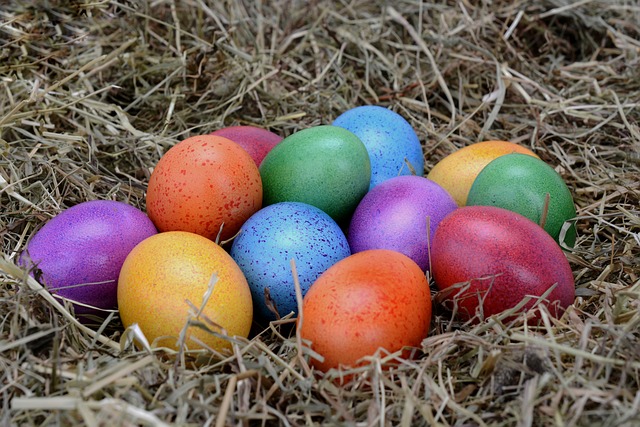
Easter Eggs at Christmas

Image by Annette from Pixabay

At Christmas, do your thoughts turn to Easter eggs?

Probably not, unless you’re an avid player of video games or a fan of certain movie franchises.

In the cinematic and computer worlds, an “Easter egg” is a secret message, image, or feature hidden in software, games, or films.

With video games, an Easter egg might be an unpublished feature or hidden property of the game that is normally hidden from the public eye. It can only be accessed by certain button combinations that are not common knowledge.

Easter eggs inserted by filmmakers in their works might involve a jokey detail or an obscure reference to a previous movie by the same auteur. Only the most alert audience members catch them.

For instance, famed film director Alfred Hitchcock had a penchant for appearing in cameo roles in his own movies. In 39 of the 52 films he directed, he left “Easter eggs” consisting of himself in blink-and-you-miss-it bit parts.

Are there any “Easter eggs” to be found hidden in the Christmas story in the Bible?

Actually, there are.

If you read the Scriptures closely, you’ll find that there are foreshadowings of Easter sprinkled throughout the accounts of Christ’s miraculous birth.

Read more

The Most Valuable Thing On Earth

Image by JamesDeMers from Pixabay

If you had to guess, what would you say is the most valuable thing in the world by weight?

If you’re a cook, you might pick costly foods like beluga caviar or white truffles. Or perhaps the spice saffron, which can go for thousands of dollars per pound.

If you’re a jewellery lover, your mind might go to precious metals like silver, gold or platinum. You’d know that gold has been revered since ancient times, and sometimes goes for thousands of dollars per ounce.

You’d be getting warmer if you worked in industry and knew that some substances used in things like catalytic converters are very costly indeed. Rhodium and palladium are even more valuable than gold.

These would all be good guesses, but not even close.

What about diamonds as the most valuable thing on earth by weight? Very rare coloured diamonds such as the red can be valued at millions of dollars per gram.

If you’re a scientist, you might get closer by guessing plutonium, used to fuel nuclear reactors. Or you might figure you’ve hit the jackpot by picking antimatter, which might power spaceships one day.

This substance requires inconceivable amounts of energy to generate. It’s estimated that antimatter costs tens of billions or even trillions of dollars per gram.

But there’s one thing on earth more valuable than even that…

Read more

Buy and Hold the Best Investment

Image by Gerd Altmann on Pixabay

Do you play the stock market?

What kind of an investor are you? Do you engage in active trading, or do you prefer to buy and hold investments?

Active or “day” traders believe that through rapid, speculative trading they can gain a larger profit more quickly than through passive investing.

The “buy and hold” strategy, on the other hand, is based on holding stocks for a long period of time with the idea that their value will gradually increase over the years.

It’s beyond my pay grade to tell you which form of investing is better: after all, The Faith Cafe isn’t a financial blog.

But I do have a hot investing tip for you.

This tip comes from an unlikely source, but don’t worry, I’m not engaging in insider trading or passing on confidential information.

This sure-fire investment advice comes from the Book of Proverbs in the Bible.

Would you like to hear it?

Read more

Golden at the Broken Places

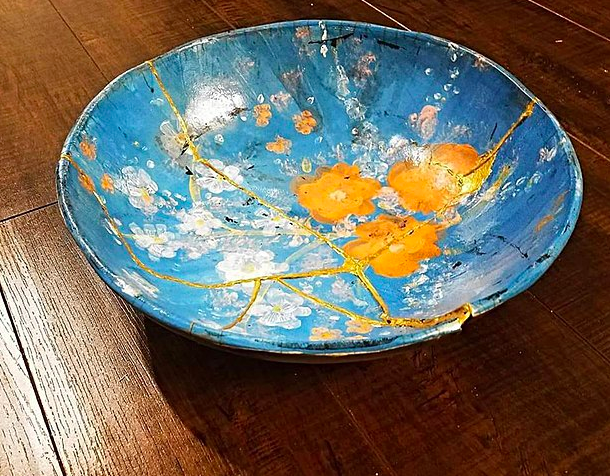
Bowl repaired by Kintsugi method by artist Ruthann Hurwitz
Wikimedia Commons CC BY-SA-4.0

We all shudder at the sound of something breaking, don’t we? We can’t help but wince when we hear glass or crockery shattering into pieces on the floor.

Why do we have that involuntary reaction? Because we know that the object probably can’t be repaired: it’s likely to be damaged irreparably, and must be thrown away.

We’re wincing at the sound of loss.

But what if there were a way to not only put the pieces back together, but to make the object more beautiful than it was before, despite the breaks?

The Japanese long ago invented a way of doing just that, and have even made an art form of it. It’s called “Kintsugi,” which means “golden joinery.” The process involves mending the cracks in pottery with gold lacquer. Instead of trying to hide the damaged areas, they are instead highlighted with something precious. The end result is a restored piece of pottery that is beautiful at the broken places.

But what happens if it’s not a piece of pottery that is broken, but a life? How can a shattered heart be put back together?

Read more

How To Make Maple Syrup

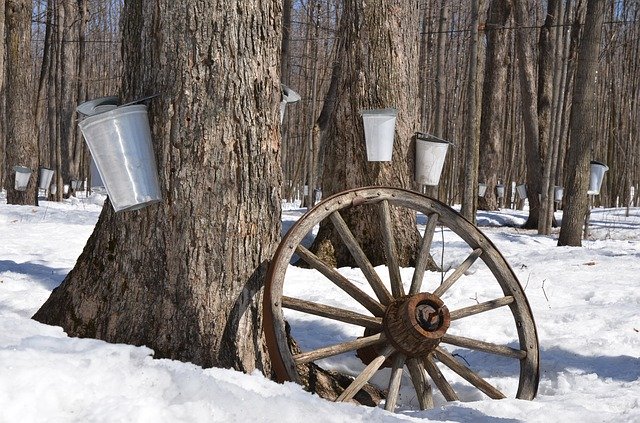
Collecting maple sap the traditional way, in buckets

Sometimes the sweetest things take the most effort to produce, don’t they?

Take, for instance, maple syrup, one of Canada’s iconic products. We often use it atop pancakes or waffles, or in desserts (see below). This delicious liquid starts out as sap collected from sugar maple trees.

Right now it’s maple syrup season in Eastern Canada: as the weather warms, the sap in the trees starts flowing freely. Holes are drilled into the trunks of the maples, and buckets or tubing collects the dripping sap, which is then transported to a central location.

And then it’s ready to be bottled, right? No! Actually, the process has only just begun.

Read more