Trinitometry 101

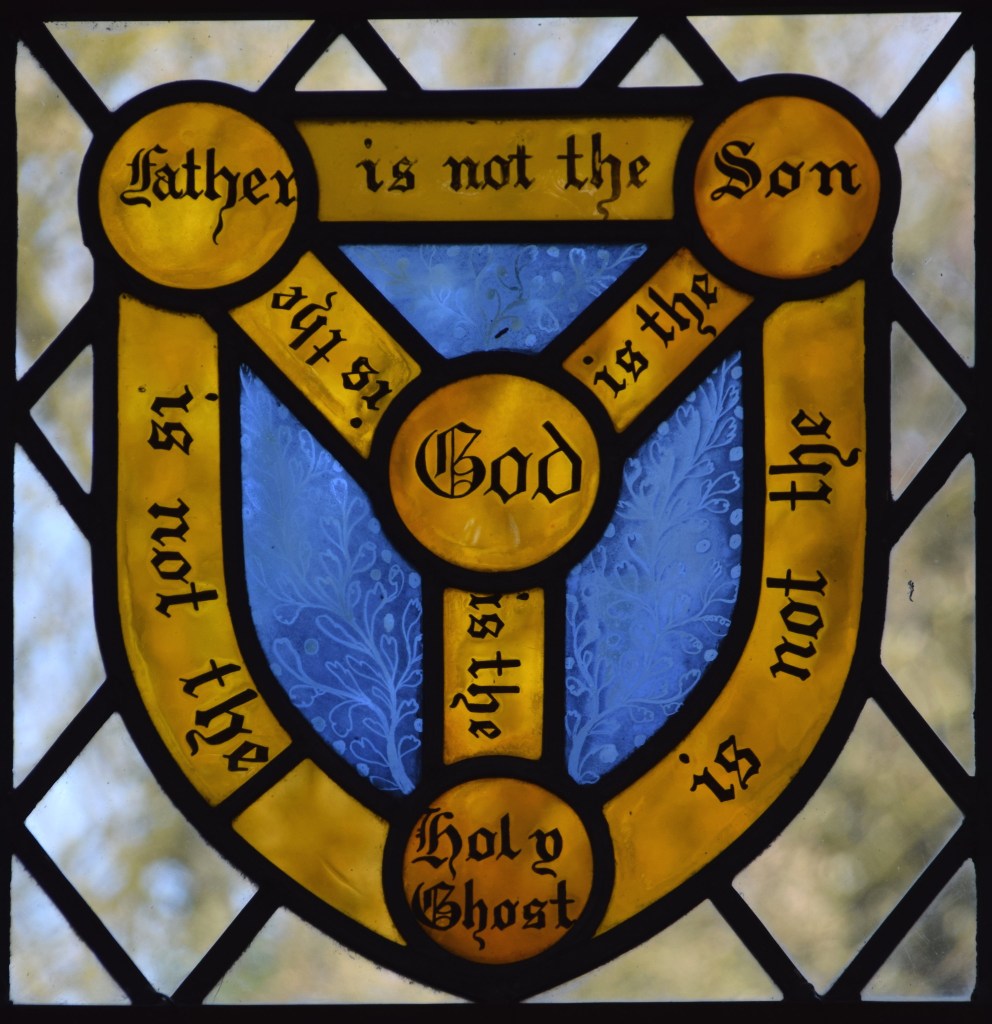
The Shield of the Trinity, a traditional way of depicting that the three Persons of the Trinity are different and yet are co-equally God.

No, there’s not a typo in the title. I didn’t mean to write “Trigonometry.”

So don’t fear that we’ll be discussing math in this post!

I’m referring instead to the Trinity, a concept that can leave some people scratching their heads.

Do Christians worship three gods?

How does the “three-in-one” idea even work?

Over the centuries people have come up with different analogies to explain the idea that God exists in three distinct Persons: the Father, the Son, and the Holy Spirit.

St. Patrick famously employed a shamrock as a visual metaphor to explain the Trinity to the Irish. He used the shamrock’s three leaves growing from a single stem to illustrate how the three Persons of the Trinity are distinct yet one.

But here we risk leaving the impression that each member is only one third of God, instead of each being 100% God. So the luck of the Irish fails us in finding the perfect analogy in a shamrock.

Some compare the Trinity to an egg, which also has three parts. The shell, the white, and the yolk together make up one egg. But this analogy has its flaws, too, and leaves the concept rather scrambled.

Read more

Your Guardian Lion

For over a century, two marble lions have guarded the main branch of the New York Public Library at Fifth Avenue and 42nd Street in Manhattan.

These majestic stone creatures flank the entrance to the building, keeping careful watch over all who enter.

During the 1930s the library lions were officially named “Patience” and “Fortitude” by then-mayor Fiorello LaGuardia. He felt that those names embodied the qualities that New Yorkers would need to survive the Great Depression of that era.

Truth be told, our need for patience and fortitude has never waned. Whether in pandemics, wars, or economic disruptions, we still need guardians.

Who is the “lion” guarding your door?

Scripture says that God guards and protects those who trust in Him.

“He guards the paths of the just and protects those who are faithful to him.” (Proverbs 2:8)
“God guards you from every evil,
 he guards your very life.
He guards you when you leave and when you return,
 he guards you now, he guards you always.” (Psalm 121:7-8, The Message)
Read more

Your New Favourite Number

What’s your favourite number?

There’s a good chance you’ll pick the number 7.

In global polls, seven consistently ranks as the most popular favourite number.

With good reason, too.

There are seven days in the week, seven colours in the rainbow, seven continents, and seven seas. The number seven has significance in several major religions. It’s considered a “lucky” number.

But may I suggest you consider making the number 8 a favourite, too?

The number eight has a lot going for it. It’s especially rich in Biblical symbolism.

In the Scriptures, eight often represents a new beginning:

Circumcision occurs on the eighth day, marking entrance into covenant: a new life of belonging to God.

In the process of consecrating priests in the Old Testament, the eighth day heralded a new phase of ministry and access to God.

Eight people were saved in Noah’s ark, a picture of rebirth through water.

Read more

The Most Astounding Thing About Christmas

What’s the most astounding thing about Christmas to you?

The amount of electricity used in powering all the Christmas lights on people’s homes?

The credit card bill you’re racking up to buy gifts for family, friends, and coworkers?

The way your Uncle Louie consistently manages to buy you the most inappropriate gift imaginable, every single year?

The ugly Christmas sweater said uncle wears to every holiday event, even formal ones?

No, the most astounding thing about Christmas is that the Creator of the Universe, Almighty God, came down to earth and was born as a baby.

God Himself, the perfect and holy One, entered our messy, sinful world in the form of Jesus and dwelt with us for 33 years. Then He died on a Cross for our sins. All this was done out of immense love for us.

The theological term for God coming to us in this fashion is the Incarnation, which literally means “God made flesh.”

The Incarnation features heavily in my favourite Christmas carol, “Hark the Herald Angels Sing.”

Its writer, Charles Wesley, seems to have been so astounded by the fact of the Incarnation that he sprinkled this hymn with at least 10 references to it. See if you can spot them:

Read more

Are You on Santa’s Naughty or Nice List?

Are you on Santa’s “Naughty” list or his “Nice” list?

Sometimes it’s hard to know, isn’t it?

You shovelled the snow off your elderly neighbour’s walkway, so that counts as nice.

But on the other hand, you greedily ate half a pan of freshly baked brownies before sharing them with your family. Not so nice.

You made up for that by running errands for a sick friend, and volunteering to work late at the office to help finish a project. Definitely heading well into “nice” territory!

But then you lost your temper at your spouse, fibbed to get out of visiting your mother-in-law, and illegally parked your car in a disabled space while you dashed into the store to buy milk. Uh-oh! Looks like you’re squarely back on the naughty list.

With Santa, it’s hard to know where you stand on the naughty/nice spectrum.

That’s why it’s good to know that, if you’re a believer in Jesus, there’s only one list:

Forgiven.

If you’re trusting in Jesus’ atoning work on the Cross, your name is added to the “Forgiven” list.

Read more

You’re Not Insignificant to God!

When you look up at the stars in the night sky, what do you feel?

Many people say the vastness of the universe and the countless stars make them feel puny and insignificant.

In a way, that’s understandable.

The star that Earth orbits around is just one of many in the Milky Way, the galaxy in which we live. In fact, there are perhaps 100 billion stars in our cosmic “neighbourhood.”

And the Milky Way is just one of many galaxies. Estimates vary as to how many galaxies exist in the observable universe: some experts suggest a couple hundred billion, and others postulate as many as 10 trillion.

It’s impossible for us to know how many stars there are in the observable universe, but here’s the largest guess I came across: Multiplying the higher number of estimated galaxies by the Milky Way’s estimated 100 billion stars gives a possibility of 1 septillion stars in the universe (1 quadrillion in the European system). That’s a “1” with 24 zeroes after it!

The Milky Way is so enormous that, even travelling at light speed, it would take 100,000 years to travel across it. The observable universe is incredibly more vast: according to current thinking, it’s about 93 billion light years in diameter.

No wonder people feel small when they contemplate the unimaginable expanse of the universe!

But for me, this knowledge doesn’t make me feel insignificant.

It makes me feel just the opposite.

Read more

Who Loves You?

Photo from Pxhere

How many times today has someone told you that they love you?

If you have a loving family, you’ll probably hear them express their love for you frequently.

But what if your family ties are a bit strained? What if you don’t have many close relationships at all, and consider yourself to be fairly alone in the world?

Then you probably don’t hear the words “I love you” nearly enough.

There’s a remedy for that:

Open a Bible.

The unfailing love of God is a soundtrack that reverberates through the Scriptures.

It’s easy to find verses in the New Testament that exemplify God’s love:

“But God demonstrates his own love for us in this: While we were still sinners, Christ died for us.” (Romans 5:8)
“This is real love—not that we loved God, but that he loved us and sent his Son as a sacrifice to take away our sins.” (1 John 4:10)
And of course: “For God so loved the world that he gave his one and only Son, that whoever believes in him shall not perish but have eternal life.” (John 3:16)

But what about the Old Testament?

Read more

If This Isn’t Love…

The love of God for us is one of those topics that you could spend a lifetime exploring.

As believers, we often focus on the Crucifixion of Jesus to demonstrate God’s love.

And rightly so: Jesus’ sacrifice on the Cross to redeem us from our sins was the epitome of extravagant love.

“God showed his great love for us by sending Christ to die for us while we were still sinners.” (Romans 5:8)

But I wonder if we give short shrift to the Incarnation.

The fact that God took on human form and walked among us for 33 years shows an astonishing level of love.

When Jesus came to earth, our story became His story. He chose to go through the same pain we do, and carry the same burdens we do.

Read more

With God, You Get the Flower First!

Eastern Redbud Tree

Sometimes nature can be a bit unpredictable—things happen in an order we wouldn’t expect.

Normally, plants put forth leaves long before they produce flowers.

But some trees and shrubs flip the script, so to speak.

With certain plants, the normal sequence is reversed: the flowers come first, before the leaves have developed.

A good example is the beautiful redbud tree. It puts forth gorgeous pink flowers on its bare branches in early spring, when none of its leaves are yet in sight.

The forsythia shrub bears its bright yellow flowers in advance of its leaves, and the lovely magnolia presents its pink or white blooms before the green foliage appears. Some maples and oaks also exhibit this flower-first behaviour, although with less showy blossoms.

All of these plants give us a treat in springtime when we’re starved for colour. We get the flower first without having to wait for the leaves.

Why do some plants reverse the normal order of things?

Some trees are wind-pollinated, so put forth flowers before their bulky leaves get in the way. The same goes for flowers that need extra sunlight. Other plants produce a mass of conspicuous flowers first, unobscured by leaves, to better attract the attention of pollinating insects.

Did you know that God also flipped the script and gave us the flower first, so to speak?

Read more

The Best Worst Day

There are some dates in history which stand out for being associated with awful events. Each year, when the calendar rolls around to these dates, we shudder in horror when we recall what happened.

Here are a few “worst days in history” that come to mind:

September 11th, 2001: the deadly World Trade Centre terrorist attacks in New York.

August 6, 1945: the dropping of a nuclear bomb on Hiroshima, Japan.

June 28, 1914: the day Archduke Ferdinand was assassinated, igniting the horrific First World War which killed tens of millions.

December 26, 2004: the Boxing Day tsunami which killed hundreds of thousands.

Some horrible dates in history have specific terms associated with them, such as:

December 7, 1941: the Japanese attack on Pearl Harbor, a date which President Roosevelt said would “live in infamy.”

October 29, 1929: called “Black Tuesday,” the worst day of a stock market crash which would send the world spiralling into the Great Depression.

What term is associated with the horrible day Jesus Christ was crucified?

“Good.” It’s called Good Friday.

But why?

Read more