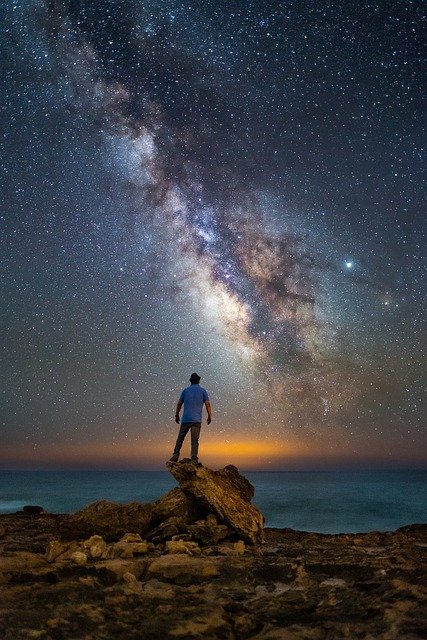
When you look up at the stars in the night sky, what do you feel?
Many people say the vastness of the universe and the countless stars make them feel puny and insignificant.
In a way, that’s understandable.
The star that Earth orbits around is just one of many in the Milky Way, the galaxy in which we live. In fact, there are perhaps 100 billion stars in our cosmic “neighbourhood.”
And the Milky Way is just one of many galaxies. Estimates vary as to how many galaxies exist in the observable universe: some experts suggest a couple hundred billion, and others postulate as many as 10 trillion.
It’s impossible for us to know how many stars there are in the observable universe, but here’s the largest guess I came across: Multiplying the higher number of estimated galaxies by the Milky Way’s estimated 100 billion stars gives a possibility of 1 septillion stars in the universe (1 quadrillion in the European system). That’s a “1” with 24 zeroes after it!
The Milky Way is so enormous that, even travelling at light speed, it would take 100,000 years to travel across it. The observable universe is incredibly more vast: according to current thinking, it’s about 93 billion light years in diameter.
No wonder people feel small when they contemplate the unimaginable expanse of the universe!
But for me, this knowledge doesn’t make me feel insignificant.
It makes me feel just the opposite.
Read more
 The Faith Cafe
