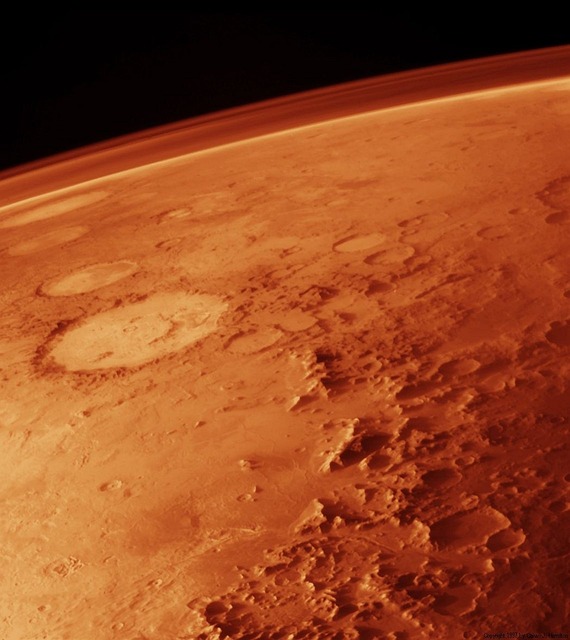
Life on Mars

Image of Mars by WikiImages from Pixabay

Is there life on Mars?

For generations, we earthlings have conjectured about the possible existence of alien life on the planet next door to us.

I’m afraid this blog can neither confirm nor deny the presence of little green men on Mars.

Scientists do tell us, however, that water once flowed on its surface.

That’s right: the Red Planet was once blue, like Earth.

So why is Mars known today as a dusty, dry, barren place, whereas Earth still has abundant supplies of water?

The key lies in Earth’s magnetic field.

A planet’s magnetic field acts as a shield, protecting its atmosphere from being blown into space by radiation from its star.

Mars once had a magnetic field of its own. But is was both farther from the Sun and smaller than Earth to begin with. Scientists theorize that over time, its molten iron core cooled, and with it the dynamo powering its magnetic field.

As Mars’ magnetic field weakened, the Sun’s solar wind slowly stripped away its atmosphere. The water which once flowed on its surface dried up, until there was nothing left but some empty channels to hint at the rivers which once coursed through them.

Simply put, Mars let its fire burn out.

I think we can learn an important lesson from our planetary neighbour.

We shouldn’t let our fire for God fizzle out.

Read more

There’s No Place Like Home

Image by burtamus from Pixabay

There’s no place like home, is there?

A lot of animals would agree with that statement, if they could speak.

Many birds and animals have an uncanny “homing instinct” that allows them to travel thousands of miles to return to the very same location each year.

Monarch butterflies from eastern North America return to the same wintering grounds in central Mexico each year, even to the very same forest.

Sea-dwelling Pacific salmon return to the same river they were born in to spawn.

Pregnant sea turtles migrate thousands of miles across the ocean to lay their eggs on the same beach on which they were born decades earlier.

And then there are homing pigeons, the champions of long-distance way-finding. Their homing instincts are so reliable that they’ve been used in wartime to deliver crucial messages over enemy lines.

But how do they do it?

One theory suggests that homing pigeons may have a mineral called magnetite in their beaks, which acts as a tiny GPS unit. This would allow them to sense the earth’s magnetic fields and their own position in relation to it. If true, it would mean that these birds are essentially flying compasses, with their beaks pointing them in the direction they should go.

It makes me wonder: do humans have a “homing instinct”?

Read more

Angels Are Fighting For You

Image of the Northern Lights by Noel Bauza from Pixabay

If you’re lucky enough to have seen the Northern or Southern Lights, what do you think you’re seeing?

This spectacular light display, called the aurora borealis or australis, is usually confined to the high latitudes at the Earth’s poles.

Many people view these shifting ribbons of light as a sort of otherworldly dance in the sky. Others see the swirling colours as a mystical painting come to life. Some indigenous peoples believed the eerie, glowing streamers were ancestral spirits.

But when you look at the auroras, what you’re really seeing is a battle.

The entrancing, ghostly lights result from charged particles from the Sun interacting with the Earth’s magnetic field. These particles, borne on the solar wind, are constantly bombarding our planet. At times they’re more intense, as during periods of high sunspot activity.

The Earth’s magnetic field protects us from this barrage of particles, like a “deflector shield” in a science fiction movie. Without this protection, the solar wind would eventually kill us.

Our magnetic field is always there, an invisible but highly effective shield. It deflects 98% of the particles spewed out by the Sun in our direction, but is slightly weaker near the poles. During the ethereal display known as the Northern and Southern Lights, our magnetic blanket becomes visible as it works to protect us.

What we see as an intriguing and beautiful phenomenon is actually visible evidence of a fierce battle going on for our lives.

Likewise, in life, sometimes we don’t fully understand the battles that are raging behind the scenes.

Unknowingly, as we go about our daily lives, believers are being protected by heavenly forces from harm. We usually can’t see these protective beings, but they’re there nonetheless, working on our behalf.

Read more