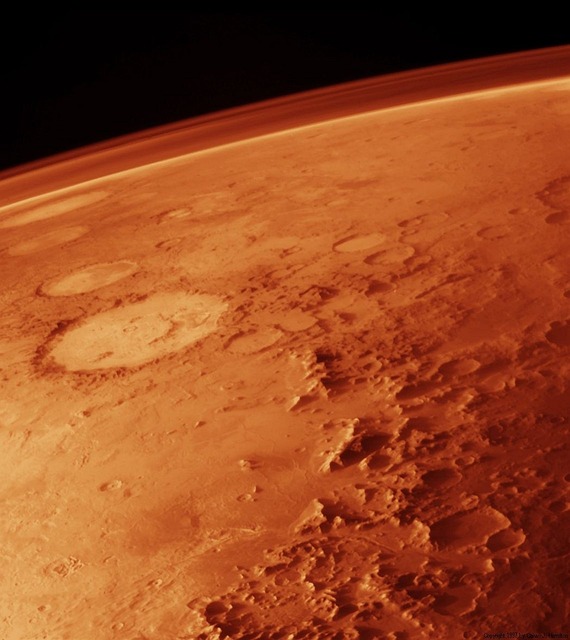
Is there life on Mars?
For generations, we earthlings have conjectured about the possible existence of alien life on the planet next door to us.
I’m afraid this blog can neither confirm nor deny the presence of little green men on Mars.
Scientists do tell us, however, that water once flowed on its surface.
That’s right: the Red Planet was once blue, like Earth.
So why is Mars known today as a dusty, dry, barren place, whereas Earth still has abundant supplies of water?
The key lies in Earth’s magnetic field.
A planet’s magnetic field acts as a shield, protecting its atmosphere from being blown into space by radiation from its star.
Mars once had a magnetic field of its own. But is was both farther from the Sun and smaller than Earth to begin with. Scientists theorize that over time, its molten iron core cooled, and with it the dynamo powering its magnetic field.
As Mars’ magnetic field weakened, the Sun’s solar wind slowly stripped away its atmosphere. The water which once flowed on its surface dried up, until there was nothing left but some empty channels to hint at the rivers which once coursed through them.
Simply put, Mars let its fire burn out.
I think we can learn an important lesson from our planetary neighbour.
We shouldn’t let our fire for God fizzle out.
Read more
 The Faith Cafe
