Trinitometry 101

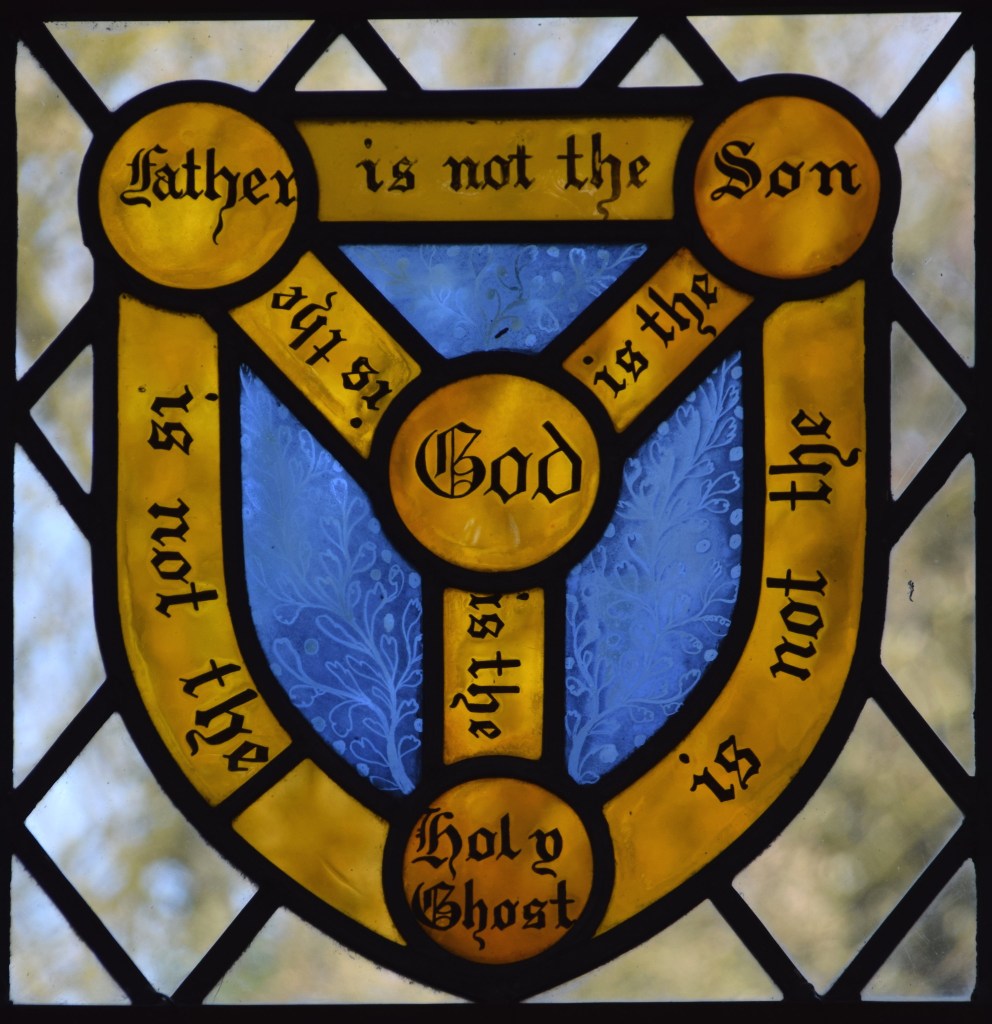
The Shield of the Trinity, a traditional way of depicting that the three Persons of the Trinity are different and yet are co-equally God.

No, there’s not a typo in the title. I didn’t mean to write “Trigonometry.”

So don’t fear that we’ll be discussing math in this post!

I’m referring instead to the Trinity, a concept that can leave some people scratching their heads.

Do Christians worship three gods?

How does the “three-in-one” idea even work?

Over the centuries people have come up with different analogies to explain the idea that God exists in three distinct Persons: the Father, the Son, and the Holy Spirit.

St. Patrick famously employed a shamrock as a visual metaphor to explain the Trinity to the Irish. He used the shamrock’s three leaves growing from a single stem to illustrate how the three Persons of the Trinity are distinct yet one.

But here we risk leaving the impression that each member is only one third of God, instead of each being 100% God. So the luck of the Irish fails us in finding the perfect analogy in a shamrock.

Some compare the Trinity to an egg, which also has three parts. The shell, the white, and the yolk together make up one egg. But this analogy has its flaws, too, and leaves the concept rather scrambled.

Read more
Do The Math

Image by Gerd Altmann from Pixabay

Life is sort of like math class.

How so?

Let’s assume I’m in school and have to take a math test.

There’s an equation at the top of the page I’m handed, and blank space underneath for me to write out my solution to the equation.

But I don’t solve the equation.

Instead, in the first third of the blank space I write a funny, rhyming poem about math class. Next, I draw a bunch of smiling numerals with little arms and legs and depict them as dancing together. In the last third of the page I write a short essay about the benefits of studying math.

I hand in my test to the teacher, and await the results.

The next day, the teacher tells me, “Lori, the poem you wrote had me in stitches. Your drawing of the dancing numbers was delightful, too. And I’d love to incorporate some of the insights in your essay into one of my lessons.”

“That’s great!” I’d say. “So what mark did I get?”

“Zero,” the teacher would respond.

“But why?” I’d ask. “I thought you loved what I wrote.”

“I did: the things you filled the page with were all good and creative and helpful. But they don’t count towards your mark. You failed to do the one thing required of you, which was to solve the equation.”

Is the teacher being fair? Yes.

Is there one thing that God requires of us?

Read more

Your Training Won’t Make Sense at First

Image by Bart via Flickr. CC-BY-NC 2.0

“Why do we have to learn math? We’ll never use it in real life!”

Did you ever say something like that to your teachers in school?

It’s true that you may never have used algebra once you graduated from high school. Your knowledge of trigonometry or calculus may have lain dormant since then, too.

But that wasn’t actually the point of algebra, or any other subject.

The point of learning math was to train your brain.

Mastering mathematical concepts increases your problem-solving skills, develops flexible thinking and creativity, and encourages analytical reasoning.

These are things that are extremely valuable in every area of life.

But you might not have been able to see that when you were trying to understand the Pythagorean theorem in school.

That’s because your training often won’t make sense until much later.

Several heroes in the Bible found this out:

Read more