Create Your Own Dark Sky Preserve

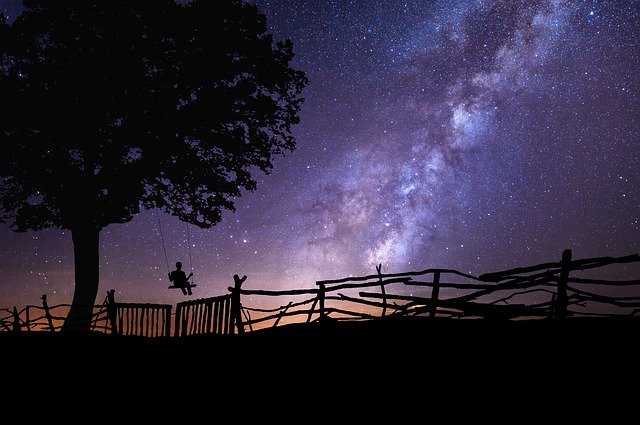
I sometimes wonder if people who live in the countryside have a better appreciation for God’s creation than we city folk?

I’m specifically thinking of the ability to see the majesty of God’s handiwork as seen in the starry night sky.

Living in a big city (in my case, Toronto), I’m only able to see a handful of heavenly bodies. I can see the Big Dipper and a smattering of other stars, bright planets such as Venus, and the moon in its phases. But that’s about it.

Big cities produce so much ambient light that it obscures our view of the wonder of the night sky. That’s why many jurisdictions are creating what’s known as “dark sky preserves.” These are regions far enough away from the lights of built-up urban areas that the majority of stars can still be seen.

Governments commit to protecting these preserves from development so that the full range of the starry sky will always be visible from those areas. They seem to understand that it’s important for us to be able to maintain our connection with the night sky, and see it the way our ancestors did.

Perhaps we should take a page from their book, and create some “dark sky preserves” in our own lives.

I don’t mean areas from which to see the night sky, but spaces in our lives that remind us of God’s majesty and creative ingenuity as expressed in nature.

Read more
You’re Not Insignificant to God!

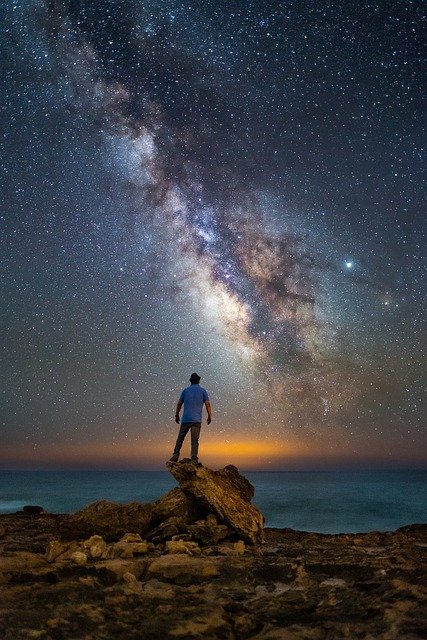
When you look up at the stars in the night sky, what do you feel?

Many people say the vastness of the universe and the countless stars make them feel puny and insignificant.

In a way, that’s understandable.

The star that Earth orbits around is just one of many in the Milky Way, the galaxy in which we live. In fact, there are perhaps 100 billion stars in our cosmic “neighbourhood.”

And the Milky Way is just one of many galaxies. Estimates vary as to how many galaxies exist in the observable universe: some experts suggest a couple hundred billion, and others postulate as many as 10 trillion.

It’s impossible for us to know how many stars there are in the observable universe, but here’s the largest guess I came across: Multiplying the higher number of estimated galaxies by the Milky Way’s estimated 100 billion stars gives a possibility of 1 septillion stars in the universe (1 quadrillion in the European system). That’s a “1” with 24 zeroes after it!

The Milky Way is so enormous that, even travelling at light speed, it would take 100,000 years to travel across it. The observable universe is incredibly more vast: according to current thinking, it’s about 93 billion light years in diameter.

No wonder people feel small when they contemplate the unimaginable expanse of the universe!

But for me, this knowledge doesn’t make me feel insignificant.

It makes me feel just the opposite.

Read more

It’s Raining Diamonds!

If diamonds are a girl’s best friend, I’m on the wrong planet.

I’ve just discovered that there are planets on which it rains diamonds.

Scientists believe that diamond rain could occur deep in the atmospheres of our gas giant neighbours in the solar system: Jupiter, Saturn, Uranus and Neptune.

Thousands of miles below the surface of these planets, carbon atoms come under such crushing pressure in the dense atmospheres that diamonds could form. The conditions are so extreme that further down, the diamonds could melt into liquid, forming diamond “rain” drops.

On some planets in the universe, these drizzles could involve diamonds millions of carats in size.

The wonders of the cosmos don’t end there. Scientists suggest that on the exoplanet WASP-121b it rains liquid rubies and sapphires. Clouds on this planet could be made of corundum, a mineral out of which these precious gems are formed.

It gets better.

The asteroid Psyche 16, which orbits the sun in the asteroid belt between Mars and Jupiter, is made entirely of solid metal. It has enough gold to turn every person on Earth into a billionaire. As well as gold, this intriguing minor planet contains metals such as platinum, iron and nickel in abundance. If Psyche 16’s metals were on Earth, their combined value would be worth perhaps $100,000 quadrillion.

Talk about an embarrassment of riches!

What does all this tell us?

That the precious gems and metals we covet are a dime a dozen in God’s universe. After all, Scripture tells us that in Heaven, the streets are paved with gold.

More importantly, God has an inexhaustible supply of the things that we truly need: grace, mercy, love, and forgiveness.

Read more

More Than Meets The Eye

Image by kalhh from Pixabay

Sometimes we don’t realize what we’re looking at, do we?

This winter solstice is a good example of that, because tonight we’ll be able to see a particularly bright “star” in the night sky.

That is, you might assume it’s a star, but you’ll actually be seeing something quite different.

This rare “Christmas star” will actually be a planetary conjunction. The planets Jupiter and Saturn will be so closely aligned tonight that they will appear to be one ultra-bright object.

At other times, a bright “star” you see might actually be a binary star system; that is, two stars orbiting each other. Or it could be the planet Venus. You’d need to study it through a telescope, adjust your focus and consult an astronomical guide to know for sure.

The truth is, sometimes we don’t really understand what we’re seeing.

That was certainly true for many of the people who saw the baby Jesus and the star which heralded His birth.

Read more