Lest We Forget

View from D-Day Landing Craft, June 6, 1944

Each year we mark November 11th as Remembrance Day in Canada (Veterans Day in the US).

On this special day, we remember the servicemen and -women who lost their lives to ensure the freedom we cherish so deeply today.

The numbers are staggering: it’s estimated that over 400,000 U.S. military personnel lost their lives during World War II. The US National D-Day Memorial Foundation estimates that over 4,000 Allied servicemen lost their lives on June 6, 1944 (D-Day) alone.

The fatalities during World War I are equally appalling, with close to 60,000 Canadians having lost their lives in service. The best estimate of war historians is that over 140,000 Allied soldiers lost their lives during the hellish Battle of the Somme alone in 1916 (including my great-uncle Pte. Robert John Tisdale, still in his teens).

The numbers who lost their lives in the Korean War, the Gulf War, Afghanistan, and others only adds to the toll of war’s terrible cost.

But wait a minute…every sentence I just wrote contained a mistake. Did you spot it?

Read more
Remembering The Few and The One

Squadron Leader D Finlay, CO of No. 41 Squadron RAF, standing with four of his pilots in front of a Supermarine Spitfire Mk II at Hornchurch, Essex, December 1940.
Wikimedia Commons, Public Domain

This week we commemorate Remembrance Day, and honour those who gave their lives for our freedom.

Some of those we remember are the airmen who made the ultimate sacrifice eighty years ago in the Battle of Britain during World War II. This battle, fought in the skies in 1940, saved that island nation from almost certain invasion by Hitler’s Nazis.

But it came at a terrible cost to the Allied flight crews who were battling the Luftwaffe. The average life expectancy of a Spitfire pilot during the battle was heartbreakingly short: a mere four weeks.

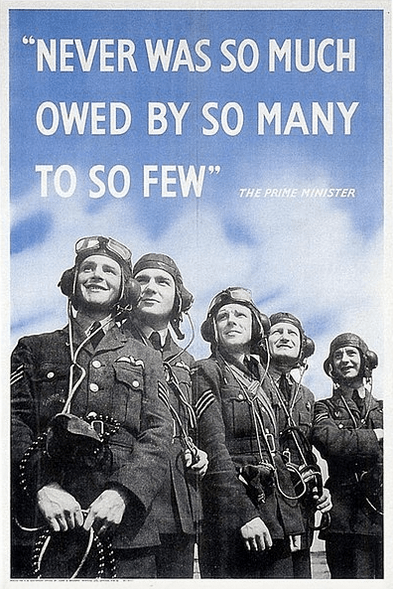
British Prime Minister Winston Churchill paid tribute to those airmen in his famous wartime speech on August 20, 1940:

“Never in the field of human conflict was so much owed by so many to so few.”

This became one of the most famous of Churchill’s sayings, and those airmen became known as “The Few.”

Battle of Britain poster
Wikimedia Commons, Public Domain

But did you know that Churchill actually started out with a different line when he was composing his speech, and felt he had to change it?

Read more