How to Win at Chess

Image by Jan Vašek from Pixabay

Let’s assume you’ve challenged the all-time, undefeated World Chess Champion to a game.

You were confident in your chess skills, and figured that you had a fair chance of winning. The challenge seemed like a good idea at the time.

As the game progresses, however, you realize you’re vastly outmatched. You severely overestimated your abilities. The champion is on course to trounce you easily.

Worse still, you’d made a rash and cocky wager. You bet everything you had that you’d win: your house, your car, all your possessions.

Now you have a horrible sinking feeling, certain that you’re about to lose everything you own.

But then the chess champion does something unexpected.

He comes over to your side of the table, picks up one of your pieces, and makes a move for you.

Then he goes back to his side of the table and makes his own move.

This pattern repeats several times. Eventually you realize what he’s doing: he’s making very shrewd moves on your behalf, employing a strategy you’d never have thought of.

It slowly dawns on you that he’s opening up a path to victory for you.

The chess champion is actually helping you win! He’s doing for you what you had no possibility of doing for yourself.

After he’s won the game for you, the champion gives you a hearty handshake and a wink. All you can do is humbly thank him with profound gratitude. If it weren’t for his gracious actions, you’d have lost everything.

What’s the spiritual lesson for us here?

To ultimately “win” at life, you need God to be on both sides of the equation.

Read more

You Dirty Dog!

Bad dog! Image from Picryl, Public Domain.

Imagine your living room is perfectly clean.

I mean perfectly. Your white couch is utterly spotless. Your white carpet looks pristine. There isn’t an iota of dust or dirt anywhere in the room.

And then your dog wants in.

Rover somehow found the only mud puddle in the dog park and spent a considerable amount of time rolling around in it.

He stands on the other side of the back door, wagging his tail and smiling, unable to figure out why you won’t let him in. After all, surely you love him, don’t you?

But you know that the second you let Rover in, he’ll shake his fur and send thousands of bits of mud all over your perfectly clean living room.

The solution?

Clean Rover off before he can enter the house. Hose him down, dry him off, and wipe his paws. Rover may not understand the necessity of all this, but it’s your living room and your rules.

Likewise, we sometimes can’t understand why God wouldn’t let us into Heaven just as we are.

Sure, we’ve committed a few sins, but we’re pretty decent people overall, aren’t we? Doesn’t God love us? What’s the necessity of a having a Saviour to atone for our sins?

Read more

Thirteen By Any Other Name…Is Still Thirteen

I recently realized that I wasn’t living in the house that I thought I was.

Last summer I moved into a house bearing the number 15. I love everything about it: the house itself, the neighbours, and the area’s community spirit.

It wasn’t until some months later that I realized that I didn’t actually live at #15: I live at #13. The house next door is #11, and opposite my house is #12. Counting from the bottom of the street, mine is the thirteenth house.

So why didn’t the city call it #13 when it was assigning street numbers to the houses?

In many countries, the number 13 has unlucky connotations. Why? One reason is that there were thirteen present at the Last Supper, including Judas, who would betray Jesus.

Some people are superstitious about this number, and try to avoid its “bad luck” by keeping away from anything labelled 13. There’s even a word for the fear of the number thirteen: triskaidekaphobia.

The result is that many companies and cities fudge their numbering to avoid 13. This is why many hotels and tall buildings seem to lack a thirteenth floor: the elevator buttons skip from floor 12 to 14.

The thirteenth floor continues to exist, as does the thirteenth house on a street: we haven’t erased them. But we just call them by other names. We simply pretend that they’re actually the fourteenth floor or the fifteenth house. Everyone goes along with this fiction because it means we don’t have to face reality. We’re deluding ourselves, of course, but it seems we prefer to live in denial.

We do the same with sin, don’t we?

We call it by other names so we don’t have to face up to the reality of what it really is.

Read more

Weed-Free Living

Image of dandelions by Hans Linde from Pixabay

Is it just my imagination, or do weeds actually grow faster than the flowers I’m trying to nurture?

Gardeners will know what I’m talking about. Weeds seem to be gifted with internal steroids that accelerate their growth, outpacing the delicate flowers that we’ve brought home from the garden centre.

Weeds don’t seem to be affected by lack of rain or by intense heat. They’ll grow just about anywhere. They’re speed demons of growth compared to the flowers we try to baby along with regular watering and fertilizing.

I looked into this crucial issue on behalf of readers of The Faith Cafe, and found that weeds do have some competitive advantages.

Weeds which are perennials have the benefit of established root systems that have been alive for many years; these dormant roots have a lot of stored energy. Perennial weeds grow faster and are harder to kill than annuals.

Weeds are already acclimated to the region’s soil, and are highly adaptable. They’re usually native plants that thrive in the local ecosystem, unlike plants from the garden centre which may be non-native and need time to adjust.

Weed seeds are already present in our garden soil. They bide their time until the right conditions present themselves, and then race out of the soil. They’re often excellent self-propagators and are opportunistic growers.

All these things give weeds a head start over the flowers we favour.

This got me thinking:

Why do the “weeds” of our character grow better than the fruits of the Spirit?

Are there lessons we can learn from the natural world?

Read more

The Essential Ingredient

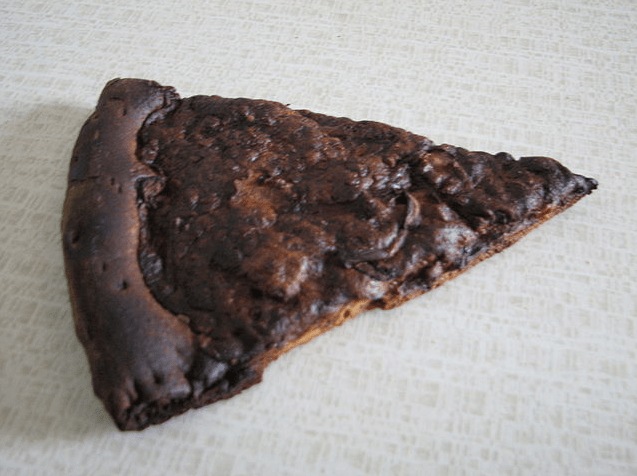
Perhaps this pizza slice is slightly overcooked?
Photo by Kevin Payravi, Wikimedia Commons, CC BY SA-3.0

Have you ever cooked a dish which turned out to be plainly inedible, or even downright dangerous to consume?

It can happen to the best of us, as these examples prove:

A grandmother with failing eyesight accidentally grabbed a bottle of ammonia instead of vinegar when making potato salad for her family. They started gagging at the mere smell of it, which fortunately prevented anyone from eating it!

An 18-year-old living on his own for the first time wanted to make fried rice. He poured some oil into a very hot pan, then dumped in a bunch of uncooked rice. Needless to say, the burned mess had to be thrown out.

Another young person forgot to add water when cooking packaged ramen noodles. I guess cooking isn’t for everyone!

Did you know that a cooking fail even happened in the Bible?

Read more