Jam the Signal!

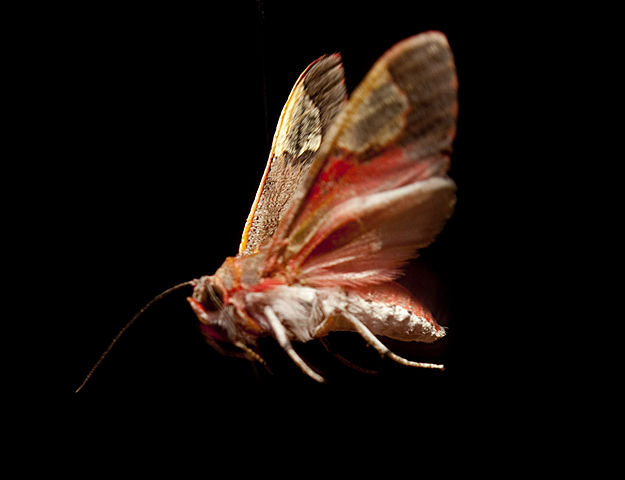
The tiger moth Bertholdia trigona is the only animal in nature known to jam
the echolocation of its predator
Photo from Wikimedia Commons

Bats are crafty creatures.

Being nocturnal, bats search for food at night, but their night vision is fairly poor. So instead they use echolocation, or reflected sound, to home in on insects such as moths. Their built-in sonar directs them to the precise location of the tasty morsels; then it’s just a matter of swooping in and gobbling them up.

So the bats’ prey have to be crafty as well.

Certain species of tiger moth have the ability to emit sonar of their own. As a bat is closing in, the moth emits a fusillade of ultrasonic clicks. This barrage blurs and disrupts the bat’s echolocation: the signal is essentially jammed. The baffled hunter can no longer “see” the moth, and is tricked into thinking its target has vanished. Thwarted, the hungry predator flies away, and the prey is safe.

Our little tiger moth beats its enemy at its own game.

Wouldn’t it be nice if we could “jam the signal” of the enemy of our soul? If we could disrupt and counter the lies the world tells us about ourselves?

In fact, there’s a way that we can.

Read more


Fooled You, Satan!

Image by Marco Verch on Flickr

What is the best April Fool’s prank in history?

Many believe that a BBC TV hoax from over 60 years ago takes the cake.

In 1957 the news show Panorama reported that, thanks to a mild winter in Switzerland, the dreaded spaghetti weevil had been eradicated. As a result, Swiss farmers had enjoyed a bumper crop of spaghetti. The programme showed farmers carefully plucking strands of spaghetti from trees.

Scores of viewers fell for the prank, calling the BBC and asking how they could grow a spaghetti tree themselves. They were advised to “place a spring of spaghetti in a tin of tomato sauce and hope for the best.”

There must be something in the water at the BBC, because in 1980 their pranksters were at it again. On April Fool’s Day they announced that Big Ben, London’s iconic clock tower, would become digital and henceforth be known as Digital Dave. This “news” produced a flood of irate calls to the station.

Other European countries are no slouches at April Fool’s pranks either.

In 1969 the Netherlands’ public broadcaster announced that government inspectors would be roving the streets armed with remote scanners, detecting people who had not paid their TV/radio tax. It was suggested that the only way to stymie the scanners was to wrap the TV or radio in aluminum foil. The next day, all the supermarkets were sold out of foil, and suddenly a flood of TV/radio taxes were being paid.

These probably rate as some of the best wide-scale practical jokes ever.

But with Easter Monday falling on April Fool’s Day this year, it got me thinking of an ever greater example of someone being outwitted.

Read more

The J-Turn

Image by Kahl Orr from Pixabay

I’ll bet that for many of us, car chases on TV shows or in films are a guilty pleasure.

There’s invariably a suspenseful moment where it looks like the bad guys have the heroes at their mercy: they’re coming at the protagonists head-on. The good guys are forced to throw their car into reverse to escape their pursuers.

It seems like the baddies have the upper hand, because our heroes are at the disadvantage of driving backwards.

But then comes the thrilling moment when the good guys make a 180-degree reverse turn, spin their car around, and peel off facing forwards without losing any speed. The bad guys are left in the dust.

Our heroes have just performed a “J-turn.”

This evasive driving technique is a staple of almost every action film with a car-chase scene. It was made famous in the old detective show “The Rockford Files,” in which it was Jim Rockford’s signature maneuver. The J-turn is also called the “reverse 180” or simply “The Rockford Turn.”

The master of J-turns in the Bible was none other than Jesus.

Although he never drove a car, Jesus was adept at rescuing people by suddenly reversing their situation.

Read more

Master of Deception

Peacock butterfly on a flower. Image from Pixabay

If you’re out for a walk in nature, you may not realize how much you’re being tricked.

You may think you’ve got an accurate picture of the natural world around you, but in many cases, you’re being fooled.

That’s because some creatures are masters of deception.

Stick insects camouflage themselves by mimicking the shape and colour of twigs on a tree. Moths may blend in so well with the bark pattern of the tree they’re resting on that you’d never know they’re there.

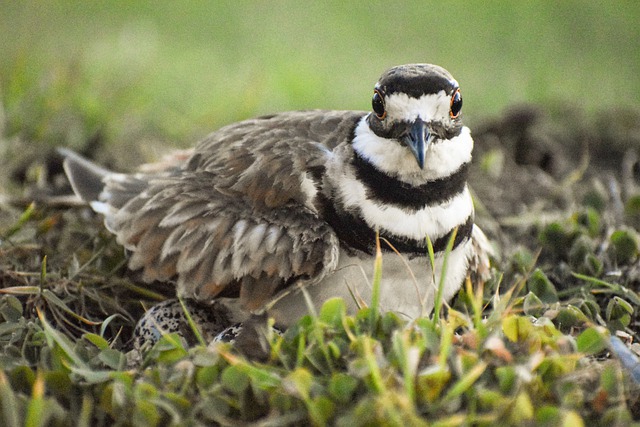
The killdeer bird fakes having a broken wing to make a predator think she will be an easy meal, thereby luring it away from the vulnerable chicks in her nest before she flies away.

Even beautiful butterflies get in on the act of trickery. Some species have markings on their wings that look like huge eyes. The eyespots may discourage a predator from attacking by making it think the insect is in fact a much larger animal.

These false eyes may serve another purpose: to encourage an attacker to aim for the wrong target. The markings deflect an attack away from the butterfly’s head or body to parts less vital for survival, such as its wing margins. By using this deception, the butterfly outwits its enemies and is able to fly away with a torn wing at worst, but otherwise relatively unscathed.

Butterflies aren’t the only creatures to use misdirection in this way:

Satan does, too, and we need to be wise to his tactics. We may not realize how much he’s tricking us.

Read more

The Missing Epitaph

Image by Neil Chappell on Pixabay

What would you like written on your tombstone?

Maybe you’ve already given some thought as to what your epitaph should be. Perhaps you’d like a mention of your accomplishments or family ties.

You might even hope that something humorous be inscribed on your gravestone, as in the following examples:

“I told you I was sick.” (Written on the gravestone of William H. Hahn, Jr., of Princeton, New Jersey.)

“Here lies Lester Moore, Four slugs from a 44, No Les, No more.” (An actual epitaph in the Boothill Graveyard in Tombstone, Arizona.)

“There goes the neighborhood.” (Epitaph of self-deprecating comedian Rodney Dangerfield.)

“Here lies the body of Jonathan Blake. Stepped on the gas instead of the brake.” (On the tombstone of an accident victim in Unionville, Pennsylvania.)

“Here lies John Yeast. Pardon me for not rising.” (This cheeky epitaph is on a grave in Ruidoso, New Mexico.)

What was written on Christ’s tombstone? Any guesses?

Absolutely nothing.

Why?

Because He didn’t stay in the tomb for very long and isn’t there now.

Jesus was only a temporary resident in the dark chamber in which He lay.

Unlike John Yeast, Jesus did rise.

Read more

Saved By The Blood

Image of ground squirrel by Roy Buri from Pixabay

In a match between a ground squirrel and a deadly rattlesnake, whom would you bet on?

Remember, this is a ground squirrel: it can’t run up a tree to escape.

And if the squirrel needs to defend its burrow with its babies inside, it doesn’t have much choice: it has to stand its ground.

What chance does it have against a venomous rattlesnake?

More than you’d expect.

California ground squirrels have an ace up their sleeve.

When confronted by a rattlesnake, this squirrel is able to engorge its tail with extra blood. It then waves its tail back and forth vigorously, super-heating the blood.

The snake, while lethal, has relatively poor vision, so it can’t clearly see what it’s facing. It instead uses its built-in infrared sensor to detect heat.

The squirrel’s hot, blood-filled tail swishing to and fro mimics the heat signature of a much larger animal. The snake thinks twice about taking on such a formidable creature, and more often than not it slinks away, defeated.

The squirrel has been saved from its enemy by the blood.

And so are we.

On our own, we are no match for that serpent of old, Satan.

Read more

Look Beyond The Obvious

Image of a killdeer bird by Esteban Rodriguez from Pixabay

Sometimes the most innocent-looking birds can be the craftiest.

Take the killdeer, for instance.

This bird, a type of plover, has cheery horizontal stripes across its front in bold black and white. The rest of its body is decked out in gentle brown and buff colours. It has what look to me like honest, kind eyes.

It seems like a bird that has nothing to hide.

But looks can be deceiving.

The killdeer isn’t above pulling a fast one on you.

If you or a predator gets too close to its nest, which is invariably on the ground, the killdeer puts on an act worthy of an Oscar-winner.

It pretends to be injured, holding its wing out at an awkward angle while emitting plaintive cries of distress.

This “broken-wing act” distracts the predator and lures it away from the bird’s eggs or chicks in the nest.

So if you want to take a peek at the killdeer’s nest, you have to look beyond the deception. You have to realize there’s something the bird doesn’t want you to see; hence the hullabaloo.

You have to have the discipline to not let yourself be distracted by the bird’s conniving song and dance.

I think sometimes Satan works a bit like the killdeer.

There are things he doesn’t want us to see or realize.

So he deceives us.

Read more

The Master of Deception

Peacock Butterfly. Image by 👀 Mabel Amber from Pixabay

If you’re out for a walk in nature, you may not realize how much you’re being tricked.

You may think you’ve got an accurate picture of the natural world around you, but in many cases, you’re being fooled.

That’s because some creatures are masters of deception.

Stick insects camouflage themselves by mimicking the shape and colour of twigs on a tree. Moths may blend in so well with the bark pattern of the tree they’re resting on that you’d never know they’re there.

The killdeer bird fakes having a broken wing to make a predator think she will be an easy meal, thereby luring it away from the vulnerable chicks in her nest. Then she suddenly flies away, to the surprise of the predator.

Even beautiful butterflies get in on the act of trickery. Some species have markings on their wings that look like huge eyes. The eyespots may discourage a predator from attacking by making it think the insect is in fact a much larger animal.

These false eyes may serve another purpose: to encourage an attacker to aim for the wrong target. The markings deflect an attack away from the butterfly’s head or body to parts less vital for survival, such as its wing margins. By using this deception, the butterfly outwits its enemies and is able to fly away with a torn wing at worst, but otherwise relatively unscathed.

Butterflies aren’t the only creatures to use misdirection in this way:

Satan does, too, and we need to be wise to his tactics. We may not realize how much he’s tricking us.

Read more

The Cutworms Of Our Lives

Image by congerdesign from Pixabay

If you’re a young seedling trying to survive, the worst thing that can happen to you is to be set upon by a cutworm.

Gardeners know this all too well. We start seeds indoors early in the season, with grand visions of the sturdy and beautiful plants they’ll eventually become. We baby the seedlings and give them just the right amount of water and light to set them on their journey to a bright future.

But then, soon after we’ve planted the seedlings in their forever home in our garden, disaster strikes.

The dreaded cutworm arrives in the night and stealthily attacks our precious young plants. It eats through their tender stems at ground level, cutting them off at the knees, as it were.

When we eagerly bound outside in the morning to check on the progress of our young charges, we’re confronted with a garden plot that has been laid waste in the most cruel way. Severed young plants lie helplessly wilting, cut off from the roots supplying them with sustenance. There is no hope for them now: they will surely die.

What makes it worse is that the cutworm hasn’t even bothered to eat the whole seedling, like a rabbit would: it seems to have acted out of sheer spite.

The cutworm has done its worst, and all we can do is mourn.

I’m overdramatizing this, of course, but the frustration, anger and sense of powerlessness gardeners feel when faced with the cutworm’s nefarious deeds are very real.

Even if you’re not a gardener, you’ve probably experienced emotions like these in your life. I’m sure we all have.

Because there will always be people trying to cut you down to size.

Read more

Leave Satan Speechless

Image by Robin Higgins from Pixabay

Have you ever been at a complete loss for words?

Like if your little boy comes in the house, covered in purple paint, and proudly announces, “Guess what, Dad! I’ve painted your car!”

Or when your daughter announces that she’s dropping out of med school to become an itinerant street juggler?

Maybe you’ve been left speechless after you’ve searched the house for the vintage fishing tackle box in which you hid thousands of dollars, and your spouse says, “That old thing? I donated it to the thrift shop months ago.”

How would you like to leave Satan speechless?

Jesus showed us that it’s possible, as long as you have the key.

Read more