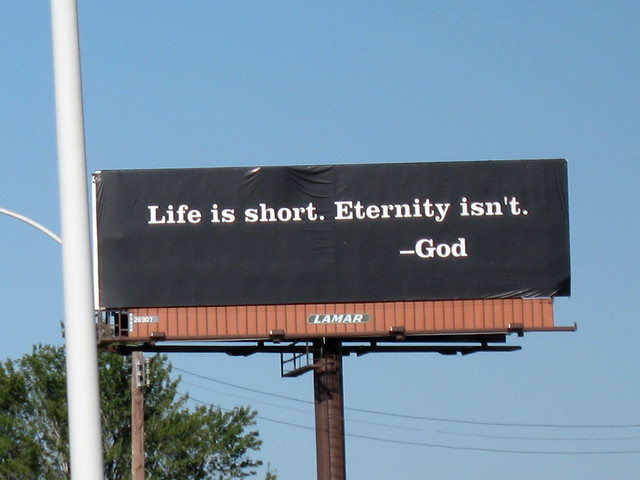
A Sign From God

Do you sometimes wonder whether something that happened to you is a sign from God?

Maybe you’ve heard the joke about the guy who told God that if the parking spot directly in front of the donut shop was open, he’d take that as a sign that he could go ahead and buy a dozen donuts.

And sure enough, after his eighth time around the block, it was open!

It’s sometimes hard to recognize when something really is a sign from God, isn’t it? We put our own spin on circumstances, and conveniently draw the conclusions that align with our desires.

But there are some things that we can be absolutely certain are signs from God, because they align with His Word.

When you see the following “signs” in your life, take note and obey them:

ONE WAY: There is only one way to God, and that is through Jesus Christ.

Jesus answered, "I am the way and the truth and the life. No one comes to the Father except through me. (John 14:6)
Read more

Are You a Cat or a Dog?

It’s hard to embarrass a cat. They just don’t seem to have a sense of shame.

If they’ve done something naughty, like shredded the fabric on your expensive couch with their claws, they’re not actually sorry about it. They’re just ticked off that you’re making such a big fuss about it.

Cats seem to lack the ability to be repentant.

Dogs, on the other hand, can definitely feel and show contrition.

Just take a look at the plethora of “dog-shaming” videos online.

Dog owners upload clips in which they confront their mutts with the evidence of their misdeeds. The owners come home to garbage-strewn rooms, destroyed furniture, and chewed-up shoes. The disaster area is documented on video, and then the camera pans to the dog…

The results are often hilarious.

The mutt slinks off with its tail between its legs, or else sits there looking sheepish and trying not to meet their owner’s eyes. The pooch might even try to hide in a cupboard.

Yes, dogs know when they’ve done something wrong.

The question is, do we?

Are we quick to ask God’s forgiveness when we sin, or do we justify our behaviour to ourselves and continue in our disobedience?

Read more

The Best Worst Day

There are some dates in history which stand out for being associated with awful events. Each year, when the calendar rolls around to these dates, we shudder in horror when we recall what happened.

Here are a few “worst days in history” that come to mind:

September 11th, 2001: the deadly World Trade Centre terrorist attacks in New York.

August 6, 1945: the dropping of a nuclear bomb on Hiroshima, Japan.

June 28, 1914: the day Archduke Ferdinand was assassinated, igniting the horrific First World War which killed tens of millions.

December 26, 2004: the Boxing Day tsunami which killed hundreds of thousands.

Some horrible dates in history have specific terms associated with them, such as:

December 7, 1941: the Japanese attack on Pearl Harbor, a date which President Roosevelt said would “live in infamy.”

October 29, 1929: called “Black Tuesday,” the worst day of a stock market crash which would send the world spiralling into the Great Depression.

What term is associated with the horrible day Jesus Christ was crucified?

“Good.” It’s called Good Friday.

But why?

Read more

The Game is Rigged

In life, it’s easy to conclude that you’re getting the short end of the stick.

On social media, everyone seems to be having a better life than you are.

At the grocery store, each year you pay a bit more for the same item.

In the parking lot, the other guy inevitably gets the spot you were waiting for.

At the casino, the house always wins.

Even your bathroom scale seems to be part of the conspiracy against you: surely it’s rounding up?

But with God, this isn’t true. The game is rigged in your favour!

How so?

When we think of the scales of justice and mercy, we assume they’re evenly balanced. But God actually has his finger on the scale, so to speak. For those who believe in His Son, it’s tilted heavily toward mercy.

“The Lord isn't slow about keeping his promises, as some people think he is. In fact, God is patient, because he wants everyone to turn from sin and no one to be lost.” (2 Peter 3:9)

God longs to be merciful (Isaiah 30:18). But at the same time He must judge sin.

How does He reconcile these two seemingly contradictory impulses?

At the Cross.

Read more

You Dirty Dog!

Bad dog! Image from Picryl, Public Domain.

Imagine your living room is perfectly clean.

I mean perfectly. Your white couch is utterly spotless. Your white carpet looks pristine. There isn’t an iota of dust or dirt anywhere in the room.

And then your dog wants in.

Rover somehow found the only mud puddle in the dog park and spent a considerable amount of time rolling around in it.

He stands on the other side of the back door, wagging his tail and smiling, unable to figure out why you won’t let him in. After all, surely you love him, don’t you?

But you know that the second you let Rover in, he’ll shake his fur and send thousands of bits of mud all over your perfectly clean living room.

The solution?

Clean Rover off before he can enter the house. Hose him down, dry him off, and wipe his paws. Rover may not understand the necessity of all this, but it’s your living room and your rules.

Likewise, we sometimes can’t understand why God wouldn’t let us into Heaven just as we are.

Sure, we’ve committed a few sins, but we’re pretty decent people overall, aren’t we? Doesn’t God love us? What’s the necessity of a having a Saviour to atone for our sins?

Read more

The Throne of Grace

Image by Ralph from Pixabay

What does your favourite chair look like?

Is it a ratty recliner held together with pieces of duct tape, like the one used by Marty Crane on the TV sitcom “Frasier”?

Or is it more regal and imposing, dominating the room like a throne?

I think many of us rather like the idea of having a throne like the ones monarchs throughout history sat on.

The seat of the Chinese emperors was known as the Dragon Throne. The Mughal emperors of India had the Peacock Throne.

Korean monarchs sat on the Phoenix Throne, and Japanese emperors on the Chrysanthemum Throne.

The Shahs of Persia sat on a royal throne known as the Marble Throne, while Swedish monarchs were crowned on the Silver Throne.

Both the emperors of Vietnam and the Pharaoh Tutankhamen were enthroned on a Golden Throne.

And of course fantasy novelist George R. R. Martin has given us the Iron Throne, the seat of the monarch in the fictional Seven Kingdoms of Westeros. It was said to have been made of the swords of defeated enemies.

But there’s a throne made of something infinitely more precious than any of the above…

The Throne of Grace.

Read more

The Mystery of the Larch Tree

It’s easy to categorize trees, isn’t it?

Deciduous trees lose their leaves in the autumn. Coniferous trees bear cones and keep their needles throughout the year. It’s simple to tell them apart.

Case closed, right?

But what about the larch tree? It bears cones and has needles like a conifer, but the needles drop off each autumn like a deciduous tree.

So which is it, coniferous or deciduous?

The answer to this mystery is that it’s both at once. The larch tree is actually a “deciduous conifer.”

Larches fall into a special third category of tree. It’s a member of the pine family, and yet its wood is harder than pine wood; it’s more like the hardwood of deciduous trees. It has needles like a conifer, but they turn a golden yellow each autumn and drop off, like the leaves of a deciduous tree.

Larches are a rare combination of deciduous and coniferous, unique trees with characteristics of both.

You could say that larches are two things at the same time.

In the same way, you could say that Jesus was two things at once. Just as the larch is one tree with two natures, Jesus was one being with dual natures: both God and human.

Read more

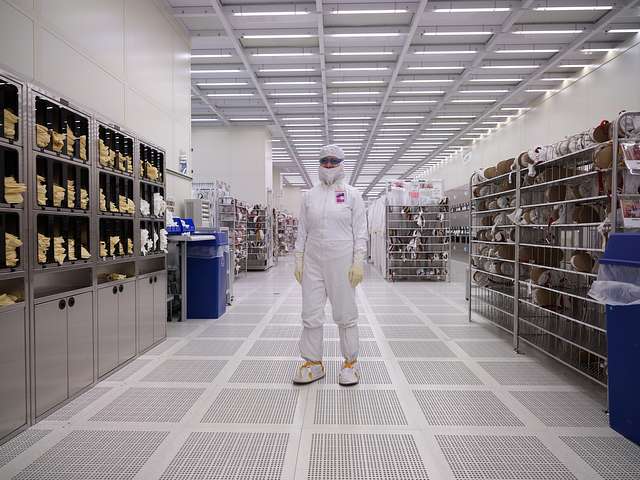
The Cleanest Place in the World

What is the cleanest place on Earth?

If you guessed a room where semiconductors are made, you’d probably be right.

A microchip factory has to be exceptionally clean to avoid introducing contamination into the chip-making process. In fact, the air in their “cleanrooms” is filtered to be vastly cleaner than that of a sterile hospital operating room.

Anything that sheds particles must be avoided in a microchip cleanroom. Contaminants include human hair, dead skin cells, makeup, bacteria, and even micro-dust from pencils or paper.

So semiconductor workers must wear head-to-toe “bunny suits,” protective glasses, booties, hoods, face masks, and two pairs of gloves. These suits may include self-contained HEPA filter packs, because even human breath contains contaminants.

Let’s assume that I arrived one morning at a microchip factory as a new employee.

Let’s say I told the supervisor that I’d cleaned myself diligently in the shower that morning, washed my hair twice, gargled with Listerine, scrubbed my hands with bleach, and put on brand-new clothes. I was certain that I was clean enough to enter the factory.

The supervisor would say, “Hold your horses, Lori. You still have to put on a protective covering before you can come into the cleanroom.”

I might argue, “But I’m already cleaner than 95% of other people. I don’t need a covering. Let me in!”

My boss would say, “I’m sorry, but you’re not as clean as you think you are. We have very high standards here. You have to suit up first.”

Isn’t that sort of what entering Heaven is like?

Read more

Nip Sin in the Bud

Image by mouad gnnoni from Pixabay

Is it possible to limit yourself to just one piece of chocolate?

I’ve never been able to.

I find that having the first piece simply whets my appetite for a second. And I deserve a treat, don’t I?

Then I reason that dark chocolate contains antioxidants, so I’d better have several more pieces, if only for medicinal purposes. After all, you wouldn’t want me to oxidate, would you? I should hope not.

Finally, I rationalize continuing my chocolate binge by referring to the nutritional information on the package of my favourite dark chocolate for support.

It states that 4 squares of the chocolate contain 25% of my daily recommended amount of iron. So if I ate 16 squares, I’d be getting 100% of my daily iron needs met, right? Well, it’s important to prevent anemia, so I then decide I’d better finish off the package completely.

Do you see how my excuses and justifications led from having one piece of chocolate to consuming an entire heap of the stuff in short order? And how easily this all happened?

It’s the same way with sin, isn’t it?

It starts out tiny and unnoticeable, but can soon grow into a mess of mammoth proportions.

That’s why it’s so important to nip sin in the bud, because we have no idea where a “small” sin will lead.

Read more

The Burning Question

Image by Anelka from Pixabay

Are tomatoes fruits or vegetables?

I might have opened up a can of worms just by asking, because disagreement has surrounded this issue for generations.

In fact, the US Supreme Court has even weighed in on this burning question.

This issue was brought to a head in 1893 in Nix v. Hedden. The Court held that, even though tomatoes are fruits botanically, they would be classified as vegetables for the purposes of tariffs, imports and customs.

Did this settle the matter? Hardly.

Some US states have since named the tomato their state fruit; others call it their state vegetable.

It’s the sort of issue that produces arguments to this day.

Let me ask you another question:

Was Jesus simply a good man and teacher, or was He Lord?

The answer to this question has eternal consequences for each of us. It’s not simply a matter of “You say tomayto, I say tomahto.”

Read more