The Mystery of the Larch Tree

It’s easy to categorize trees, isn’t it?

Deciduous trees lose their leaves in the autumn. Coniferous trees bear cones and keep their needles throughout the year. It’s simple to tell them apart.

Case closed, right?

But what about the larch tree? It bears cones and has needles like a conifer, but the needles drop off each autumn like a deciduous tree.

So which is it, coniferous or deciduous?

The answer to this mystery is that it’s both at once. The larch tree is actually a “deciduous conifer.”

Larches fall into a special third category of tree. It’s a member of the pine family, and yet its wood is harder than pine wood; it’s more like the hardwood of deciduous trees. It has needles like a conifer, but they turn a golden yellow each autumn and drop off, like the leaves of a deciduous tree.

Larches are a rare combination of deciduous and coniferous, unique trees with characteristics of both.

You could say that larches are two things at the same time.

In the same way, you could say that Jesus was two things at once. Just as the larch is one tree with two natures, Jesus was one being with dual natures: both God and human.

Read more
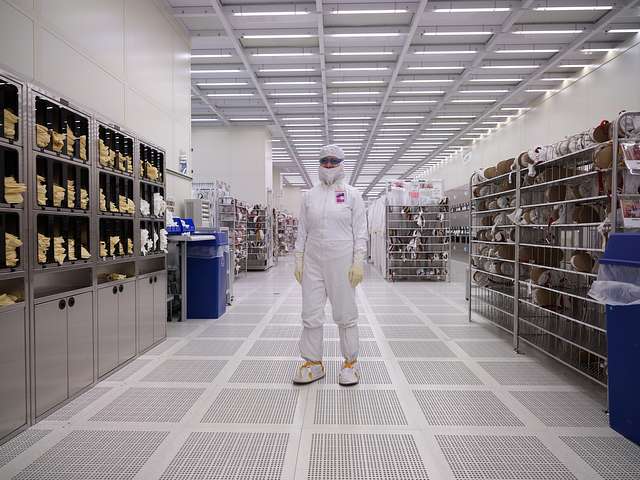
The Cleanest Place in the World

What is the cleanest place on Earth?

If you guessed a room where semiconductors are made, you’d probably be right.

A microchip factory has to be exceptionally clean to avoid introducing contamination into the chip-making process. In fact, the air in their “cleanrooms” is filtered to be vastly cleaner than that of a sterile hospital operating room.

Anything that sheds particles must be avoided in a microchip cleanroom. Contaminants include human hair, dead skin cells, makeup, bacteria, and even micro-dust from pencils or paper.

So semiconductor workers must wear head-to-toe “bunny suits,” protective glasses, booties, hoods, face masks, and two pairs of gloves. These suits may include self-contained HEPA filter packs, because even human breath contains contaminants.

Let’s assume that I arrived one morning at a microchip factory as a new employee.

Let’s say I told the supervisor that I’d cleaned myself diligently in the shower that morning, washed my hair twice, gargled with Listerine, scrubbed my hands with bleach, and put on brand-new clothes. I was certain that I was clean enough to enter the factory.

The supervisor would say, “Hold your horses, Lori. You still have to put on a protective covering before you can come into the cleanroom.”

I might argue, “But I’m already cleaner than 95% of other people. I don’t need a covering. Let me in!”

My boss would say, “I’m sorry, but you’re not as clean as you think you are. We have very high standards here. You have to suit up first.”

Isn’t that sort of what entering Heaven is like?

Read more

With God, You Get the Flower First!

Redbud blossoms. Photo by Sheila Brown, Public Domain CC0

Sometimes nature can be a bit unpredictable—things happen in an order we wouldn’t expect.

Normally, plants put forth leaves long before they produce flowers.

But some trees and shrubs flip the script, so to speak.

With certain plants, the normal sequence is reversed: the flowers come first, before the leaves have developed.

A good example is the beautiful redbud tree. It puts forth gorgeous pink flowers on its bare branches in early spring, when none of its leaves are yet in sight.

The forsythia shrub bears its bright yellow flowers in advance of its leaves, and the lovely magnolia presents its pink or white blooms before the green foliage appears. Some maples and oaks also exhibit this flower-first behaviour, although with less showy blossoms.

All of these plants give us a treat in springtime when we’re starved for colour. We get the flower first without having to wait for the leaves.

Why do some plants reverse the normal order of things?

Some trees are wind-pollinated, so put forth flowers before their bulky leaves get in the way. The same goes for flowers that need extra sunlight. Other plants produce a mass of conspicuous flowers first, unobscured by leaves, to better attract the attention of pollinating insects.

Did you know that God also flipped the script and gave us the flower first, so to speak?

Read more