If This Isn’t Love…

The love of God for us is one of those topics that you could spend a lifetime exploring.

As believers, we often focus on the Crucifixion of Jesus to demonstrate God’s love.

And rightly so: Jesus’ sacrifice on the Cross to redeem us from our sins was the epitome of extravagant love.

“God showed his great love for us by sending Christ to die for us while we were still sinners.” (Romans 5:8)

But I wonder if we give short shrift to the Incarnation.

The fact that God took on human form and walked among us for 33 years shows an astonishing level of love.

When Jesus came to earth, our story became His story. He chose to go through the same pain we do, and carry the same burdens we do.

Read more

Lost In Translation

Sign on toilet door in Chengdu airport, China
Photo by Anne Roberts on Flickr, CC BY-NC-SA-2.0

There’s a real art to translation: zeroing in on just the right words to convey the nuance of what the original author intended.

Done well, a translated work can be a masterpiece in its own right.

Oftentimes, though, a translation can turn out to be a farce, as in the following examples:

A menu item in Chinese for a roasted gluten dish was translated into English as “Sixi Roasted Husband.” (The perfect dish for wives who’ve finally had enough of their mates?)

A hot and spicy chicken dish on another Chinese menu became “Chicken Rude and Unreasonable” in English. (No wonder the chicken met his end—he had it coming!)

Or this Google Translate zinger: “It’s been the goat in the budget, because His raining badly, so quite short, he is on the bucket month out.” (Not sure what this meant in the original Danish, but I hope the goat was able to figure it out.)

Then there’s the sign for a hair salon in China whose English name is “Could Not Connect To Translator Service.” (A bit of a give-away that they didn’t bother hiring a real live translator?)

Sometimes, we have a different understanding or “translation” of what God actually meant in certain Bible verses.

For example, in times of difficulty, we cling to verses such as Romans 8:28:

“And we know that all things work together for good to those who love God, to those who are the called according to his purpose.”

However, it can often be hard to see what good could possibly come from our difficult situations. We might be going through health challenges, injustice, hardship or loneliness. Where is the good in any of that?

But maybe we have a limited understanding of what “good” means. Perhaps we and God have different “translations” of what this looks like in our lives.

Read more

God Won’t Waste Your Pain

Quilting Bee circa 1910s, New Jersey
Photo by Richard on Flickr CC BY-2.0

Did you grow up in a family that hated wasting things? So did I.

Instead of throwing out old scraps of fabric, my paternal great-grandmother would twist the lengths and sew the resulting cords together into a rag rug. Nothing was wasted.

It was the same on my mother’s side of the family. Material from clothes that were no longer of use would be cut up and sewn into quilts. My Mom recalls sitting underneath the quilting frame as a child when her mother and other female relatives worked together at a quilting bee (Mom thought she was “helping” push the needle back up to the top surface). Even as a little girl, my mother learned an early lesson in letting nothing go to waste.

I must have inherited that trait.

I love recipes that not only produce a yummy result, but that are efficient. By that I mean that you’re not left with partly used cans of an ingredient that will languish in the fridge and eventually have to be thrown out.

I prefer a recipe that uses up the whole can of an ingredient, or, if it calls for 3 egg yolks for the batter, it also calls for 3 egg whites for the filling or a meringue. Nothing is wasted. No leftover egg whites that you have to store until you think of another recipe that can use them up.

Likewise, I think God is efficient in how He manages our lives. He won’t waste anything we go through: it all has a purpose, even the negative parts.

Read more

The Other Side of the Window

Image from PIckpik

While walking in my neighbourhood the other day, I saw something mysterious.

On one person’s front lawn there stood a jumble of foot-high letters of the alphabet, placed upright on stakes near the front window.

But the letters seemed randomly placed; they didn’t form coherent words. Was this some sort of secret code? Also, the letters were backwards from the perspective of anyone walking by on the sidewalk.

I then realized that they were meant to be read by someone inside the house.

When I deciphered the letters with this in mind, it suddenly made sense. Someone inside looking out the front window would see this message clearly spelled out on their front lawn:

“Happy Birthday!”

I was looking at the letters from the wrong side of the window. If I had been inside the home gazing out, the message would have been clear from the get-go.

I think this is true of a lot of things in our lives.

Some things we go through as believers won’t make sense until we’re on the “other side of the window.” By that I mean when we’re in Heaven, looking back at our time on Earth.

Read more

The J-Turn

Image by Kahl Orr from Pixabay

I’ll bet that for many of us, car chases on TV shows or in films are a guilty pleasure.

There’s invariably a suspenseful moment where it looks like the bad guys have the heroes at their mercy: they’re coming at the protagonists head-on. The good guys are forced to throw their car into reverse to escape their pursuers.

It seems like the baddies have the upper hand, because our heroes are at the disadvantage of driving backwards.

But then comes the thrilling moment when the good guys make a 180-degree reverse turn, spin their car around, and peel off facing forwards without losing any speed. The bad guys are left in the dust.

Our heroes have just performed a “J-turn.”

This evasive driving technique is a staple of almost every action film with a car-chase scene. It was made famous in the old detective show “The Rockford Files,” in which it was Jim Rockford’s signature maneuver. The J-turn is also called the “reverse 180” or simply “The Rockford Turn.”

The master of J-turns in the Bible was none other than Jesus.

Although he never drove a car, Jesus was adept at rescuing people by suddenly reversing their situation.

Read more

Islands of Hope

Image of lighthouse on the coast of Newfoundland by Felix Dilly from Pixabay

Transoceanic plane travel has always been fraught with potential problems.

Fuel could run low or a plane could develop mechanic problems mid-flight. The pilots would need a place to set down, pronto.

But in the middle of the ocean, where is there to land?

That’s where islands come in.

There are some handy places to land even in the vast expanse of the oceans.

In the Pacific, islands such as Midway, Wake, and Hawaii are available. The Atlantic offers Iceland, the Azores, and Bermuda, among others.

Not least is Newfoundland, an island off the eastern coast of Canada. For decades its Gander airport was used as a refuelling stop for planes making the hop across the Atlantic. It’s also an emergency landing spot for aircraft in trouble.

Gander is perhaps best known for its role in accepting 38 diverted planes that had to set down during the terrorist attacks in the U.S. on 9/11, twenty-two years ago today. Over six thousand passengers were generously hosted by the surrounding communities until U.S. airspace was reopened, a story commemorated in the hit musical, “Come From Away.”

Gander was truly an island of hope during that time.

I think we can all be islands of hope for others.

Read more

Master of Deception

Peacock butterfly on a flower. Image from Pixabay

If you’re out for a walk in nature, you may not realize how much you’re being tricked.

You may think you’ve got an accurate picture of the natural world around you, but in many cases, you’re being fooled.

That’s because some creatures are masters of deception.

Stick insects camouflage themselves by mimicking the shape and colour of twigs on a tree. Moths may blend in so well with the bark pattern of the tree they’re resting on that you’d never know they’re there.

The killdeer bird fakes having a broken wing to make a predator think she will be an easy meal, thereby luring it away from the vulnerable chicks in her nest before she flies away.

Even beautiful butterflies get in on the act of trickery. Some species have markings on their wings that look like huge eyes. The eyespots may discourage a predator from attacking by making it think the insect is in fact a much larger animal.

These false eyes may serve another purpose: to encourage an attacker to aim for the wrong target. The markings deflect an attack away from the butterfly’s head or body to parts less vital for survival, such as its wing margins. By using this deception, the butterfly outwits its enemies and is able to fly away with a torn wing at worst, but otherwise relatively unscathed.

Butterflies aren’t the only creatures to use misdirection in this way:

Satan does, too, and we need to be wise to his tactics. We may not realize how much he’s tricking us.

Read more

The Wrong Idea of Dessert

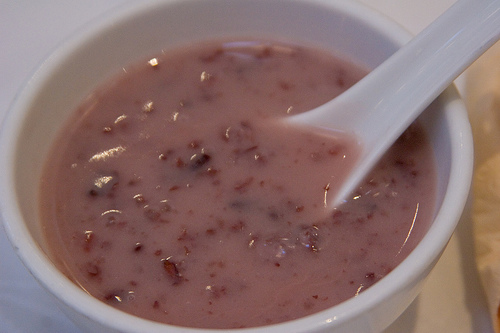
Image of sweet red bean soup by Roland from Flickr, CC BY 2.0

Do you like brownies? How about chocolate cake?

If you do, then you and I are on the same page when it comes to sweets. We both have the same idea of what a perfect dessert is.

Not everyone might agree with us, however.

Take my friend John, whose background is Greek. He likes syrupy-sweet desserts like the Greek classic baklava, or nut-based ones like walnut cake, things I love as well.

John happens to be married to an Asian woman. They agree on most things, except when it comes to dessert.

Case in point: John’s in-laws once treated him to dinner at a Chinese restaurant. They promised him an extra-special dessert to finish off the banquet, something he’d absolutely love.

John couldn’t wait: his mouth was watering in anticipation of this mystery dessert. He imagined something intensely sweet to finish off the meal, perhaps a cake with multiple layers and lots of icing.

But when the dessert was placed in front of him, John was confused.

It was red bean soup.

While this dish is popular among Chinese people and is considered the crown jewel to end a banquet with, it wasn’t John’s idea of dessert. He was gracious in front of his in-laws, but secretly felt cheated.

The problem? John’s definition of dessert was different to that of his in-laws. His expectations were askew, so he was disappointed with what he got.

I think the same thing happens to us when read certain Bible verses—we may build up incorrect expectations based on our ingrained ideas.

Read more

Same Spider, Different Silks

Dew drops on spider’s web. Image by Pezibear from Pixabay

When you let your mind wander, do you ever find yourself asking odd questions?

Such as, “Why doesn’t glue stick to the inside of the bottle?”

Or, “How do you grow a seedless fruit?”

Or how about this one:

“Why don’t spiders get caught in their own webs?”

I can’t help you with the first two, but I do have an answer for the third.

When spiders build their webs, they draw out silk from their abdomens with six spinnerets. The key is that they’re able to emit different types of silk for different purposes.

The spider first constructs a frame for its web. Then, it lays down spokes of non-sticky silk to use as walkways.

Next, the spider weaves spirals of connecting lines between the spokes using sticky silk. This is for ensnaring small insects that it will later eat. The spider knows to avoid walking on these gluey strands.

A spider can also spin stretchy silk for the centre of its web, or extra-strong silk for the anchor lines.

Whichever type of silk the spider decides to spin, it all has a specific purpose. And even though the types of silk differ, they all come from the same source.

I think we can borrow this analogy to describe how we can receive quite different things from God’s hand.

Read more

Shift Your Perspective

Mallard duck. Image by Ralphs_Fotos from Pixabay

Among the most spectacular aspects of nature for me are its colours.

I’m continually wowed by the vivid colours found in nature, such as the brilliant red plumage of the Northern cardinal.

The cardinal’s red feathers, which come courtesy of pigments, look the same when viewed from any angle. But there’s another source of colour in nature that is even more mesmerizing:

Iridescence.

With iridescence, the hue of something changes when seen from different angles. You’ve probably experienced this shimmery optical phenomenon yourself when looking at certain insects, butterflies, birds, or even soap bubbles.

A good example of iridescence is the head of the mallard, a common duck found in the northern hemisphere. Its head appears to be a bright emerald green at first, but if you shift your angle of observation, it can appear green-gold, blue, or indigo.

It all depends on your perspective.

Maybe there’s a little lesson here for us.

If we shift our perspective about our own situations, we can see beauty that we didn’t know was there.

Read more