Get With God’s Program!

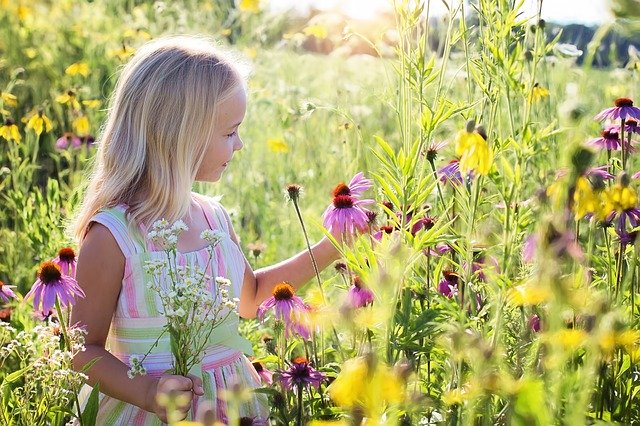
Photo by Jill Wellington on Pixabay

I don’t seem to have much luck getting birds to cooperate with me.

Years ago, I bought a Victorian-style birdhouse, and painted it light blue with white trim. I nailed it to a tree where I could see it when sitting at my kitchen table. I imagined the delight I’d have watching birds move in and raise their young there. I couldn’t wait for my new feathered neighbours!

But the birds refused to move in.

Year after year, the pretty birdhouse sat empty. I was so disappointed. What ingrates those birds were! And after all the trouble I’d gone to for them!

The problem was, I’d put the birdhouse where I wanted it, with no thought to their needs.

The birdhouse was pretty, certainly, but its placement didn’t suit the birds one bit. Being nailed to a tree made it too accessible to predators like squirrels or racoons. The birds didn’t feel safe nesting there.

I thought the problem was with the birds, but it was with me. I’d done it all on my terms and expected them to get with the program.

Don’t we sometimes do the same with God?

We want to do things on our terms, in our own way, and expect God to get with our program. I’m afraid it doesn’t work that way.

Read more

Give It Time

Antique clock photo by Wallpaper Flare

Do you get the feeling that society is becoming too impatient?

We seem to expect instant results these days: immediate responses to our texts or emails, same-day delivery for things we order, or instantaneous loading of videos or web pages. In fact, a study showed that a YouTube video that loads slowly will start losing viewers after two seconds.

The problem is that sometimes our impatience with technology gets applied to people, too. We expect people to change quickly, and if they don’t, we lose patience with them and give up on them.

This reminds me of the tale of the handkerchief tree.

Called the dove tree in its native China, it became known to Western visitors in the late 1800s, who were entranced by it. The handkerchief tree features stunning white bracts surrounding its flowers, which resemble doves, ghosts or fluttering handkerchiefs, hence its name in the West.

European botanists in China collected the seeds and brought them back home, keen to grow such a gorgeous tree. One gardener planted the seeds, but was disappointed to find after a year that they hadn’t sprouted into seedlings. Figuring that the seeds must be no good, he discarded them by dumping them onto his compost pile, then forgot about them.

To his surprise, two years later he saw a bunch of seedlings on the compost pile. They were from the handkerchief tree. They had sprouted after all!

What he didn’t know was that seeds of the handkerchief tree have what’s called a “double dormancy”: they require two years to germinate, unlike most seeds which will sprout within the first year.

He had written them off too soon.

Don’t we do the same with people sometimes?

Read more

Consider the Lilies

Photo of Tiger Liliy from Pxfuel

Do you spend a lot of time in the morning fretting about what to wear?

You’re not alone. Many of us worry about our clothes. We’re afraid that they aren’t stylish enough, or that they make us look fat, or that they’re last year’s (or even last millennium’s) fashions.

Some of us even worry that we won’t have enough money to buy the basic clothes we need.

But we shouldn’t be anxious that God won’t provide for us. After all, look how He’s clothed the flowers.

Have you ever marvelled at the rich “vestments” some flowers are clad in?

Look at the iris attired in silky frills, the peony robed in ruffles, or the delicate tracery of Queen Anne’s lace. The sumptuous, constantly unfurling petals of the rose boast the finest tailoring. Some flowers are decked out in speckles, mimicking the polka-dots on a dress; others are costumed in stripes, like a crocus. Even the common petunia can have petals that resemble luxurious velvet.

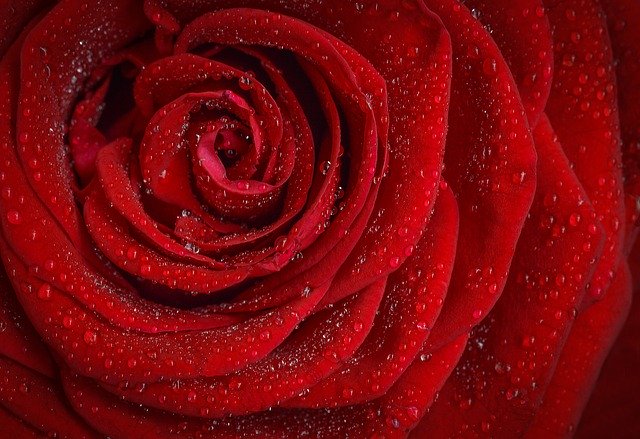
Red Rose photo by AliceKeyStudio on Pixabay

God hasn’t stinted on giving flowers rich colours, either. What about the intense blue of lobelia, suitable for any royal robe? Or the bright yellows of daffodils, the vivid oranges of marigolds, or the saturated reds of poppies? On the paler end of the spectrum are the shy blues of the forget-me-nots and the delicate ballet-pinks of some tulips.

Some flowers even have names which relate to clothing: bachelor’s buttons, lady’s slipper, Texas bluebonnet, foxglove, lady’s mantle, and monk’s hood.

And how about those lilies? In fact, I seem to remember a Bible verse which talks about the beautiful garments lilies wear:

“So why do you worry about clothing? Consider the lilies of the field, how they grow: they neither toil nor spin, yet I say to you that even Solomon in all his glory was not arrayed like one of these.” (Matthew 6:28-29 NKJV)
Read more

What’s in a Name?

Photo by Jill Wellington on Pixabay

As a gardener, I must admit that I prefer using the common or folk names for flowers.

These sometimes ancient names are often whimsical and enchanting. Who wouldn’t love calling flowers by such names as cherry pie plant, lady’s slipper, love-in-a-mist, baby blue eyes, bachelor’s button, quaker ladies, whirling butterflies, johnny-jump-up, busy lizzie, or candytuft? It makes the heart sing to use endearing names like these.

The scientific or botanical names for flowers, on the other hand, can seem daunting. They’re usually derived from Latin, and while they can give a more accurate description of what a plant’s nature is, they can sound a bit intimidating to my ears.

In fact, some botanical names actually sound like a disease:

“Don’t tell anyone, but I’ve got Scabiosa again.”

“That’s nothing! You should see my sister’s Myosotis: it’s rampant.”

“You don’t say! But did you hear about Kelly? She’s got Nepeta nervosa.”

“No! Is she seeing a psychiatrist for that?”

(In case you’re wondering, Scabiosa is the botanical name for the pincushion flower; you might know Myosotis better as the little blue forget-me-not; and Nepeta nervosa is a type of catmint.)

I’m so glad that we have the opportunity to use informal names for the flowers we cherish.

In the same way, believers have been given the great privilege of using a remarkably intimate name for God: “Abba Father.”

Read more

When Nature Sings, Sing Along!

Image of crocuses by Annette Meyer from Pixabay

No matter where you live, spring is a time of joy.

In my part of the world, shy white snowdrops are the first flowers to bloom in spring.

Crocuses, slightly bolder in colour with their yellows or purples, are the next to make an appearance.

The tulips take their time, first poking the tips of their leaves above the ground like a periscope, as if checking to see whether it’s safe to emerge. They then burst forth in bright, vivid colours, their blooms held aloft on tall stems like upright trumpets.

“The flowers are springing up, the season of singing birds has come, and the cooing of turtledoves fills the air.” (Song of Solomon 2:12)

After a long, colourless winter, it makes my heart sing to see the arrival of spring.

But do the flowers and trees themselves sing? And if they do, what is their song telling us?

Author Linda Brooks, in her 2018 book, “Orchestra In My Garden,” seems to share my sentiments about the spring season:

”Once the snow disappears and my garden starts to emerge from its slumber, I cannot jump up fast enough to catch the first light, to lose (and find) myself among kindred spirits and bend my ear to their voices. No, I am not deluded. I do understand that plants are not human and cannot speak, but no one can convince me that they do not sing.”

She’s right: plants do sing. But she’s perhaps missed who they’re singing to.

They sing to God.

Read more

It’s Raining Diamonds!

If diamonds are a girl’s best friend, I’m on the wrong planet.

I’ve just discovered that there are planets on which it rains diamonds.

Scientists believe that diamond rain could occur deep in the atmospheres of our gas giant neighbours in the solar system: Jupiter, Saturn, Uranus and Neptune.

Thousands of miles below the surface of these planets, carbon atoms come under such crushing pressure in the dense atmospheres that diamonds could form. The conditions are so extreme that further down, the diamonds could melt into liquid, forming diamond “rain” drops.

On some planets in the universe, these drizzles could involve diamonds millions of carats in size.

The wonders of the cosmos don’t end there. Scientists suggest that on the exoplanet WASP-121b it rains liquid rubies and sapphires. Clouds on this planet could be made of corundum, a mineral out of which these precious gems are formed.

It gets better.

The asteroid Psyche 16, which orbits the sun in the asteroid belt between Mars and Jupiter, is made entirely of solid metal. It has enough gold to turn every person on Earth into a billionaire. As well as gold, this intriguing minor planet contains metals such as platinum, iron and nickel in abundance. If Psyche 16’s metals were on Earth, their combined value would be worth perhaps $100,000 quadrillion.

Talk about an embarrassment of riches!

What does all this tell us?

That the precious gems and metals we covet are a dime a dozen in God’s universe. After all, Scripture tells us that in Heaven, the streets are paved with gold.

More importantly, God has an inexhaustible supply of the things that we truly need: grace, mercy, love, and forgiveness.

Read more

Jesus Has an Open Door Policy

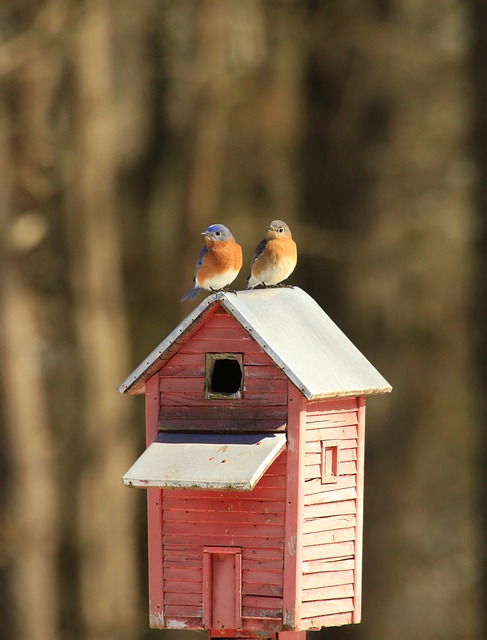
Image by Lori from Pixabay

When building a birdhouse for your feathered friends, the size of the “front door” is crucial.

You must create the right-sized entrance hole or the “wrong” bird will take up residence.

For instance, a wren or chickadee prefers an entrance hole to be about 1.125 inches across. A bluebird likes a slightly bigger doorway, about 1.5 inches in diameter.

A finch needs an opening 2 inches across, thank you very much, and purple martins prefer a bit more wiggle room than that to squeeze through the front door.

And if you don’t surround the hole with protective metal mesh, the squirrels will chew the hole bigger and move in themselves. Then you’ll discover you’re the proud owner of a squirrel house (I learned this the hard way).

All of this got me thinking about the story of Noah’s Ark in the Bible…

Read more

Why Is The Universe So Big?

Image from Pixexid

Have you ever wondered why the universe is so immensely big?

Astronomers at NASA suggest that the most distant objects in the universe are about 47 billion light years away from Earth. This would make the size of the observable universe about 94 billion light years across. (A light year is the distance light travels in one year, about 6 million million miles.)

But that just describes the extent of our observable limits. The universe is vastly larger than that, because it is expanding at a rapid rate.

If there is an “edge” to the universe, it’s expanding away from us faster than we could ever catch up. No matter how swift our spaceship, we would never hit a boundary of some kind.

So for all practical purposes, you could say that the universe is infinitely big.

But why did God create it this way?

Read more

The Mystery of the Larch Tree

It’s easy to categorize trees, isn’t it?

Deciduous trees lose their leaves in the autumn. Coniferous trees bear cones and keep their needles throughout the year. It’s simple to tell them apart.

Case closed, right?

But what about the larch tree? It bears cones and has needles like a conifer, but the needles drop off each autumn like a deciduous tree.

So which is it, coniferous or deciduous?

The answer to this mystery is that it’s both at once. The larch tree is actually a “deciduous conifer.”

Larches fall into a special third category of tree. It’s a member of the pine family, and yet its wood is harder than pine wood; it’s more like the hardwood of deciduous trees. It has needles like a conifer, but they turn a golden yellow each autumn and drop off, like the leaves of a deciduous tree.

Larches are a rare combination of deciduous and coniferous, unique trees with characteristics of both.

You could say that larches are two things at the same time.

In the same way, you could say that Jesus was two things at once. Just as the larch is one tree with two natures, Jesus was one being with dual natures: both God and human.

Read more

God Will Provide

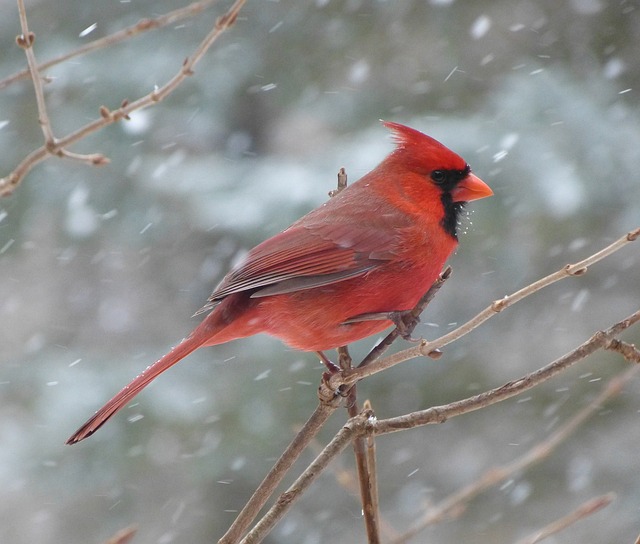
Image by tlparadis from Pixabay

If you live in eastern North America, you might be lucky enough to have seen a gorgeous bird called the northern cardinal.

The male is especially distinctive, with his breathtaking red plumage and black “mask” on his face.

Up here in Canada, the cardinal is at the northernmost part of its range. We’re especially fortunate that, unlike many songbirds, cardinals don’t migrate south for the winter. We get to enjoy their presence year-round.

But what on earth do the cardinals eat here, when parts of Canada might be covered in several feet of snow?

Read more