A Series of Fortunate Events

Sometimes it takes a bit of time before we can tell if an event will turn out to be good or bad for us.

Take the famous Chinese proverb about Sai Weng losing his horse. The story goes like this:

Sai Weng, a old farmer, raised horses for a living. One day, his prized stallion ran away. His neighbours comforted him in his misfortune by saying, “What terrible luck!”

Sai Weng merely replied, “Maybe so, maybe not. We’ll see.”

Later, the stallion returned, bringing with it several wild mares. The farmer’s neighbours congratulated him on his good fortune: “What wonderful luck!”

Again, Sai Weng only said, “Maybe so, maybe not. We’ll see.”

One day, Sai Weng’s son tried to ride one of the new mares, but was thrown off and broke his leg. The neighbours again commiserated with the farmer, saying, “What bad luck!”

Sai Weng once again replied, “Maybe so, maybe not. We’ll see.”

Later, soldiers from the national army came through town, conscripting all able-bodied men for service in the war. The farmer’s son was spared, however, because he was still recovering from his broken leg. The neighbours said, “What great luck!”

Sai Weng simply said with a smile, “We’ll see.”

We often can’t judge whether an event in an of itself is fortunate or unfortunate. Sometimes only time will tell the whole story.

This is especially true when God is working behind the scenes of our lives, fashioning seemingly random events to conform to His purposes. God is often playing a “long game,” as it were: in the end, individual events that we might view as bad actually turn out to be good.

Read more


The Perfect Christmas?

Photo by Adam Clark on Flickr CC BY-SA 2.0

What’s your idea of the perfect Christmas? Many of us have images in our minds of what the ideal Yuletide should look like.

It usually involves a spectacular Christmas tree with enticing gifts piled beneath it. The house would be decorated with pine boughs and red bows inside, and the exterior decked out with lights. The day itself would feature a scrumptious dinner with all the fixings, and numerous home-baked desserts. Top it all off with a house full of family, friends and laughter.

There’s only one problem with this picture.

It’s awfully hard to live up to.

Perhaps you were laid off from your job just before Christmas. Or maybe you’re employed, but things are still really tight financially. You just can’t provide all the gifts that your children have been asking for, and you know they might be disappointed.

Or maybe someone in your family is going through a health crisis. It looks serious, and you’re all under a lot of stress as a result. It might be hard to feel “merry” this Christmas.

It could be that you have some fractured or broken relationships in your life. Maybe things are very tense with a certain family member. Or perhaps you’ve lost someone dear to you, and this will be the first Christmas without them. The holidays might be a lonely time for you.

There are a lot of reasons why the Christmas season might fall short of what we want it to be.

But when you think about it, the first Christmas was fraught with struggles, too. Mary and Joseph certainly didn’t have it easy.

Read more

The Other Side of the Window

Image from PIckpik

While walking in my neighbourhood the other day, I saw something mysterious.

On one person’s front lawn there stood a jumble of foot-high letters of the alphabet, placed upright on stakes near the front window.

But the letters seemed randomly placed; they didn’t form coherent words. Was this some sort of secret code? Also, the letters were backwards from the perspective of anyone walking by on the sidewalk.

I then realized that they were meant to be read by someone inside the house.

When I deciphered the letters with this in mind, it suddenly made sense. Someone inside looking out the front window would see this message clearly spelled out on their front lawn:

“Happy Birthday!”

I was looking at the letters from the wrong side of the window. If I had been inside the home gazing out, the message would have been clear from the get-go.

I think this is true of a lot of things in our lives.

Some things we go through as believers won’t make sense until we’re on the “other side of the window.” By that I mean when we’re in Heaven, looking back at our time on Earth.

Read more

Last-Minute Christmas

Image of Lafayette department store in Paris
by Peggy und Marco Lachmann-Anke from Pixabay

Do you leave your Christmas shopping until the last minute?

Surveys show that many of us do, with some people putting off their gift-buying until Christmas Eve itself.

This is a risky practice, because more often than not, the gift you come up with will be rather…interesting, shall we say.

With the stores sold out of the most popular items and the most common sizes and colours, you’re reduced to choosing gifts that are sometimes not well matched to the recipient.

Such as an extra-small sweater (in purple, no less) for your hefty brother.

Or an electric drill for your great-aunt Elspeth.

Oh, well, I suppose there are always gift cards!

But sometimes last-minute ideas can be wonderful.

Think of the origin of the Christmas carol “Silent Night,” which dates back to Austria in 1818.

Read more

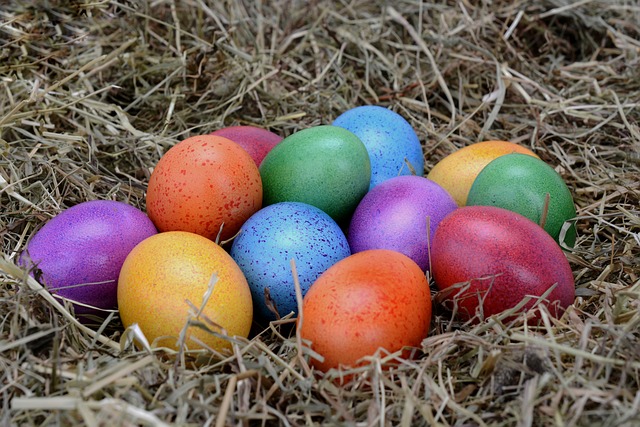
Easter Eggs at Christmas

Image by Annette from Pixabay

At Christmas, do your thoughts turn to Easter eggs?

Probably not, unless you’re an avid player of video games or a fan of certain movie franchises.

In the cinematic and computer worlds, an “Easter egg” is a secret message, image, or feature hidden in software, games, or films.

With video games, an Easter egg might be an unpublished feature or hidden property of the game that is normally hidden from the public eye. It can only be accessed by certain button combinations that are not common knowledge.

Easter eggs inserted by filmmakers in their works might involve a jokey detail or an obscure reference to a previous movie by the same auteur. Only the most alert audience members catch them.

For instance, famed film director Alfred Hitchcock had a penchant for appearing in cameo roles in his own movies. In 39 of the 52 films he directed, he left “Easter eggs” consisting of himself in blink-and-you-miss-it bit parts.

Are there any “Easter eggs” to be found hidden in the Christmas story in the Bible?

Actually, there are.

If you read the Scriptures closely, you’ll find that there are foreshadowings of Easter sprinkled throughout the accounts of Christ’s miraculous birth.

Read more

Your Training Won’t Make Sense at First

Image by Bart via Flickr. CC-BY-NC 2.0

“Why do we have to learn math? We’ll never use it in real life!”

Did you ever say something like that to your teachers in school?

It’s true that you may never have used algebra once you graduated from high school. Your knowledge of trigonometry or calculus may have lain dormant since then, too.

But that wasn’t actually the point of algebra, or any other subject.

The point of learning math was to train your brain.

Mastering mathematical concepts increases your problem-solving skills, develops flexible thinking and creativity, and encourages analytical reasoning.

These are things that are extremely valuable in every area of life.

But you might not have been able to see that when you were trying to understand the Pythagorean theorem in school.

That’s because your training often won’t make sense until much later.

Several heroes in the Bible found this out:

Read more

Cna Yuo Raed Tihs?

Image by WOKANDAPIX from Pixabay

I’ll bet you can!

I’m sure most of us immediately deciphered the title of this post as “Can You Read This?”

But how was your brain able to make sense of the jumbled letters so quickly?

Researchers believe that our brains use context to make predictions about what’s to come. Take an example like:

“Yuo cna porbalby raed tihs esaliy desptie teh msispeillgns.”

This is readable because as our brains decipher each word, they also predict which words would logically come next in order to make a coherent sentence. When faced with a word we can’t quite unscramble, our brains fill in the gaps based on subsequent words.

This even works with words that have NUMB3RS 1NST3AD 0F L3773RS. The numbers’ similar appearance to letters trumps their normal meaning.

Jumbled words are easiest to read when the first and last letters of the word remain the same, and only the letters between them are transposed. But when the middle letters are scrambled more confusingly, your brain has a harder time trying to process all the letters simultaneously. Try deciphering this:

“Big ccunoil tax ineesacrs tihs yaer hvae seezueqd the inmcoes of mnay pneosenirs.”

That was a bit more difficult, wan’t it?

But what about when it’s our lives that are a-jumble? When things happen to us that don’t seem to fit a meaningful pattern?

How do we make sense of the bewildering hardships and crises that often beset believers?

Read more

Unsung Heroes

Image by Myriams-Fotos from Pixabay

Ever had a time when all your plans were upended?

Joseph certainly did.

The man who would become the earthly father of Jesus probably had his life all mapped out.

He thought he’d get married to Mary, settle in Nazareth with her, have a posse of kids, and build his business. He could probably foresee how his life would unfold over the ensuing decades.

But then God stepped in.

First Joseph had to deal with the jaw-dropping news that an angel told Mary that she would bear the Messiah. Joseph was told by a divine messenger to go ahead with the marriage, despite tongues wagging in town about his being cuckolded by some other man. No doubt Joseph hadn’t figured his married life would start out this way.

Then the couple had to travel to Bethlehem to be counted in a census. While there, Mary delivered her child in a stable. Joseph certainly never thought this was how a child of his would be born.

The next thing you know, the young family had to flee to Egypt to escape those who wanted to murder Jesus. I’m sure Joseph hadn’t banked on having to travel to a foreign country to evade capture by the authorities.

At every turn, Joseph’s life and plans were upended.

And yet he’s something of a hero in the Christmas story, albeit an unsung one.

Read more

You CAN Get There From Here!

Image by sdmacdonaldmiller from Pixabay

Have you ever heard the phrase, “You can’t get there from here?”

Said to have originated in the US state of Maine, it’s used humorously when describing a distant location that can’t be accessed without extensive, complicated directions.

The place might be difficult to get to from your current location, and the route may be very hard to describe. People simply throw up their hands rather than try.

This phrase is now used more generally to describe a problem that can’t be solved:

You simply can’t get there from here.

…or can you?

There may be things in your life that you think are impossible to solve.

But with God in the driver’s seat, you’d be surprised at where you may end up.

Read more

Get Ready For God To Act

Image by webvilla from Pixabay

When you read a cake or muffin recipe, it will usually instruct you to preheat your oven and get your baking pans prepared before describing how to make the dessert itself.

But why do it in this order? Why not make the batter first, and let it sit there in the bowl while you leisurely grease or line the baking pans and let the oven slowly heat up?

There’s a very good reason to have everything prepared before you start the actual baking, and it has to do with how leaveners behave.

As soon as a raising agent like baking soda comes into contact with the liquids in your cake batter, a chemical reaction starts to take place. Gases are generated, and bubbles begin forming. You want those bubbles to stay trapped inside the cake to give it loft and airiness.

If you let the batter sit there on the counter for too long, the gases would escape into the air. This would prevent your finished cake from being as light and fluffy as it could be. So as soon as the leavening agent is added and mixed in, put the batter into the prepared pan and get it into the heated oven as quickly as you can.

It’s the same way in life, isn’t it?

When God adds the circumstance or person that will be a catalyst to change your situation, things often begin moving very fast. If you’re not ready, it might catch you off guard. You may end up stumbling instead of stepping confidently into the new level God has in mind for you. You might not rise as high as you could have.

Read more