A Series of Fortunate Events

Sometimes it takes a bit of time before we can tell if an event will turn out to be good or bad for us.

Take the famous Chinese proverb about Sai Weng losing his horse. The story goes like this:

Sai Weng, a old farmer, raised horses for a living. One day, his prized stallion ran away. His neighbours comforted him in his misfortune by saying, “What terrible luck!”

Sai Weng merely replied, “Maybe so, maybe not. We’ll see.”

Later, the stallion returned, bringing with it several wild mares. The farmer’s neighbours congratulated him on his good fortune: “What wonderful luck!”

Again, Sai Weng only said, “Maybe so, maybe not. We’ll see.”

One day, Sai Weng’s son tried to ride one of the new mares, but was thrown off and broke his leg. The neighbours again commiserated with the farmer, saying, “What bad luck!”

Sai Weng once again replied, “Maybe so, maybe not. We’ll see.”

Later, soldiers from the national army came through town, conscripting all able-bodied men for service in the war. The farmer’s son was spared, however, because he was still recovering from his broken leg. The neighbours said, “What great luck!”

Sai Weng simply said with a smile, “We’ll see.”

We often can’t judge whether an event in an of itself is fortunate or unfortunate. Sometimes only time will tell the whole story.

This is especially true when God is working behind the scenes of our lives, fashioning seemingly random events to conform to His purposes. God is often playing a “long game,” as it were: in the end, individual events that we might view as bad actually turn out to be good.

Read more

Your Training Won’t Make Sense at First

Image by Bart via Flickr. CC-BY-NC 2.0

“Why do we have to learn math? We’ll never use it in real life!”

Did you ever say something like that to your teachers in school?

It’s true that you may never have used algebra once you graduated from high school. Your knowledge of trigonometry or calculus may have lain dormant since then, too.

But that wasn’t actually the point of algebra, or any other subject.

The point of learning math was to train your brain.

Mastering mathematical concepts increases your problem-solving skills, develops flexible thinking and creativity, and encourages analytical reasoning.

These are things that are extremely valuable in every area of life.

But you might not have been able to see that when you were trying to understand the Pythagorean theorem in school.

That’s because your training often won’t make sense until much later.

Several heroes in the Bible found this out:

Read more

You CAN Get There From Here!

Image by sdmacdonaldmiller from Pixabay

Have you ever heard the phrase, “You can’t get there from here?”

Said to have originated in the US state of Maine, it’s used humorously when describing a distant location that can’t be accessed without extensive, complicated directions.

The place might be difficult to get to from your current location, and the route may be very hard to describe. People simply throw up their hands rather than try.

This phrase is now used more generally to describe a problem that can’t be solved:

You simply can’t get there from here.

…or can you?

There may be things in your life that you think are impossible to solve.

But with God in the driver’s seat, you’d be surprised at where you may end up.

Read more

Remembering The Few and The One

Squadron Leader D Finlay, CO of No. 41 Squadron RAF, standing with four of his pilots in front of a Supermarine Spitfire Mk II at Hornchurch, Essex, December 1940.
Wikimedia Commons, Public Domain

This week we commemorate Remembrance Day, and honour those who gave their lives for our freedom.

Some of those we remember are the airmen who made the ultimate sacrifice eighty years ago in the Battle of Britain during World War II. This battle, fought in the skies in 1940, saved that island nation from almost certain invasion by Hitler’s Nazis.

But it came at a terrible cost to the Allied flight crews who were battling the Luftwaffe. The average life expectancy of a Spitfire pilot during the battle was heartbreakingly short: a mere four weeks.

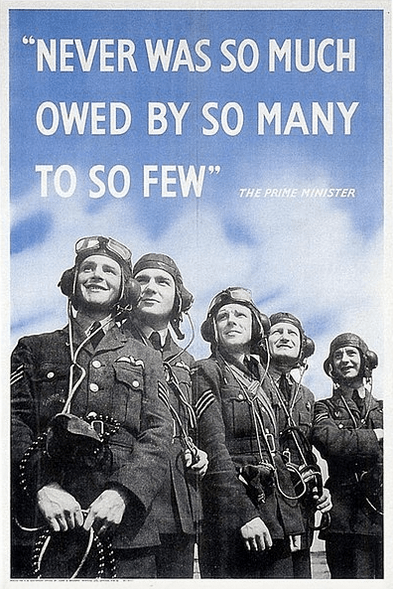
British Prime Minister Winston Churchill paid tribute to those airmen in his famous wartime speech on August 20, 1940:

“Never in the field of human conflict was so much owed by so many to so few.”

This became one of the most famous of Churchill’s sayings, and those airmen became known as “The Few.”

Battle of Britain poster
Wikimedia Commons, Public Domain

But did you know that Churchill actually started out with a different line when he was composing his speech, and felt he had to change it?

Read more