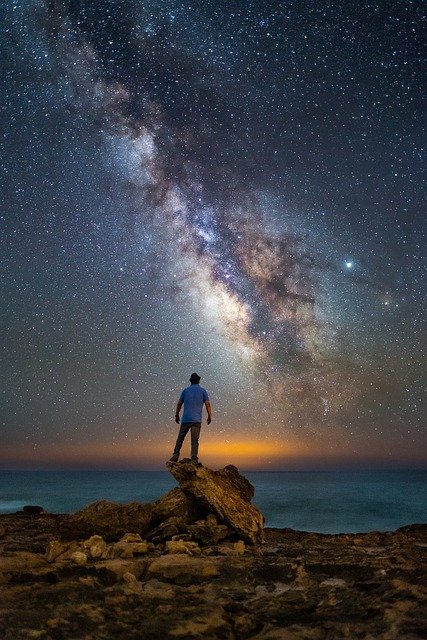
You’re Not Insignificant to God!

When you look up at the stars in the night sky, what do you feel?

Many people say the vastness of the universe and the countless stars make them feel puny and insignificant.

In a way, that’s understandable.

The star that Earth orbits around is just one of many in the Milky Way, the galaxy in which we live. In fact, there are perhaps 100 billion stars in our cosmic “neighbourhood.”

And the Milky Way is just one of many galaxies. Estimates vary as to how many galaxies exist in the observable universe: some experts suggest a couple hundred billion, and others postulate as many as 10 trillion.

It’s impossible for us to know how many stars there are in the observable universe, but here’s the largest guess I came across: Multiplying the higher number of estimated galaxies by the Milky Way’s estimated 100 billion stars gives a possibility of 1 septillion stars in the universe (1 quadrillion in the European system). That’s a “1” with 24 zeroes after it!

The Milky Way is so enormous that, even travelling at light speed, it would take 100,000 years to travel across it. The observable universe is incredibly more vast: according to current thinking, it’s about 93 billion light years in diameter.

No wonder people feel small when they contemplate the unimaginable expanse of the universe!

But for me, this knowledge doesn’t make me feel insignificant.

It makes me feel just the opposite.

Read more
Why Is The Universe So Big?

Image from Pixexid

Have you ever wondered why the universe is so immensely big?

Astronomers at NASA suggest that the most distant objects in the universe are about 47 billion light years away from Earth. This would make the size of the observable universe about 94 billion light years across. (A light year is the distance light travels in one year, about 6 million million miles.)

But that just describes the extent of our observable limits. The universe is vastly larger than that, because it is expanding at a rapid rate.

If there is an “edge” to the universe, it’s expanding away from us faster than we could ever catch up. No matter how swift our spaceship, we would never hit a boundary of some kind.

So for all practical purposes, you could say that the universe is infinitely big.

But why did God create it this way?

Read more

Jesus, Our Fellow Astronaut

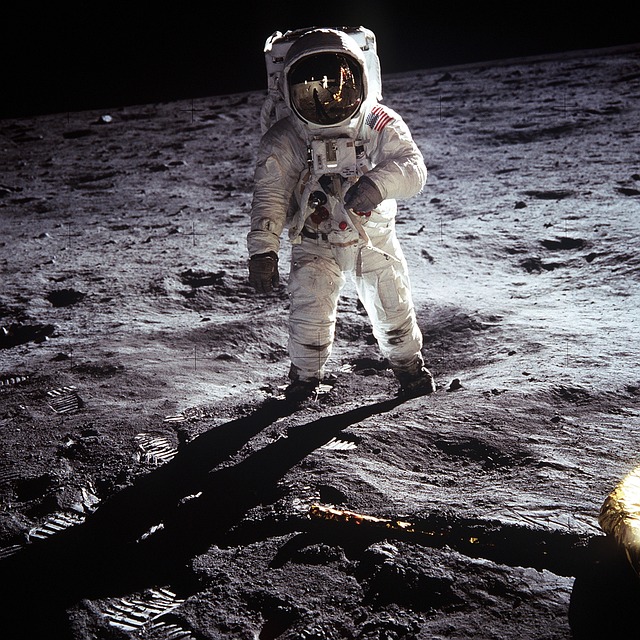
Image by WikiImages from Pixabay

When you’re an astronaut about to set foot on a new world, you don’t want an amateur at the helm back at Mission Control on Earth.

That’s why the role of CAPCOM is so crucial to any space journey.

CAPCOM is short for Capsule Communicator, the person at NASA who is the liaison between the astronauts in their “capsule” and Mission Control. This individual is the single voice the crew members on the spacecraft hear when communicating with Earth, with all information being filtered through them.

The CAPCOM is listening to all the data about the mission from every console at Mission Control. This person hears what the Flight Director wants the crew to know, and turns it into words the crew will understand. They’re also the crew’s trusted agent on the ground, fighting battles and arguing in their stead.

The CAPCOM is essential to the success of each mission.

Understandably, this job isn’t given to just anyone.

Right from the start of the U.S. space program, it was recognized that the astronauts would need someone they could trust to be their relay back on Earth. Someone who knew what they were going through, because they’d gone through the same experience.

So the role of CAPCOM has traditionally been given almost exclusively to former astronauts.

Although there are numerous highly trained and very talented people at Mission Control who could assume the job of CAPCOM, NASA felt that someone who had been an astronaut themselves would be best able to understand what’s going on in the spacecraft and to pass information along in the clearest way.

After all, no one but an astronaut knows what it’s like to blast off in a rocket and “let slip the surly bonds of Earth.” No one but a fellow space traveller knows the vulnerable feeling of floating in the vast blackness of space, hundreds or even thousands of miles from your home planet.

Even though you and I may not be launching into space anytime soon, we still need a CAPCOM of our own.

Read more

What Will You Grow: Fear or Faith?

Image by HeungSoon from Pixabay

With the arrival of spring, gardeners are faced with some difficult decisions:

What should I grow in my garden?

You only have so much square footage and only so much soil.

You have to make hard choices about what plants will be given space, and which ones you’ll have to forgo this year.

Maybe you’d like to grow dozens of pink roses in your garden plot. That’s a great idea: it would look gorgeous and smell beautiful.

But then you’d have to give up on the idea of growing a vegetable garden in that spot. You simply don’t have the space to do both.

If you dream of having a wildflower meadow in your yard, you’ll have to skip your plan of creating a formal French garden. You have enough room for one or the other, but not both.

Similarly, you only have so much real estate in your mind.

You have to make decisions about what you’ll let take up space.

What will you grow there?

Faith or fear?

They both grow in the same soil, so to speak: uncertainty.

But only one of them produces a harvest that’s worthwhile.

Read more

The Bright Side of Storms

Photo by slgckgc on Flickr CC BY-2.0

Gardeners know that storms can wreak terrible havoc with their plant friends.

If the winds are strong enough, mature trees can be downed, leaving a gaping hole where they once stood.

In a garden, the loss of a large tree upsets the ecosystem of the area. It changes all manner of things, from the shade afforded plants in the understory, to the strength of the wind that buffets them, to the amount of rain reaching the ground. The entire microclimate is affected.

But the subtraction of a tree also presents new opportunities for a gardener.

Suddenly, more sunlight and rain can reach the area. There is space now for new plants or trees to grow that couldn’t before. Where once the gardener was limited to plants suitable only for shade, now he or she can consider roses, vegetables or other sun-loving plants.

So I suppose a storm’s effects aren’t always strictly negative for gardeners.

But what about the storms of life? Is there anything good that can come when some disaster leaves a gaping hole in our lives?

Read more

Faster Than The Speed of Light

Artist’s concept of Mars Perseverance Rover, Wikimedia Commons, Public Domain

Last week, NASA’s science rover “Perseverance” landed successfully on Mars, to jubilant cheers from scientists back home.

Mission managers at NASA’s Jet Propulsion Lab near Los Angeles had been waiting anxiously for confirmation that the craft had landed safely.

Because it takes radio waves 11 minutes to reach Earth from Mars, “Perseverance” had already settled on the surface of the Red Planet by the time news of its safe arrival reached scientists back on Earth. NASA had to endure a nerve-wracking wait before they got the verification.

We encounter this time lag throughout our universe.

The light from our own Sun takes 8 minutes to reach Earth. Light from Pluto takes 5 hours. It takes 8 years for the light from the “Dog Star” Sirius to reach our planet.

This time lag means that with stars extremely distant from us, we’re actually seeing them now as they were thousands of years ago. It takes that long for their light to travel to us.

It sometimes seems as though there’s a similar “time lag” between our brains and our hearts.

Read more