You Need a North Star

Polaris star trail

Many of us have GPS systems in our cars or on our phones. They allow us to pinpoint our locations on a map, letting us know exactly where we are.

But in the days before modern technology, how did people navigate? If they needed to cross an ocean, what told them where they were?

The North Star did.

More formally known as Polaris, the North Star is the brightest star in the Ursa Minor constellation. Because it’s almost in a direct line above the north celestial pole, the North Star appears to stand motionless in the sky, with the other stars seeming to rotate around it.

This made it a perfect fixed point by which to draw measurements for celestial navigation. In fact, the Old English word for the North Star meant “ship-star,” reflecting its use in helping to chart a course when sailing.

We still need a north star today.

Not to get from point A to point B in our vehicles, but to navigate the seas of our lives. When our whole world has turned topsy-turvy, we need a fixed point to focus on to keep us on a stable course.

Read more
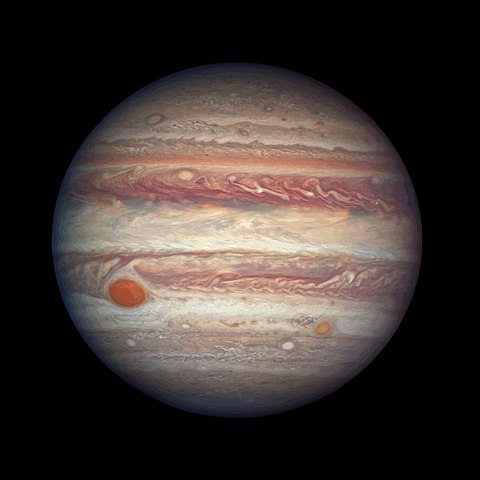
The Storms of Jupiter

Image of Jupiter from NASA/ESA’s Hubble Space Telescope, via Wikimedia Commons CC 4.0

Can storms be beautiful?

Yes, if you’re far enough away from them!

The most distinctive feature of the planet Jupiter, its Great Red Spot, is actually a massive storm.

Astronomers have been observing this maelstrom continuously since 1878, but it’s likely that it had been raging for centuries before that. The size of this storm is so vast that it could swallow the entire earth.

From a safe distance away here on earth, the Great Red Spot’s colourful swirls are beautiful, like marbled ice cream or the end papers of antique books. Jupiter’s storms appear to us like abstract art; indeed, images of them have appeared on everything from posters and ties to bedsheets and yoga mats.

But up close, they’re violent tempests, howling hurricanes of ammonia and water. Because Jupiter is a gaseous planet, there is no solid ground to dissipate the energy of these swirling vortexes, as would happen on earth when a hurricane makes landfall. At its edges, the Red Spots’s wind speeds can reach 270-425 mph (430-680 km/h), over twice the speed of even the most monstrous hurricane here on earth.

Do you feel like you’re in a storm like that right now?

Perhaps you’ve been enduring heartache, unemployment, illness, or loneliness.

Maybe it seems like the tempest has been raging in your life for years. Nothing seems to slow it down. From a distance, people can’t see how destructive it is to you.

The good news is that God offers hope to those in the midst of the storms of life.

Read more

My Lifeguard Walks On Water

Image by Hermann Traub from Pixabay

For those of you who live near a large body of water, or who might be visiting one during the summer, what are some important things to remember when spending a day at the beach?

Remembering to apply sunscreen is definitely important. So is bringing snacks, a blanket to lie on, and perhaps an umbrella to sit under. Maybe a toy bucket and shovel for the kids to play with in the sand.

But isn’t there something more important than all of those?

How about remembering to pay attention to the lifeguard?

If you’re visiting a public beach by an ocean or large lake, there will probably be a lifeguard station there. Lifeguards will be in place at intervals on raised platforms above the sandy shoreline. If the lifeguard tells you the undertow makes it unsafe to swim in the water, obey his or her instructions.

There will also be rules set forth on signs along the beach. To have an enjoyable and safe day at the beach, it’s important to obey those rules. Stay within the boundaries of the supervised areas. Pay close attention to the warning flags.

The rules are there to protect you.

It’s the same with God, isn’t it? He has set forth rules for us in His Word, the Bible. He wants us to stay within His boundaries in the way we behave. He wants us to obey His instructions, because they’re for our good.

His rules are there to protect us.

Read more

The Bright Side of Storms

Photo by slgckgc on Flickr CC BY-2.0

Gardeners know that storms can wreak terrible havoc with their plant friends.

If the winds are strong enough, mature trees can be downed, leaving a gaping hole where they once stood.

In a garden, the loss of a large tree upsets the ecosystem of the area. It changes all manner of things, from the shade afforded plants in the understory, to the strength of the wind that buffets them, to the amount of rain reaching the ground. The entire microclimate is affected.

But the subtraction of a tree also presents new opportunities for a gardener.

Suddenly, more sunlight and rain can reach the area. There is space now for new plants or trees to grow that couldn’t before. Where once the gardener was limited to plants suitable only for shade, now he or she can consider roses, vegetables or other sun-loving plants.

So I suppose a storm’s effects aren’t always strictly negative for gardeners.

But what about the storms of life? Is there anything good that can come when some disaster leaves a gaping hole in our lives?

Read more