This Is Who We Are

Today, Canada celebrates its birthday! July 1st is Canada Day, a holiday on which we have parties, set off fireworks, and wave the flag.

We’re all attached to our national flags, aren’t we? Each is beautiful in its own way. Some flags have blocks of colour; some feature significant symbols; others have patterns of stars and stripes. A handful of countries depict plants or trees on their flags, mine among them.

Canada’s flag has a maple leaf at its centre. In fact, the nickname for our flag is the Maple Leaf. As a nature lover, I’m proud to have a symbol of a plant on my national flag, and especially pleased that it’s a leaf from one of my favourite trees.

Growing up, I loved maple trees: I climbed them, enjoyed the sugar and fudge made from their sap, collected their red and orange leaves in autumn to press and even jumped into raked-up piles of them.

I’d venture to say that all Canadians love maple trees. The trees themselves are beautiful and stately; the wood harvested from them is so strong it can be used as the flooring for bowling alleys; we harvest precious sap from them to make sought-after products like maple syrup; and the leaves turn gorgeous colours in the autumn.

The maple leaf is the emblem of Canada. It symbolizes who we are as a people: hardy, strong, nature-loving northerners.

Just as the maple tree is important to Canadians, there’s another tree which is very important to a certain group of people:

It’s the tree Christ was crucified on.

Read more

Turning the Bitter Sweet

Image by Steve Buissinne from Pixabay

“Go suck a lemon!”

Have you ever heard anyone say that?

It means they’re annoyed with you and want you to experience something unpleasant. Lemon juice is so sour that it makes your mouth pucker.

But if lemon juice is so bitter, why are lemon desserts so yummy?

It’s thanks to the addition of a sweetener.

I like lemon-based desserts much better than orange-flavoured ones. It seems to me that the combination of sour and sweet is what makes lemon desserts so satisfying (see below for Lemon Poppyseed Cake recipe).

They say when life hands you lemons, make lemonade.

No, when life hands you lemons, turn it over to God.

He can transform your unwelcome experiences into something good, and make the bitter waters of your life sweeter than any lemonade.

Read more

Inscribed in the Palms of His Hands

Image by Lisa Johnson from Pixabay

Have you ever been tempted to carve initials or names in the trunk of a tree?

Perhaps linking yours with those of someone you love, like “M + F” or “Josh loves Amanda”? The inscriptions could last for centuries, emblems immortalizing your love for generations to come.

(Of course, as a nature lover, I’d rather people not make carvings in the bark of a living tree. But I can understand the impulse to do so.)

In fact, people have been engraving things on tree trunks for millennia.

Birch trees are a natural choice due to their white bark. The smooth silver-grey bark of beech trees is also a magnet for trunk-carvers. Indo-European peoples have used it for writing-related purposes since antiquity. In some modern European languages, the words for “book” and “beech” are either very close or identical. No wonder the beech has been called the “patron tree” (sort of like a patron saint) of writers.

Did you know that God sometimes inscribes things in usual places, too?

Read more

Don’t Look For The Living Among The Dead

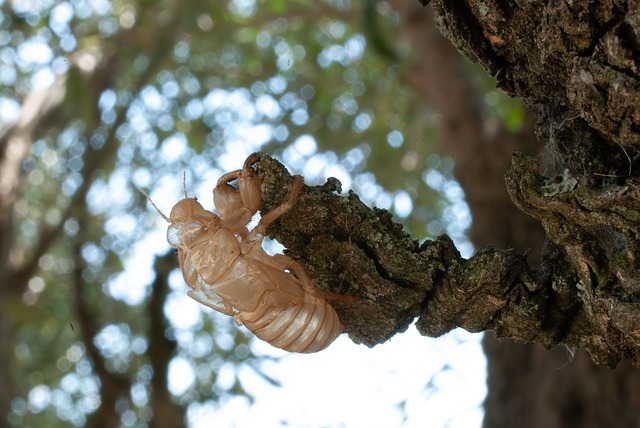
Image of cicada exoskeleton by Franck Barske from Pixabay

When I was a little girl, I loved to explore in the woods.

One day I came across a cicada clinging to a tree trunk. Except this insect didn’t look alive: its body was transparent, and it never moved.

What was wrong with the cicada, I wondered?

I finally realized that I wasn’t looking at a live bug, but rather at its discarded exoskeleton.

When it’s time for a nymph cicada to turn into an adult, it clings to a tree and sheds its outer body. The abandoned shell remains, still clinging to the bark of the tree, while the “reborn” cicada flies off.

My mistake that day?

I was looking for the living among the dead.

Some of the Jesus’ followers made the same error.

Read more

How Larch Trees Are Like Jesus

Larch Trees, Banff National Park, Alberta, Canada
Photo by Steve Jurvetson on Flickr CC BY-2.0

It’s easy to categorize trees, isn’t it? Deciduous trees lose their leaves in the autumn. Coniferous trees bear cones and keep their needles throughout the year. It’s simple to tell them apart.

Case closed, right?

But what about the larch tree? It bears cones and has needles like a conifer, but the needles drop off each autumn like a deciduous tree.

So which is it, coniferous or deciduous?

Read more