The Best Swap Of All

World’s Largest Paperclip, Bell Park, Kipling, Saskatchewan, Canada.
Photo by purecanucks on Flickr. CC BY-2.0

Did you hear about the guy who traded a paperclip for a house?

It’s a little more involved than that, but it really happened.

Over the course of a year starting in 2005, Canadian Kyle MacDonald made a series of 14 online trades, bartering small items for successively larger and more valuable ones.

He started with a red paperclip, which he traded for a pen. He swapped the pen for a doorknob, which he then bartered for a Coleman stove.

The stove was flipped for a generator, which was exchanged for an instant party, which he soon traded for a snowmobile.

Kyle’s next transactions involved a trip, a truck, a recording contract, and a year’s rent in Phoenix. They eventually culminated in a film role, which was traded for a two-storey farmhouse in Kipling, Saskatchewan.

A large sculpture of a red paperclip now stands in the small Canadian town where his trades ended, commemorating his achievement.

Pretty impressive, I must say!

But I can think of an even more astonishing swap.

It took only one transaction and involved the most valuable thing of all…

Read more
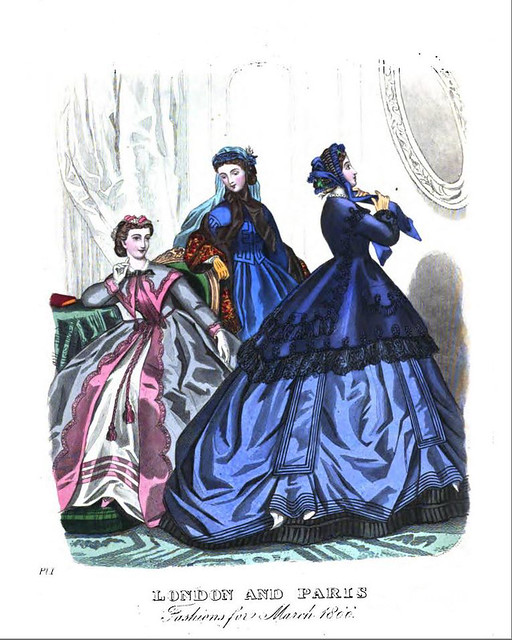
Always In Fashion

The Latest Fashions for 1866.
Image by CharmaineZoe on Flickr. CC BY-2.0

Don’t you wish there was a style of clothing you could wear that would always be in fashion?

Think of it: You’d never have to worry about being caught wearing last year’s fashions. You’d never accidentally make a fashion faux-pas. Your clothes would always be in style.

Perhaps this is a notion that preoccupies women more than men. Men seem to be a bit luckier in the fashion department: styles of suits don’t evolve very rapidly over time, and they always look becoming.

Women, on the other hand, have had to put up with fashions that have changed drastically over the years and decades. Our foremothers had to endure corsets, hoop skirts, and bustles. Perhaps some of you are old enough to recall leg warmers, tie dye and jumpsuits.

Some styles inexplicably come back into fashion for a time, like bell-bottom jeans or platform shoes.

Let’s hope that some never do: women once wore skirts so wide that they had to turn sideways to get through a door!

Wouldn’t it be wonderful to put on a style that would never go out of fashion?

As a matter of fact, there is such an item of “clothing.”

Scripture advises us to put on Christ.

Read more

Not In Kansas Anymore

Characters from the film “The Wizard of Oz.” Photo by Richard Hitt.

Have you ever brought preconceived notions to a new situation, but then realized they simply don’t apply anymore?

I did something of the sort when visiting Southern California as a teen.

Growing up in Central Canada, I was used to street numbers being put on the actual houses themselves, at eye-level. But when I stayed in San Diego for a time, I noticed that the street numbers were instead spray-painted on the vertical parts of the curb at the foot of people’s driveways, just a few inches above the pavement.

That made no sense, I thought to myself. In winter, those numbers on the curb will be covered under several feet of snow, and no one will be able to read them. How silly!

I soon realized that my line of thinking was faulty: it doesn’t snow in San Diego. The numbers on the curb will always be readable. What was true for Toronto had no bearing on what was true for San Diego.

I needed to realize that I was “not in Kansas anymore,” as Dorothy said in the film, “The Wizard of Oz.”

I think we sometimes make the same mistake when we think about the Kingdom of God.

We superimpose our past experiences and assumptions on it, but we don’t realize that with the Kingdom of God we’re in a whole new world. The old rules don’t apply anymore.

Read more

Cleaning Tips From The Bible

Image by Carola K. from Pixabay

If your Mom is like mine, she’s probably given you some handy cleaning tips over the years.

She (or your Dad or caregiver) may have told you that you can use baking soda, vinegar or lemon juice as natural cleaning products.

She might have even told you about some surprising substances you can use to clean household items, like Coca-cola, mayonnaise, toothpaste or ketchup.

You may have been taught the secret to getting blood stains out of clothes: wash the fabric in cold water only. This is counterintuitive, because it’s the opposite of how you treat most other stains.

In the case of blood, however, heat will only set the stain and make it harder to remove.

It’s good to know how to deal with pesky stains: what substances to use to clean things, and what substances and methods not to use.

For instance, you’d certainly never use blood itself to clean anything.

Or would you?

Scripture tells us that there’s a special case where blood washes things whiter than snow:

When it’s the blood of Jesus.

Read more

Weed-Free Living

Image of dandelions by Hans Linde from Pixabay

Is it just my imagination, or do weeds actually grow faster than the flowers I’m trying to nurture?

Gardeners will know what I’m talking about. Weeds seem to be gifted with internal steroids that accelerate their growth, outpacing the delicate flowers that we’ve brought home from the garden centre.

Weeds don’t seem to be affected by lack of rain or by intense heat. They’ll grow just about anywhere. They’re speed demons of growth compared to the flowers we try to baby along with regular watering and fertilizing.

I looked into this crucial issue on behalf of readers of The Faith Cafe, and found that weeds do have some competitive advantages.

Weeds which are perennials have the benefit of established root systems that have been alive for many years; these dormant roots have a lot of stored energy. Perennial weeds grow faster and are harder to kill than annuals.

Weeds are already acclimated to the region’s soil, and are highly adaptable. They’re usually native plants that thrive in the local ecosystem, unlike plants from the garden centre which may be non-native and need time to adjust.

Weed seeds are already present in our garden soil. They bide their time until the right conditions present themselves, and then race out of the soil. They’re often excellent self-propagators and are opportunistic growers.

All these things give weeds a head start over the flowers we favour.

This got me thinking:

Why do the “weeds” of our character grow better than the fruits of the Spirit?

Are there lessons we can learn from the natural world?

Read more

Cake Mix Religion

Photo by Roadside Pictures on Flickr CC BY-NC-2.0

Is there such a thing as something being too easy?

The original developers of cake mixes seemed to believe so.

When cake mixes first debuted in the 1930s, all the baker had to do was add water and then bake. It was as easy as pie, so to speak.

But they soon realized they had to tweak the recipe. First off, the powdered eggs in the original mixes didn’t taste that great.

Later, psychologists thought that bakers wanted to feel more involved in the cake-baking process. Home bakers found the mixes a bit too easy, as though they weren’t putting in enough effort. There was a sense that baking a cake from a mix didn’t really count.

So the cake mix companies changed their recipes to require home bakers to add fresh eggs in addition to the liquid. Putting the eggs back in the hands of the bakers proved to be the winning formula.

I sometimes wonder if we apply the same logic to our faith.

Does trusting in Jesus’ sacrifice on the Cross for the forgiveness of our sins seem like it’s only part of the recipe?

Are we sometimes tempted to add in some effort on our own part to make it “complete”?

Does faith alone seem too easy?

Read more

Lessons From Sundials

Image by Incygneia from Pixabay

With all the digital devices we have which can tell the time, there’s still nothing quite like a sundial.

Sundials, used since ancient times, were the very first clocks. Their faces are marked out with hour lines, and a projecting arm shows the time by the position of the shadow it casts on the face of the dial.

Sundials were, and still are, popular garden ornaments. They’re often placed on a pedestal in the centre of a flower bed as a focal point.

Most sundials include inscribed mottoes, either in Latin or English. These sayings are often wistful reflections on the passing of time and the brevity of life.

I think there are a few lessons we can learn from these mottoes, ones which jibe with Biblical counsel about making the most of our time.

Let’s look at a few of them…

Read more

Sticker Shock

Image by Merio from Pixabay

Have you been taken aback recently by rising prices?

I think a lot of us have been suffering from sticker shock lately.

Whether it’s an item at the grocery store, gas at the pumps, or a house to live in, prices have been going up.

We look at something that we’re accustomed to buying at a certain amount and do a double-take at the suddenly inflated cost.

We think, “Are you kidding me? I’m not paying that much! They’ve got to be crazy charging that price.”

And off we stomp in a huff.

But aren’t you glad Jesus didn’t do the same?

He could easily have suffered from “sticker shock” when faced with the incalculable price He’d have to pay to save us from our sins.

Read more

The Most Valuable Thing On Earth

Image by JamesDeMers from Pixabay

If you had to guess, what would you say is the most valuable thing in the world by weight?

If you’re a cook, you might pick costly foods like beluga caviar or white truffles. Or perhaps the spice saffron, which can go for thousands of dollars per pound.

If you’re a jewellery lover, your mind might go to precious metals like silver, gold or platinum. You’d know that gold has been revered since ancient times, and sometimes goes for thousands of dollars per ounce.

You’d be getting warmer if you worked in industry and knew that some substances used in things like catalytic converters are very costly indeed. Rhodium and palladium are even more valuable than gold.

These would all be good guesses, but not even close.

What about diamonds as the most valuable thing on earth by weight? Very rare coloured diamonds such as the red can be valued at millions of dollars per gram.

If you’re a scientist, you might get closer by guessing plutonium, used to fuel nuclear reactors. Or you might figure you’ve hit the jackpot by picking antimatter, which might power spaceships one day.

This substance requires inconceivable amounts of energy to generate. It’s estimated that antimatter costs tens of billions or even trillions of dollars per gram.

But there’s one thing on earth more valuable than even that…

Read more

God Hasn’t Changed A Bit!

Yesterday-today-and-tomorrow plant. Wikimedia Commons CC BY-SA-3.0

Some flowers have a trick up their sleeve (or up their petals):

They’re able to change colour.

I recently noticed a beautiful flowering plant heavy with pink blossoms in a neighbour’s garden. When I walked by several days later, I saw that some of the flowers had turned a lighter creamy colour as they matured. I did a double take and had to make sure I was indeed looking at the same plant as before.

Other flowering plants have the same ability to surprise us with shifting colours.

Among them is the aptly named “yesterday-today-and-tomorrow” plant. This tropical shrub has short-lived flowers which change colour as they age. They start out as purple, then shift to lavender and finally fade to white before dropping from the plant.

While flowers that change colour can delight and surprise us, sometimes we need something unchanging and constant in our lives.

Isn’t it good to know that we can count on God to always remain the same?

Read more