Get With God’s Program!

Photo by Jill Wellington on Pixabay

I don’t seem to have much luck getting birds to cooperate with me.

Years ago, I bought a Victorian-style birdhouse, and painted it light blue with white trim. I nailed it to a tree where I could see it when sitting at my kitchen table. I imagined the delight I’d have watching birds move in and raise their young there. I couldn’t wait for my new feathered neighbours!

But the birds refused to move in.

Year after year, the pretty birdhouse sat empty. I was so disappointed. What ingrates those birds were! And after all the trouble I’d gone to for them!

The problem was, I’d put the birdhouse where I wanted it, with no thought to their needs.

The birdhouse was pretty, certainly, but its placement didn’t suit the birds one bit. Being nailed to a tree made it too accessible to predators like squirrels or racoons. The birds didn’t feel safe nesting there.

I thought the problem was with the birds, but it was with me. I’d done it all on my terms and expected them to get with the program.

Don’t we sometimes do the same with God?

We want to do things on our terms, in our own way, and expect God to get with our program. I’m afraid it doesn’t work that way.

Read more
Jesus Has an Open Door Policy

Image by Lori from Pixabay

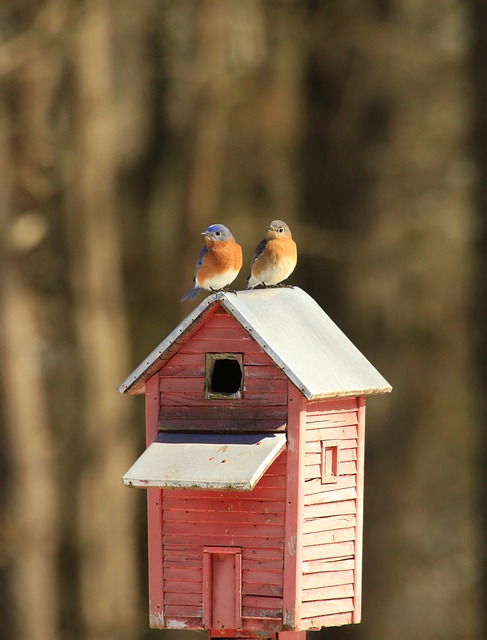
When building a birdhouse for your feathered friends, the size of the “front door” is crucial.

You must create the right-sized entrance hole or the “wrong” bird will take up residence.

For instance, a wren or chickadee prefers an entrance hole to be about 1.125 inches across. A bluebird likes a slightly bigger doorway, about 1.5 inches in diameter.

A finch needs an opening 2 inches across, thank you very much, and purple martins prefer a bit more wiggle room than that to squeeze through the front door.

And if you don’t surround the hole with protective metal mesh, the squirrels will chew the hole bigger and move in themselves. Then you’ll discover you’re the proud owner of a squirrel house (I learned this the hard way).

All of this got me thinking about the story of Noah’s Ark in the Bible…

Read more

God Will Provide

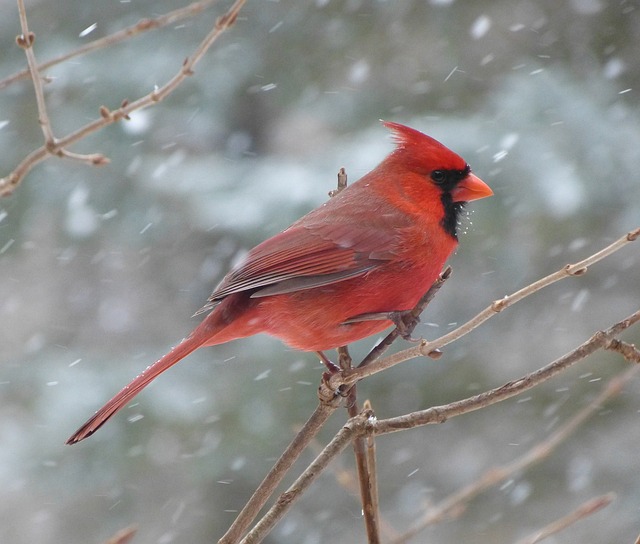
Image by tlparadis from Pixabay

If you live in eastern North America, you might be lucky enough to have seen a gorgeous bird called the northern cardinal.

The male is especially distinctive, with his breathtaking red plumage and black “mask” on his face.

Up here in Canada, the cardinal is at the northernmost part of its range. We’re especially fortunate that, unlike many songbirds, cardinals don’t migrate south for the winter. We get to enjoy their presence year-round.

But what on earth do the cardinals eat here, when parts of Canada might be covered in several feet of snow?

Read more

The Polar Bear’s Secret

Pop quiz: What colour is a polar bear’s skin?

Did you guess “white”?

It’s the obvious answer, isn’t it, because their fur is white.

Surprisingly, though, you’d be wrong.

If you shaved a polar bear, you’d discover that it would look much like its cousin, the black bear.

That’s right: polar bears have black skin!

Don’t believe me? Here’s a clue: check out their noses and foot pads. They’re both black. Their thick fur so completely hides the blackness underneath that you’d never know it’s there.

Not only that, but polar bears’ fur isn’t actually white.

Pardon me?

It’s true! Their outer coat of fur consists of translucent hollow hairs that scatter and reflect visible light. These hairs have no white pigment, but merely appear white due to an optical trick involving the physics of light.

The polar bears certainly had us fooled, didn’t they?

And they’re not the only ones.

There are people whose lives have been so thoroughly changed by the gospel of Christ that you’d be shocked to discover their dark past.

Read more

Shine Your Light!

Image by StockSnap from Pixabay

If you’re fumbling around in the darkness, what should you do?

Turn on a light, of course.

But there are places on earth where this truism can have unexpected effects.

The “midnight zone” of oceans is one of them.

This zone, ranging from about 3,000 to 13,000 feet below the water’s surface, is in constant darkness. The sun’s rays simply cannot penetrate this far down.

The only light at this extreme depth comes from the bioluminescence of various sea creatures themselves.

Scientists who want to study the sea life in this region are faced with a problem. Normally, if you want to examine a dark area, you’d simply shine a light into it. Indeed, the submersibles scientists use for underwater research have headlights for this express purpose.

But casting a light on the creatures in the midnight zone freaks them out. They’re not used to bright light, and assume it’s some sort of enemy.

Startled swordfish will attempt kamikaze runs at a submersible’s lights. Other creatures are blinded or are plunged into terror by the blazing illumination: they either freeze or flee.

Scientists soon realized that their submersibles’ lights were simply creating a no-go zone around the vessel, hampering their research. So they switched to using a red light, a colour which most of the undersea creatures can’t see.

Sometimes light can have a contradictory effect, can’t it?

As believers we see this when we introduce the light of Christ to others.

Read more

What Is Your “Burning Bush”?

Image by Leonora Enking via Flickr CC BY-SA 2.0

You’ve got to love a plant that turns pink in the autumn.

I’m referring to the Euonymus alatus shrub, whose leaves change from green to a vivid, hot pink in the fall.

One of its nicknames is “burning bush,” because in autumn the shrub looks like it’s on fire. It must have reminded people of the burning bush Moses encountered in Exodus 3, through which God spoke to him.

I think God uses many different ways to speak to us today, each a “burning bush” tailored to our unique personalities.

Probably the primary way that God communicates to us is through Scripture. We read or hear a verse that seems to speak directly into our situation. By reading the words of Jesus, we “hear” God’s heart. We may also receive a word from the Holy Spirit or sense God’s guidance through prayer.

There are many instances in the Bible of God giving someone a message through dreams or visions. He may relay information in a dramatic fashion via an audible voice, or the more subtle “still, small voice.”

Other times God may use another person to convey something to you: a Christian speaker or author, or a family member or friend who’s a believer. God may also speak to you through the lyrics of a song or hymn.

He might be sending a message to you through your circumstances, especially via some difficult situation. Or, you may encounter a coincidence that seems like a “sign,” and you think God may be trying to tell you something.

With me, I feel that God occasionally “speaks” to me through nature.

Read more

Dressing Up Animals

Image by Robledo Rafael Andrade on Pexels

Do you enjoy dressing your pet in clothes?

I won’t tell anyone if you do.

There’s something undeniably appealing about seeing animals in mini versions of human clothing, isn’t there?

(Your cat, however, might not agree.)

Even if you’re the type to roll your eyes at the idea of dressing up animals, there’s a lesson we can learn about this from the Bible.

Wait, what? The Bible mentions putting clothing on animals?

Yes, it does!

Let’s take a look at one of the more unusual stories in the Old Testament, found in the Book of Jonah.

Read more

In the Shadow of His Wings

Image by Radovan Zierik from Pixabay

Sometimes there can be something very powerful right above you, and you’re not even aware of it.

I’ve found this out a few times while on a walk in a nature area.

I’ll think I’m totally alone: I don’t see or hear any other creature.

But then suddenly a large shadow will zoom across the path in front of my feet.

I look up to see what the shadow belongs to, and spot a majestic red-tailed hawk. He’d probably been circling above me the whole time, but he was so silent that I didn’t know he was there.

Recently, I came across two large, striped feathers on the ground. Their tell-tale markings told me they belonged to a bird of prey. Looking up into a nearby tree, I was surprised to see a hawk perched by its nest. I’d walked underneath the same tree many times before without realizing the nest was even there.

In each case, the bird had been right there with me, but I initially hadn’t been aware of its presence.

Similarly, sometimes we feel that God isn’t near us.

We can’t see or hear Him. We can’t seem to feel His presence in our lives. It feels like we’re alone in our struggles.

But there is something (or rather, Someone) powerful right above us, who promises to never leave us or forsake us. God’s children are never truly alone.

Read more

Eternity In Our Hearts

Image by Szabolcs Molnar from Pixabay

They say elephants never forget; I think the same may be true of cats.

A friend of mine recently downsized by moving into the lower level of her own home and renting out the upstairs.

She’s perfectly happy with the arrangement. One of her cats, however, is not.

This cat remembers that he once had the run of the entire house. He still recalls that there was a wonderful place called Upstairs.

Despite having lots of room to roam downstairs, including access to a big backyard, this cat keeps trying to break into the upper level of the house. I’m told he meows plaintively at the connecting door between the two units, and tries to pry it open with his paw.

This cat knows that there’s something missing in his life. Even though Downstairs is perfectly nice, he still feels the ache to be Upstairs once again.

I think many of us know the feeling.

We have an innate sense that this world is not as it should be.

It’s broken in some way: there’s something missing.

Humans seem to have a mysterious longing for a world set right. We ache for it, even though we haven’t experienced it.

Read more

Conspicuous Camouflage

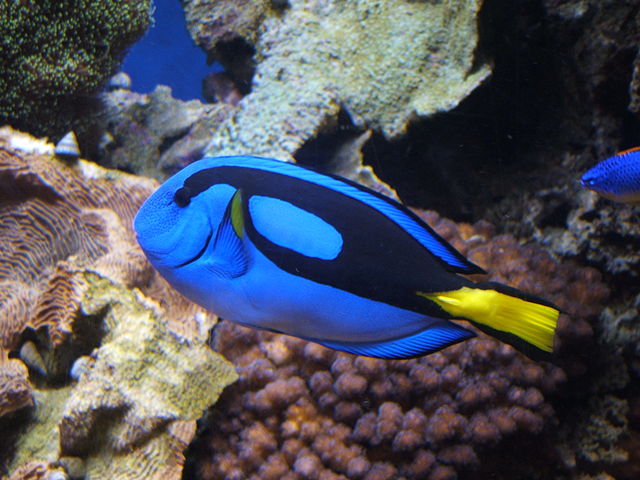
Image of blue tang fish by Tewy via Wikimedia Commons, CC BY-2.5

Whenever I did something wrong as a little girl, I thought I had a surefire way of escaping my parents.

I would hide behind a large potted plant we had and close my eyes.

Somehow, I thought that my parents wouldn’t be able to see me if I did this. Unfortunately for me, their eyesight was a bit better than I’d bargained on.

If you look at the natural world, you’ll find that I’m not the only one who often thinks they can’t be seen.

Take the blue tang fish, made famous by its cartoon equivalent in the Pixar movies “Finding Nemo” and “Finding Dory.”

Like a few other reef fish, this aquatic animal is blue and yellow. To other fish and to its predators, the blue tang is perfectly camouflaged. To them, its yellow markings seem to disappear against similarly coloured corals, and its blue body blends in with the shade of the water.

There’s only one problem:

To snorkelling humans, the blue tang sticks out like a sore thumb. Far from being camouflaged, this fish’s dramatic colours are incredibly conspicuous to our eyes. Why is that?

It’s because our eyesight is very different from that of undersea creatures. The particular trio of cones in human vision is especially good at discriminating blues and yellows.

So what is hidden to other fish is glaringly obvious to us.

I think God’s “eyesight” works in a similar fashion.

Read more