You’re Not Insignificant to God!

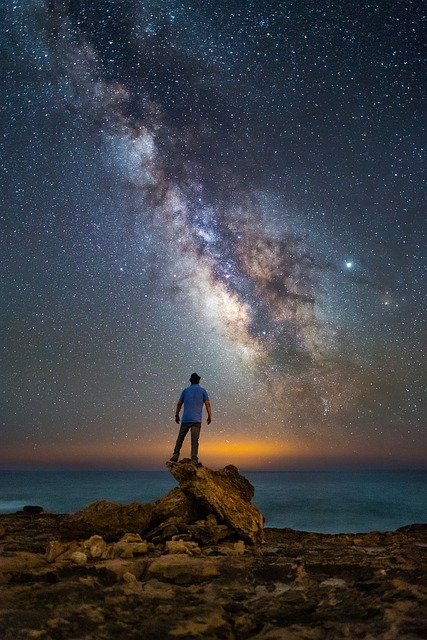
When you look up at the stars in the night sky, what do you feel?

Many people say the vastness of the universe and the countless stars make them feel puny and insignificant.

In a way, that’s understandable.

The star that Earth orbits around is just one of many in the Milky Way, the galaxy in which we live. In fact, there are perhaps 100 billion stars in our cosmic “neighbourhood.”

And the Milky Way is just one of many galaxies. Estimates vary as to how many galaxies exist in the observable universe: some experts suggest a couple hundred billion, and others postulate as many as 10 trillion.

It’s impossible for us to know how many stars there are in the observable universe, but here’s the largest guess I came across: Multiplying the higher number of estimated galaxies by the Milky Way’s estimated 100 billion stars gives a possibility of 1 septillion stars in the universe (1 quadrillion in the European system). That’s a “1” with 24 zeroes after it!

The Milky Way is so enormous that, even travelling at light speed, it would take 100,000 years to travel across it. The observable universe is incredibly more vast: according to current thinking, it’s about 93 billion light years in diameter.

No wonder people feel small when they contemplate the unimaginable expanse of the universe!

But for me, this knowledge doesn’t make me feel insignificant.

It makes me feel just the opposite.

Read more

When Nature Sings, Sing Along!

Image of crocuses by Annette Meyer from Pixabay

No matter where you live, spring is a time of joy.

In my part of the world, shy white snowdrops are the first flowers to bloom in spring.

Crocuses, slightly bolder in colour with their yellows or purples, are the next to make an appearance.

The tulips take their time, first poking the tips of their leaves above the ground like a periscope, as if checking to see whether it’s safe to emerge. They then burst forth in bright, vivid colours, their blooms held aloft on tall stems like upright trumpets.

“The flowers are springing up, the season of singing birds has come, and the cooing of turtledoves fills the air.” (Song of Solomon 2:12)

After a long, colourless winter, it makes my heart sing to see the arrival of spring.

But do the flowers and trees themselves sing? And if they do, what is their song telling us?

Author Linda Brooks, in her 2018 book, “Orchestra In My Garden,” seems to share my sentiments about the spring season:

”Once the snow disappears and my garden starts to emerge from its slumber, I cannot jump up fast enough to catch the first light, to lose (and find) myself among kindred spirits and bend my ear to their voices. No, I am not deluded. I do understand that plants are not human and cannot speak, but no one can convince me that they do not sing.”

She’s right: plants do sing. But she’s perhaps missed who they’re singing to.

They sing to God.

Read more

The Only Horoscope You’ll Ever Need

Image by Hermann Traub from Pixabay

What’s your astrological sign? Are you a Libra or a Leo?

Do you read your horoscope daily and make life decisions based on that advice?

Astrology teaches that the time cycle in which you were born determines your personality, and to some extent the course of your life. But this might leave you with a sense of being powerless, at the mercy of impersonal forces beyond your control.

Isn’t there something better to help you navigate your way through life?

I believe there is.

How would you like a horoscope that is valid for every day of the year, no matter when you were born?

One that contained truths you could always rely on, was written by Someone who knows you and loves you, and is not determined by inanimate objects like stars or an impersonal and arbitrary time cycle?

Read more

Faster Than The Speed of Light

Artist’s concept of Mars Perseverance Rover, Wikimedia Commons, Public Domain

Last week, NASA’s science rover “Perseverance” landed successfully on Mars, to jubilant cheers from scientists back home.

Mission managers at NASA’s Jet Propulsion Lab near Los Angeles had been waiting anxiously for confirmation that the craft had landed safely.

Because it takes radio waves 11 minutes to reach Earth from Mars, “Perseverance” had already settled on the surface of the Red Planet by the time news of its safe arrival reached scientists back on Earth. NASA had to endure a nerve-wracking wait before they got the verification.

We encounter this time lag throughout our universe.

The light from our own Sun takes 8 minutes to reach Earth. Light from Pluto takes 5 hours. It takes 8 years for the light from the “Dog Star” Sirius to reach our planet.

This time lag means that with stars extremely distant from us, we’re actually seeing them now as they were thousands of years ago. It takes that long for their light to travel to us.

It sometimes seems as though there’s a similar “time lag” between our brains and our hearts.

Read more

Create Your Own “Dark Sky Preserve”

I sometimes wonder if people who live in the countryside have a better appreciation for God’s creation than we city folk?

I’m specifically thinking of the ability to see the majesty of God’s handiwork as seen in the starry night sky.

Living in a big city (in my case, Toronto), I’m only able to see a handful of heavenly bodies. I can see the Big Dipper and a smattering of other stars, bright planets such as Venus, and the moon in its phases. But that’s about it.

Big cities produce so much ambient light that it obscures our view of the wonder of the night sky. That’s why many jurisdictions are creating what’s known as “dark sky preserves.” These are regions far enough away from the lights of built-up urban areas that the majority of stars can still be seen.

Governments commit to protecting these preserves from development so that the full range of the starry sky will always be visible from those areas. They seem to understand that it’s important for us to be able to maintain our connection with the night sky, and see it the way our ancestors did.

Perhaps we should take a page from their book, and create some “dark sky preserves” in our own lives.

I don’t mean areas from which to see the night sky, but spaces in our lives that remind us of God’s majesty and creative ingenuity as expressed in nature.

Read more

You’re Not Insignificant to God

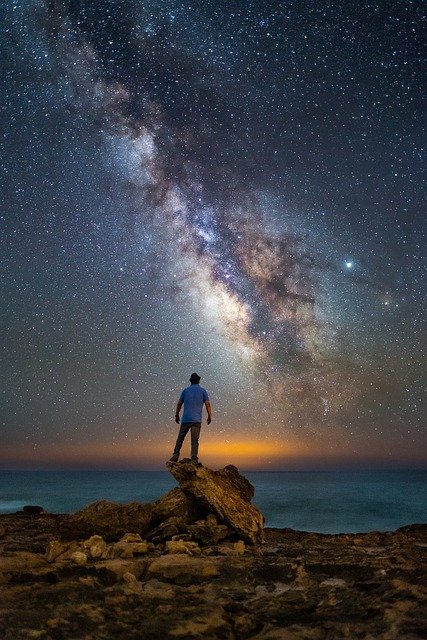
Man looking at the Milky Way
Photo by Evgeni Tcherkassi on Pixabay

When you look up at the stars in the night sky, what do you feel?

Many people say the vastness of the universe and the countless stars make them feel puny and insignificant.

In a way, that’s understandable.

The star that Earth orbits around is just one of many in the Milky Way, the galaxy in which we live. In fact, there are perhaps 100 billion stars in our cosmic “neighbourhood.”

And the Milky Way is just one of many galaxies. Estimates vary as to how many galaxies exist in the observable universe: some experts suggest a couple hundred billion, and others postulate as many as 10 trillion.

It’s impossible for us to know how many stars there are in the observable universe, but here’s the largest guess I came across: Multiplying the higher number of estimated galaxies by the Milky Way’s estimated 100 billion stars gives a possibility of 1 septillion stars in the universe (1 quadrillion in the European system). That’s a “1” with 24 zeroes after it!

The Milky Way is so enormous that, even travelling at light speed, it would take 100,000 years to travel across it. The observable universe is incredibly more vast: according to current thinking, it’s about 93 billion light years in diameter.

No wonder people feel small when they contemplate the unimaginable expanse of the universe!

But for me, this knowledge doesn’t make me feel insignificant.

It makes me feel just the opposite.

Read more

Knit One, Purl One

There’s something rather magical about knitting, isn’t there?

Think about it: you start with something as simple as a ball of yarn and some knitting needles. Doesn’t seem very promising at first, does it?

But thanks to the skill and imagination of the knitter, you end up with a beautiful and intricately woven sweater, scarf or mittens, or booties for a baby. Or even a knit-covered bicycle. All made with great care and lots of love.

Did you know that God is a knitter, too?

Read more